
Slow FIRE Strategy: How to Build Financial Freedom Without Hating Your Life
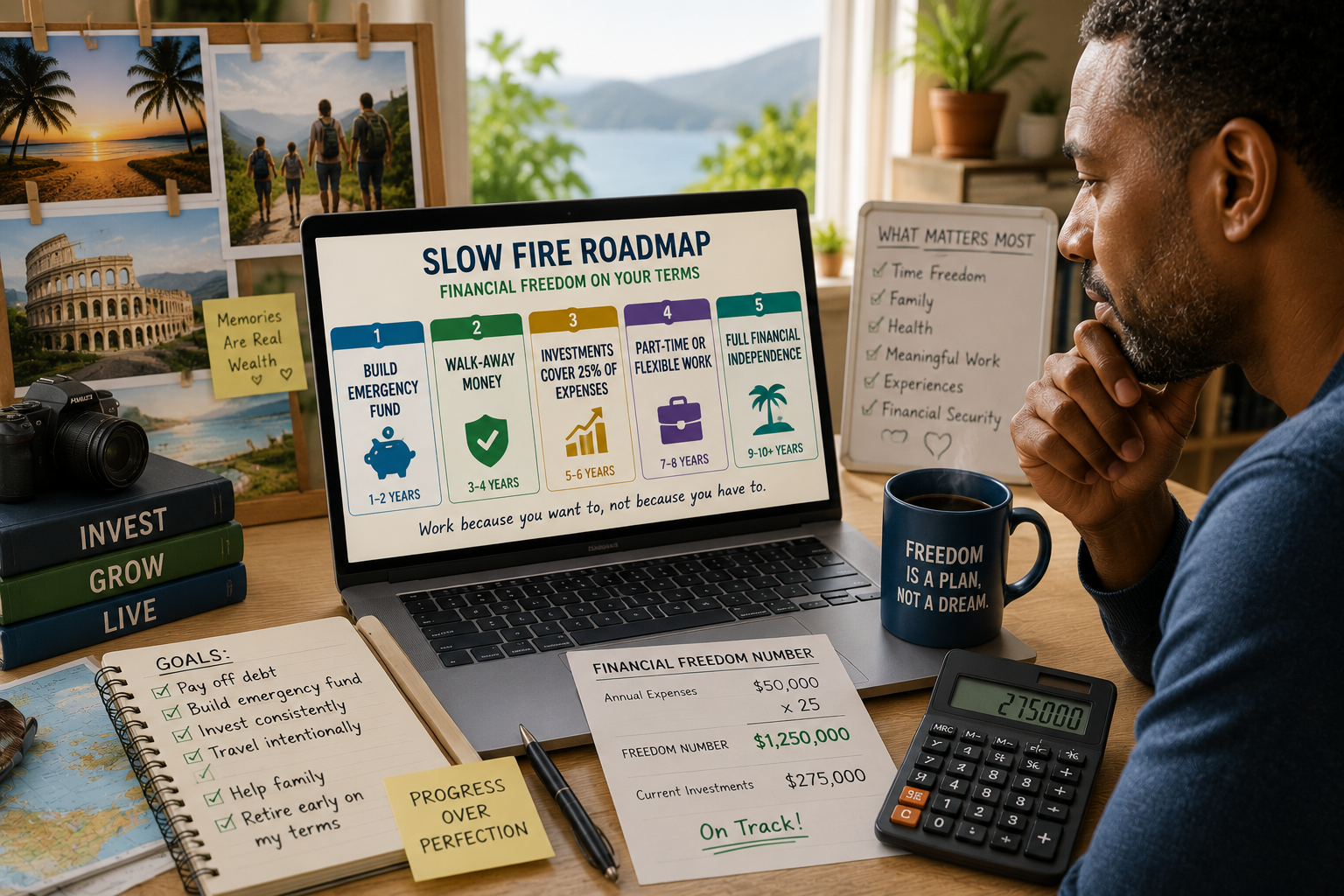
The traditional FIRE movement can sound like a financial emergency drill.
Save half your income.
Stop eating out.
Move somewhere cheaper.
Work constantly.
Invest everything.
Retire before 40.
For some people, that approach works.
For many others, it turns financial freedom into another form of pressure.
They become so focused on escaping work tomorrow that they stop enjoying life today.
That is why a slow FIRE strategy may be a better fit for ordinary workers who want more freedom without turning every purchase, vacation and family decision into a financial failure.
FIRE stands for Financial Independence, Retire Early.
But financial independence does not have to mean completely retiring in your thirties or forties.
It can mean:
- Having enough savings to leave a toxic job
- Working four days instead of five
- Taking a lower-paying job you enjoy
- Starting a business without immediate panic
- Taking several months away from work
- Caring for children or aging parents
- Turning down unethical demands
- Working part-time before traditional retirement
- Reaching a point where money no longer controls every decision
Recent discussion around FIRE increasingly emphasizes autonomy rather than permanent retirement. Many people who reach financial independence continue working, but they choose work with better hours, stronger meaning or more flexibility.
That is the real opportunity.
You do not have to hate your current life to create a freer future.
A slow FIRE strategy gives you permission to build wealth aggressively enough to create options while still allowing room for:
- Travel
- Family
- Health
- Hobbies
- Celebration
- Rest
- Meaningful spending
This guide will show you:
- What Slow FIRE means
- How it differs from traditional FIRE
- How to calculate your financial-freedom number
- Why extreme frugality often fails
- How Coast FIRE and Barista FIRE fit into the plan
- How to invest without sacrificing every present goal
- How to create “walk-away money”
- How to plan for healthcare and taxes
- How to build financial freedom in realistic stages
- The exact roadmap to follow without burning yourself out
No fantasy retirement screenshots.
No pretending everyone can save 70% of their income.
No guilt for wanting a life before age 65.
Just a sustainable plan.
Slow FIRE Strategy: What Does It Actually Mean?
A Slow FIRE approach uses the principles of financial independence without requiring an extreme timeline.
The basic idea is:
- Spend less than you earn.
- Eliminate dangerous debt.
- Build emergency savings.
- Invest consistently.
- Increase income over time.
- Control major lifestyle costs.
- Create enough wealth to make work increasingly optional.
The difference is pace.
Traditional FIRE may target financial independence within 10 to 15 years.
Slow FIRE may take:
- 20 years
- 25 years
- Or a normal working career completed with much more freedom along the way
The goal is not necessarily to stop working as quickly as possible.
The goal is to reduce how much control your paycheck has over your life.
A person following a slow FIRE strategy may decide:
- To save 20% instead of 50%
- To take vacations while investing
- To buy a reasonable home rather than live as cheaply as possible forever
- To fund children’s activities
- To work fewer hours once investments reach a certain level
- To change careers instead of remaining in a high-paying job they hate
- To retire at 55 instead of 38
That is still financial progress.
Freedom is not less valuable because it arrives gradually.
Why Traditional FIRE Can Become Emotionally Expensive
Traditional FIRE often depends on a very high savings rate.
Some advocates aim to save 50% to 70% of income.
That can accelerate financial independence dramatically.
But it may also create pressure to:
- Delay meaningful experiences
- Avoid travel
- Live in housing that no longer fits
- Refuse social invitations
- Work excessive overtime
- Turn every hobby into income
- Judge every purchase
- Remain in a miserable high-paying job
- Sacrifice health and relationships
The strategy can quietly become:
“Suffer intensely now so I can live later.”
That is dangerous because later is not guaranteed.
Your children will not remain young.
Your parents may not remain healthy.
Your body may not always allow the same travel and activities.
Your friendships require time.
Your own interests may change.
A sustainable financial plan should respect both versions of you:
- The person living today
- The person who will need security later
Slow FIRE does not mean ignoring the future.
It means refusing to destroy the present to fund it.
Slow FIRE Strategy vs Other FIRE Approaches
| FIRE approach | Main goal | Typical lifestyle | Main risk |
|---|---|---|---|
| Traditional FIRE | Stop full-time work very early | Very high savings and aggressive investing | Burnout and extreme sacrifice |
| Lean FIRE | Retire early with low spending | Minimalist lifestyle | Budget may be too fragile |
| Fat FIRE | Retire early with high spending | Requires high income and large portfolio | Very difficult target |
| Coast FIRE | Invest enough early, then let growth do more work | Contributions may decrease later | Depends heavily on time and returns |
| Barista FIRE | Investments cover part of life while part-time work covers the rest | Reduced work rather than full retirement | Healthcare and income uncertainty |
| Slow FIRE | Build independence gradually while enjoying life | Moderate savings with balanced spending | Progress takes longer |
Slow FIRE strategy comparison showing Traditional FIRE, Lean FIRE, Coast FIRE, Barista FIRE and Slow FIRE.
No approach is automatically superior.
The correct strategy depends on:
- Income
- Age
- Family responsibilities
- Health
- Career stability
- Housing costs
- Risk tolerance
- Desired lifestyle
- Personal values
The purpose of the table is not to choose a label.
It is to create a plan that fits your real life.
Calculate Your Financial-Freedom Number
Many FIRE discussions use a basic guideline sometimes called the Rule of 25.
The calculation is:
Annual expenses × 25 = estimated financial-independence target
Example:
If you expect to spend $50,000 annually:
$50,000 × 25 = $1,250,000
The theory is connected to an initial withdrawal rate around 4%.
But this is a planning estimate, not a guarantee.
Your actual target may need to be higher because of:
- Taxes
- Healthcare
- Inflation
- Housing changes
- Market performance
- Family support
- Long-term care
- Travel
- A longer retirement period
- Unexpected emergencies
Someone planning to stop work at 40 may need a more conservative withdrawal plan than someone retiring at 65 because the money may need to last much longer.
Do not treat your target as one permanent number carved into stone.
Create three numbers.
The survival number
This covers your minimum essential lifestyle.
Example:
- Housing
- Food
- Insurance
- Transportation
- Healthcare
- Utilities
Suppose that requires $36,000 annually.
Estimated target:
$36,000 × 25 = $900,000
The comfortable number
This includes:
- Travel
- Dining
- Hobbies
- Gifts
- Home maintenance
- More flexible healthcare spending
Suppose that requires $55,000 annually.
Estimated target:
$55,000 × 25 = $1,375,000
The abundant number
This supports a higher level of:
- Travel
- Family support
- Charitable giving
- Luxury spending
- Flexible housing
Suppose that requires $75,000 annually.
Estimated target:
$75,000 × 25 = $1,875,000
The three-number approach gives you options.
You may reach the survival number and decide to work part-time.
You may reach the comfortable number and leave full-time work.
You may continue toward the abundant number because you enjoy your career.
Financial freedom is not one dramatic finish line.
It can arrive in stages.
Slow FIRE Strategy: Start With Walk-Away Money
You do not need $1 million to experience financial freedom.
The first meaningful level is walk-away money.
Walk-away money is enough cash to leave a bad situation without immediate financial collapse.
That may mean:
- One month of essential expenses
- Three months
- Six months
- One year
Consider a worker with monthly essential expenses of $4,000.
One-month freedom fund
$4,000
This may cover:
- An emergency
- A delayed paycheck
- A small repair
Three-month walk-away fund
$4,000 × 3 = $12,000
This may provide time to:
- Leave a toxic workplace
- Search for another job
- Handle a medical issue
- Move after a housing problem
Six-month freedom fund
$4,000 × 6 = $24,000
This may provide room to:
- Change careers
- Recover from burnout
- Start a small business
- Handle a longer job search
You may be years away from full financial independence.
But $24,000 could still change how you respond to an abusive manager.
That is real freedom.
Do not wait for a seven-figure portfolio before recognizing progress.
Your Freedom Ladder
Use financial milestones instead of one giant target.
| Stage | Financial milestone | Freedom created |
| Stage 1 | $1,000 starter buffer | Handles smaller emergencies |
| Stage 2 | One month of expenses | Reduces paycheck panic |
| Stage 3 | Three months of expenses | Provides job-search breathing room |
| Stage 4 | Six to twelve months of expenses | Creates meaningful walk-away power |
| Stage 5 | Investments cover 25% of expenses | Makes reduced work more possible |
| Stage 6 | Investments cover 50% of expenses | Supports part-time or lower-paid work |
| Stage 7 | Investments cover all planned expenses | Full financial independence |
Slow FIRE strategy freedom ladder showing savings and investment milestones from emergency buffer to full financial independence.
This ladder is emotionally easier than staring at a $1.5 million goal.
Every stage has value.
Every stage increases choice.
Coast FIRE: Let Time Do More of the Work
Coast FIRE means you have invested enough that, if the portfolio grows over time, it could reach your traditional retirement target without requiring the same level of future contributions.
You may still need to work to cover current expenses.
But you no longer feel pressure to maximize retirement contributions forever.
Example:
Suppose a 35-year-old has $300,000 invested.
If the money grew at an average annual rate of 6% for 30 years with no additional contributions, it could grow to approximately:
$1.7 million
That estimate is not guaranteed.
Markets fluctuate.
Inflation reduces purchasing power.
Taxes and fees matter.
But the concept is powerful.
Once early investments have enough time, compound growth can carry more of the burden.
A Coast FIRE milestone may allow someone to:
- Reduce retirement contributions
- Work four days per week
- Accept a lower-paying career
- Spend more time with children
- Start a business
- Move closer to family
The mistake is assuming you must stop investing completely.
Many people continue smaller contributions because:
- Returns are uncertain
- Goals change
- Inflation may be higher
- Retirement may come earlier
- Extra savings creates safety
Coast FIRE should create flexibility, not overconfidence.
Barista FIRE: Work Less Instead of Stopping Completely
Barista FIRE means investments cover part of your expenses while part-time or lower-stress work covers the rest.
Suppose annual expenses are $50,000.
Your investments can safely provide an estimated $25,000.
A part-time job or business provides the remaining $25,000.
You are not fully retired.
But you may work:
- 20 hours instead of 40
- Seasonally
- Remotely
- In a less stressful role
- In work you find meaningful
That can be a better goal than permanent retirement for people who:
- Enjoy some structure
- Want social interaction
- Need employer health insurance
- Prefer continuing income
- Fear losing professional identity
- Want to protect investments during weak markets
Work does not have to be all or nothing.
The question is whether work remains mandatory under every condition.
Build a Savings Rate You Can Sustain
A savings rate is the percentage of income directed toward savings and investments.
Use:
Savings and investments ÷ take-home income = savings rate
Suppose monthly take-home pay is $6,000.
You save and invest $1,200.
Savings rate:
$1,200 ÷ $6,000 = 20%
Traditional FIRE communities may consider 20% too slow.
But 20% maintained for decades can build substantial wealth.
A sustainable rate is better than an extreme rate you abandon after one year.
Consider a tiered approach.
Foundation rate: 10%
This may be realistic while:
- Paying debt
- Raising children
- Building emergency savings
- Managing high housing costs
Strong rate: 15% to 25%
This may support meaningful long-term progress.
Accelerated rate: 25% to 40%
This may be possible during:
- High-income years
- Dual-income periods
- Low housing costs
- Bonus months
- Years without major caregiving expenses
Sprint rate: 40% or more
This may be useful temporarily for:
- Debt elimination
- Building walk-away money
- Catching up after late investing
- Funding a career break
You do not have to maintain the same rate forever.
Financial seasons change.
Use a Floor and a Stretch Goal
Set two savings targets.
Savings floor
The minimum contribution you make even during expensive months.
Example:
10% of take-home pay
Stretch goal
The amount you save during stronger months.
Example:
25% of take-home pay
This prevents all-or-nothing thinking.
A surprise expense does not turn one difficult month into a complete abandonment of the plan.
Your floor keeps the habit alive.
Your stretch goal accelerates progress when possible.
Slow FIRE Strategy and the 2026 Retirement Limits
Tax-advantaged accounts can be powerful tools in a Slow FIRE plan.
For 2026, the IRS increased the employee contribution limit for 401(k), 403(b) and most governmental 457 plans to $24,500. The total annual contribution limit for traditional and Roth IRAs increased to $7,500, subject to eligibility rules. citeturn294843search3turn294843search9
You do not need to reach the maximum to make progress.
A sensible order may include:
- Contribute enough to receive the full employer match.
- Eliminate high-interest debt.
- Build emergency savings.
- Increase workplace retirement contributions.
- Fund an IRA when appropriate.
- Add taxable investments for pre-retirement flexibility.
The exact order depends on your circumstances.
The employer match is especially important.
Leaving a full match unused may mean leaving part of your compensation behind.
Do Not Lock Every Dollar Until Traditional Retirement
A person planning to reduce work before age 59½ may need money outside traditional retirement accounts.
A Slow FIRE portfolio may include:
- Workplace retirement account
- Traditional IRA
- Roth IRA
- Health Savings Account, when eligible
- Taxable brokerage account
- High-yield savings
- Short-term Treasury securities
- Cash for near-term goals
Retirement accounts offer valuable tax benefits.
Taxable accounts offer flexibility.
Cash offers stability.
The correct mix should reflect when you expect to use the money.
Do not place money needed within three years into volatile investments merely to chase growth.
Do not leave money intended for 25 years in low-interest cash.
Give each dollar a timeframe.
Protect the Employer Match First
Suppose your employer matches 100% of the first 4% of salary you contribute.
Your salary is $80,000.
Your 4% contribution:
$80,000 × 4% = $3,200
Employer match:
$3,200
Total annual contribution:
$6,400
You contributed $3,200 and received another $3,200 before investment returns.
Employer formulas and vesting rules vary.
But failing to contribute enough for the match can significantly slow your plan.
Check:
- Match percentage
- Contribution requirement
- Vesting schedule
- Eligible pay
- Whether bonuses are included
- Whether the plan has a true-up contribution
The match is not free if you must remain employed long enough to vest.
Read the rules.
Increase Contributions With Raises
One of the least painful ways to accelerate financial independence is saving part of every raise.
Suppose you receive a $400 increase in monthly take-home pay.
You could:
- Invest $200
- Use $100 for current goals
- Keep $100 for lifestyle improvement
You still feel richer.
Your future becomes stronger.
This method avoids the emotional difficulty of cutting an existing lifestyle.
A practical rule is:
Invest 50% of every raise and enjoy the rest.
You can apply the same approach to:
- Bonuses
- Tax refunds
- Side-hustle income
- Overtime
- Commission checks
Do not invest every extra dollar when that makes life miserable.
But do not allow every increase to disappear into lifestyle inflation.
Control the Big Three Costs
Traditional frugality often focuses on small purchases.
Slow FIRE focuses heavily on the largest household expenses:
- Housing
- Transportation
- Food
Reducing a $1,000 housing cost has far more impact than cutting a $5 coffee once per week.
Housing
Consider:
- Buying less house than the lender approves
- Negotiating rent
- Choosing a lower-cost neighborhood
- Renting out a room where appropriate
- Avoiding constant renovations
- Refinancing only when the math works
Transportation
Consider:
- Keeping vehicles longer
- Buying used carefully
- Avoiding oversized loans
- Comparing insurance
- Living closer to work
- Using one vehicle when practical
Food
Consider:
- Meal planning
- Reducing delivery
- Using restaurant spending intentionally
- Buying groceries around actual meals
- Avoiding wasted food
The goal is not to eliminate pleasure.
It is to stop major recurring costs from quietly stealing decades of freedom.
Create a Guilt-Free Spending Category
A financial plan with no room for enjoyment is fragile.
Create a fixed category for spending that makes life better.
Examples:
- Travel
- Dining
- Hobbies
- Concerts
- Family activities
- Personal care
Suppose take-home pay is $6,000.
You decide that 5% can be used without guilt.
Monthly amount:
$6,000 × 5% = $300
You can spend the $300 without debating every purchase.
This creates boundaries around enjoyment.
It prevents both extremes:
- Spending without limits
- Feeling guilty about every dollar
A Slow FIRE plan should include memories.
Not only account balances.
The Mini-Retirement Option
You do not have to wait until permanent retirement to take extended time away from work.
A mini-retirement may be:
- One month
- Three months
- Six months
- One year
It may be used for:
- Travel
- Parenting
- Education
- Recovery
- Creative work
- Family caregiving
- Career transition
Suppose your essential monthly expenses are $4,000.
A six-month break requires:
$4,000 × 6 = $24,000
Add:
- Health insurance
- Travel
- Taxes
- Emergency reserve
- Reentry costs
Your full target might be $35,000.
That is much smaller than a $1.5 million permanent-retirement target.
A mini-retirement can deliver some of the freedom you want while you are still young enough to use it.
Plan carefully.
Do not raid retirement accounts impulsively.
Use a separate fund.
Healthcare Is a Major Early-Retirement Risk
Traditional Medicare eligibility generally begins at age 65.
Someone leaving employer coverage earlier may need alternatives such as:
- Spouse’s employer plan
- Affordable Care Act marketplace coverage
- COBRA
- Part-time employer benefits
- Private insurance
- Health Savings Account funds for eligible expenses
Healthcare can dramatically change your freedom number.
Estimate:
- Monthly premium
- Deductible
- Out-of-pocket maximum
- Prescription costs
- Dental care
- Vision care
- Long-term care risk
Do not assume a healthy person will always remain healthy.
Financial independence requires protecting against expenses that could damage the portfolio.
Do Not Ignore Purpose After Leaving Work
Some people imagine financial independence as endless relaxation.
But work can provide:
- Identity
- Structure
- Social connection
- Challenge
- Recognition
- Meaning
Leaving without a purpose can create emotional difficulty.
Before reducing work dramatically, ask:
- What will my days look like?
- Who will I spend time with?
- What will challenge me?
- How will I contribute?
- Which interests will I develop?
- Do I want to stop working—or stop doing this specific job?
Sometimes the answer is not retirement.
It is better work.
Financial independence gives you the ability to choose.
The 10-Year Slow FIRE Roadmap
Years 1–2: Stabilize
- Build a starter emergency fund
- Capture employer match
- Eliminate high-interest debt
- Track major expenses
- Establish a savings floor
Years 3–4: Build walk-away power
- Reach three to six months of expenses
- Increase retirement contributions
- Build skills that improve income
- Control housing and transportation costs
Years 5–6: Create flexibility
- Open or grow taxable investments
- Review career options
- Fund planned travel and meaningful goals
- Consider whether reduced hours are possible
Years 7–8: Measure independence
- Calculate survival, comfortable and abundant numbers
- Estimate investment coverage of expenses
- Review healthcare options
- Test a sabbatical or shorter workweek if feasible
Years 9–10: Choose the next level
- Continue full-time work
- Move to part-time
- Change careers
- Start a business
- Take a mini-retirement
- Accelerate toward full independence
This is not a promise that everyone reaches FIRE in 10 years.
It is a framework for creating more freedom every few years.
External Resource
Use the SEC’s official compound-interest calculator to estimate how recurring contributions, time and assumed returns may affect your long-term savings:
https://www.investor.gov/financial-tools-calculators/calculators/compound-interest-calculator
Continue Building Your Financial Knowledge
Read more practical investing, saving and wealth-building strategies on the True Wealth Moves blog:
https://truewealthmoves.com/wealth-blog
Use the True Wealth Moves resources page for financial tools, guides and calculators:
Final Verdict: Build a Slow FIRE Strategy You Can Live With
Financial independence is not valuable only when you stop working completely.
It begins when money gives you more choices.
A strong slow FIRE strategy can help you:
- Leave a toxic workplace
- Reduce your hours
- Change careers
- Take extended time off
- Care for family
- Start a business
- Retire before the traditional age
- Continue working because you choose to
The smartest plan is not always the fastest plan.
The fastest approach may require sacrifices you cannot sustain.
The slow approach may allow you to:
- Invest consistently
- Travel
- Enjoy your children
- Support family
- Protect your health
- Build relationships
- Create memories
while still becoming financially stronger every year.
Remember the core principles:
- Define financial independence in your own words.
- Calculate survival, comfortable and abundant numbers.
- Build walk-away money before chasing a massive portfolio.
- Capture the employer match.
- Eliminate high-interest debt.
- Invest consistently.
- Increase contributions when income rises.
- Control housing and transportation costs.
- Keep money accessible for goals before traditional retirement.
- Create room for guilt-free spending.
- Consider mini-retirements.
- Plan for healthcare.
- Build purpose beyond work.
You do not have to choose between enjoying your life and protecting your future.
You need a system that respects both.
That is the True Wealth Moves conclusion:
Financial freedom should not be the reward for surviving a life you hated. Build it slowly enough that you still have a life worth freeing.
Looking for More Finance Topics?
Use the search box below to explore hundreds of articles on True Wealth Moves — we’ve probably already written about what you’re looking for.





