
Side Hustle Burnout 2026: When Extra Income Is No Longer Worth the Extra Work
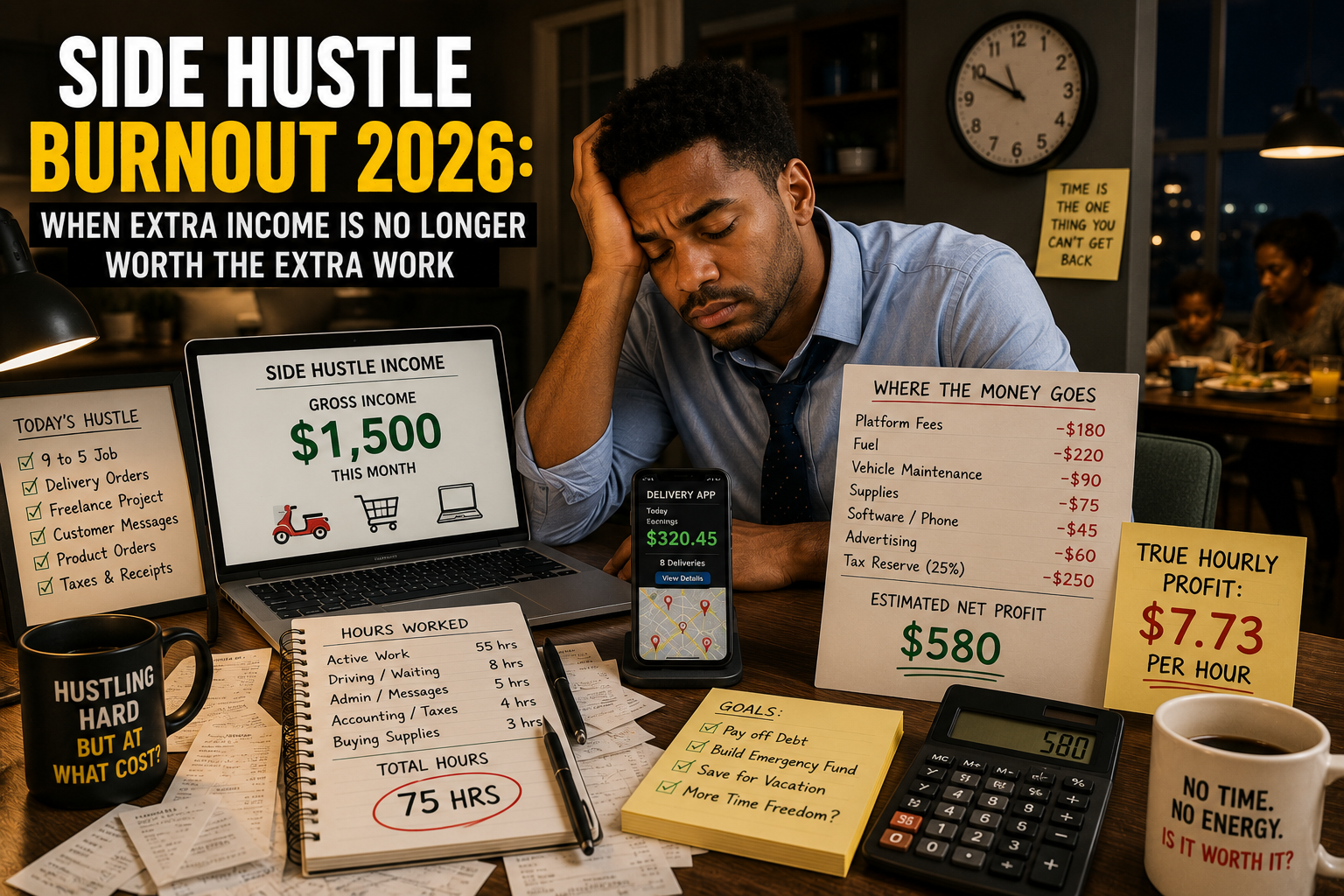
Side hustles are supposed to create freedom.
They are supposed to help you:
- Pay off debt
- Build emergency savings
- Cover rising household costs
- Invest more
- Create a path out of an unhealthy job
- Turn a useful skill into additional income
But many people discover a different reality.
They finish their regular workday, eat quickly, open another laptop, begin a delivery shift, answer customer messages, edit content, package orders or drive across town for another job.
The extra income arrives.
So do the exhaustion, taxes, vehicle expenses, missed family time and the feeling that they are never fully off the clock.
That is where side hustle burnout 2026 begins.
A 2026 LendingTree survey found that 33% of Americans reported having a side hustle, down from 38% in 2025 and 44% in 2022. Participation declined even though the side hustlers who remained reported higher average earnings. LendingTree
That decline does not necessarily mean people suddenly stopped needing extra money.
It may mean more people are questioning whether the additional income is worth the time, stress and hidden costs required to earn it.
The problem is not side hustling itself.
A profitable, controlled side business can transform a household’s finances.
The problem is running a second job without calculating whether it is producing meaningful financial progress.
A side hustle can look successful because money enters your account.
But gross income is not profit.
And profit is not the only cost.
You must also consider:
- Taxes
- Platform fees
- Fuel
- Vehicle depreciation
- Supplies
- Advertising
- Software
- Childcare
- Unpaid administrative work
- Lost rest
- Lost family time
- Reduced performance at your primary job
- The risk of physical and emotional burnout
This guide will show you how to calculate your true hourly profit, recognize side hustle burnout 2026, and decide whether to keep, change or quit your extra-income strategy.
No hustle-culture guilt.
No pretending every free hour must produce money.
Just an honest calculation.
Side Hustle Burnout 2026: Why Fewer People May Be Doing Extra Work
Side hustles became extremely popular during years when households were dealing with:
- Inflation
- Housing pressure
- Student-loan payments
- Expensive childcare
- Job insecurity
- Remote-work opportunities
- Growth in delivery and freelance platforms
- Social media stories about entrepreneurship
The message was everywhere:
Your salary is not enough.
You need multiple streams of income.
You should monetize your hobby.
You should use your evenings better.
You should build something after work.
That advice can be useful.
It can also become toxic.
Not every person needs several jobs.
Not every hobby should become a business.
Not every evening must be converted into revenue.
A second income stream should improve your life.
It should not consume the life you are trying to improve.
The decline in reported side-hustle participation may reflect several realities:
- Some people discovered the earnings were lower than expected.
- Some platform markets became more competitive.
- Some workers became exhausted.
- Some people returned to higher-paying primary jobs.
- Some side hustles never became profitable.
- Some workers decided the lost personal time was too expensive.
- Some businesses closed after initial enthusiasm disappeared.
At the same time, people who remain may be earning more because they have developed stronger skills, higher rates, better systems or more profitable business models.
The lesson is not that side hustles no longer work.
The lesson is that random extra work is different from strategic extra income.
Gross Income Is Not Side-Hustle Profit
Imagine you tell someone:
“My side hustle made $1,500 this month.”
That sounds impressive.
But what did it cost to earn the $1,500?
Suppose the monthly numbers look like this:
| Side-hustle item | Monthly amount |
|---|---|
| Gross income | $1,500 |
| Platform fees | -$180 |
| Fuel | -$220 |
| Vehicle maintenance reserve | -$90 |
| Supplies | -$75 |
| Software and phone costs | -$45 |
| Advertising | -$60 |
| Tax reserve | -$250 |
| Estimated net profit | $580 |
You did not make $1,500.
You collected $1,500 in revenue and may have kept approximately $580.
Side hustle burnout 2026 example showing how fees, fuel, supplies and taxes reduce $1,500 of gross income to $580 of estimated profit.
Now add time.
Suppose you worked:
- 55 hours completing paid tasks
- 8 hours driving between jobs
- 5 hours answering messages
- 4 hours managing records and taxes
- 3 hours buying supplies
Total time:
75 hours
True hourly profit:
$580 ÷ 75 = approximately $7.73 per hour
That is the number that matters.
The side hustle may still be useful if:
- You desperately need the $580
- The work creates future opportunity
- You enjoy it
- It is temporary
- It builds valuable skills
- The earnings are likely to grow
But you should not describe it as a $1,500 monthly business without acknowledging the real economics.
The True Hourly Profit Formula
Use this formula:
True hourly profit = Gross income − business expenses − tax reserve − unpaid support costs, divided by total hours worked
Your total hours should include:
- Customer-facing work
- Driving
- Preparation
- Cleaning
- Packaging
- Uploading listings
- Responding to messages
- Chasing payment
- Bookkeeping
- Marketing
- Scheduling
- Buying supplies
- Returns and refunds
- Platform disputes
Many side hustles appear profitable because the worker counts only the time that produces immediate payment.
But unpaid work is still work.
A photographer may charge $400 for a session.
That does not mean the photographer earned $400 for one hour.
The full job may include:
- One hour of shooting
- One hour of travel
- Four hours of editing
- One hour of communication
- Equipment costs
- Software
- Taxes
A delivery driver may earn $25 during one active hour.
But the real calculation should include:
- Waiting between orders
- Driving back to busy areas
- Fuel
- Maintenance
- Depreciation
- Additional insurance exposure
- Taxes
Calculate the full process.
Not just the attractive part.
Side Hustle Burnout 2026 Warning Signs
Burnout does not always begin with complete exhaustion.
It often starts with smaller signals.
You are constantly tired
You wake up tired, work tired and use weekends to recover just enough to repeat the cycle.
Your primary job performance is declining
You arrive late, make more mistakes or lose focus because your second job consumes your energy.
This is dangerous because the primary job may provide:
- Most of your income
- Health insurance
- Retirement benefits
- Paid leave
- Career advancement
Do not endanger a $70,000 primary income to protect a side hustle producing $500 per month.
You have become irritable
Customers, family members and coworkers begin to feel like interruptions.
That is often a sign that your time capacity is gone.
The money has no clear purpose
You are working extra but cannot explain where the income goes.
Without a specific goal, side-hustle money may disappear into normal spending.
You cannot take a week off
The business or platform collapses whenever you stop working.
That may mean you built another job rather than an asset.
You are spending to cope with working
You use more money on:
- Takeout
- Convenience groceries
- Childcare
- Rideshares
- Cleaning services
- Impulse purchases
- Weekend recovery spending
Those costs may reduce the value of the extra income.
You resent the side hustle
You once enjoyed it.
Now every customer message creates anger.
That does not always mean you should quit.
It may mean your pricing, schedule or business model needs to change.
The Convenience-Spending Trap
Extra work often creates extra spending.
Suppose your side hustle earns $800 in monthly profit before lifestyle costs.
Because you are working more, you begin spending:
- $180 extra on takeout
- $80 on coffee and snacks
- $120 on childcare
- $70 on transportation
- $100 on convenience services
Total added household spending:
$550
Real household improvement:
$800 − $550 = $250
You worked evenings and weekends to improve your finances by only $250.
Again, the side hustle may still be worthwhile.
But you need the real number.
This is why your analysis should include two separate calculations:
- Business profit
- Household profit after work-created spending
The second number tells you whether the hustle is actually changing your life.
Side Hustle Burnout 2026 and Taxes
Side-hustle income is generally taxable.
The IRS states that gig-economy income must be reported even when it comes from temporary, part-time or side work, is paid in cash or is not shown on an information form. The IRS also says people with at least $400 in net self-employment earnings generally have a federal filing obligation related to that income. IRS
That means the amount deposited into your account is not necessarily yours to spend.
Independent contractors may need to plan for:
- Federal income tax
- State income tax
- Self-employment tax
- Estimated quarterly payments
- Local business taxes
- Licensing requirements
A simple starting rule is to move part of each payment into a separate tax savings account.
The appropriate percentage depends on:
- Your total income
- Filing status
- State
- Business deductions
- Other employment
- Estimated tax obligations
Some side hustlers use a preliminary reserve of 20% to 30%, then refine it with a tax professional or tax software.
Do not wait until filing season to discover that you spent the government’s share.
A $10,000 side-hustle year can feel successful until a large tax bill arrives with no money reserved.
Your Side Hustle May Be Underpriced
Burnout is sometimes a pricing problem.
Suppose you provide a service for $100.
Each client requires:
- Two hours of service
- One hour of preparation
- One hour of communication and follow-up
- $20 in supplies
- $20 tax reserve
Estimated profit:
$100 − $20 − $20 = $60
Total time:
4 hours
True hourly profit:
$60 ÷ 4 = $15 per hour
You could work more clients.
Or you could increase the price.
If the price rises to $160:
Estimated profit:
$160 − $20 supplies − $32 tax reserve = $108
True hourly profit:
$108 ÷ 4 = $27 per hour
You could serve fewer clients while earning similar or greater profit.
That creates more recovery time.
Many people respond to low earnings by increasing volume.
Sometimes the better answer is:
- Higher pricing
- A minimum order
- Fewer service areas
- Better clients
- More efficient processes
- Removing unprofitable services
- Charging for rush work
- Deposits and cancellation fees
Do not automatically add more hours to a weak business model.
Fix the economics first.
The Side Hustle Profit and Burnout Table
| Situation | Financial signal | Burnout signal | Better response |
|---|---|---|---|
| High revenue but low profit | Expenses consume earnings | Long hours with little progress | Raise prices or cut costs |
| Good profit but no free time | Strong hourly rate | No recovery or family time | Limit schedule or set capacity |
| Low profit and high stress | Weak economics | Resentment and exhaustion | Change or quit |
| Moderate profit with skill growth | Income is improving | Work remains manageable | Keep and review quarterly |
| Strong seasonal income | High return during limited months | Rest available afterward | Keep as seasonal work |
| Side hustle harms primary job | Extra income is smaller than salary risk | Mistakes, fatigue and lateness | Reduce immediately |
| Profit disappears into convenience spending | Household gain is small | More takeout and paid help | Track lifestyle costs |
Side hustle burnout 2026 decision table comparing profitability, stress and the best response.
The Keep, Change or Quit Test
Every side hustle should fall into one of three decisions.
Keep the Side Hustle
Keep it when:
- The true hourly profit is competitive
- The work supports a clear financial goal
- Your health is stable
- Your primary job is not suffering
- Family responsibilities remain manageable
- Taxes are being reserved
- The income is consistent enough to matter
- You still have recovery time
- The business has realistic growth potential
A good side hustle should create measurable progress.
Examples:
- Paying off a $10,000 credit-card balance
- Building a three-month emergency fund
- Funding an IRA
- Saving a home down payment
- Replacing an unreliable vehicle
- Building a business that can eventually replace employment
Keep does not mean work endlessly.
It means the economics and the lifestyle still make sense.
Change the Side Hustle
Change it when the idea is valuable but the current model is not.
Changes may include:
- Raising prices
- Reducing service areas
- Working only on high-demand days
- Firing difficult clients
- Setting office hours
- Automating scheduling
- Requiring deposits
- Eliminating low-profit products
- Outsourcing simple tasks
- Limiting orders
- Specializing in a profitable niche
- Moving from one-to-one work to group services
- Creating packages instead of hourly pricing
Change may also mean switching side hustles entirely.
Perhaps food delivery is destroying your vehicle.
A remote freelance service may produce better profit.
Perhaps handmade products require too much labor.
Digital templates may be more scalable.
Perhaps content creation is producing no income after two years.
A local paid service may create faster cash flow.
Do not remain loyal to a business model that is not loyal to your life.
Quit the Side Hustle
Quit when:
- The true hourly profit is extremely low
- You consistently lose money
- Your health is declining
- Your relationships are suffering
- Your primary job is at risk
- The hustle requires debt
- You dread every customer
- There is no path to better pricing
- The platform controls too much of the income
- The work violates employer rules
- You have achieved the original financial goal
- You continue only because quitting feels like failure
Quitting is not automatically failure.
Sometimes quitting an unprofitable hustle is a raise.
You recover:
- Time
- Sleep
- Energy
- Vehicle life
- Family connection
- Focus
- Career performance
That recovered capacity can produce more wealth than the side hustle.
Compare the Hustle With Improving Your Main Income
Many people spend hundreds of hours building a side hustle while ignoring opportunities in their primary career.
Compare both paths.
Side-hustle path
- 15 hours per week
- $12 true hourly profit
- Approximately $180 weekly profit
- Approximately $9,360 annually before unexpected losses
Career-growth path
Use the same time for:
- Certification
- Portfolio improvement
- Job applications
- Networking
- Interview preparation
- Salary negotiation
If the effort helps you earn a $10,000 raise, you may improve your income without permanently working 15 extra hours every week.
This does not mean everyone should abandon side hustles.
It means career growth belongs in the comparison.
Ask:
Would 200 hours improve my finances more if invested in my main career, a side business or rest that protects my job performance?
The answer will differ by person.
Employer Rules and Conflict of Interest
Before starting or expanding a side hustle, review:
- Employment agreement
- Moonlighting policy
- Confidentiality rules
- Non-solicitation clauses
- Intellectual-property terms
- Conflict-of-interest policy
- Rules about using company equipment
- Restrictions on competing businesses
Do not:
- Use your employer’s laptop
- Use confidential information
- Recruit company clients
- Work on the side hustle during paid work hours
- Use employer software licenses
- Store business files on company systems
A side hustle should diversify your income.
It should not give your employer a reason to terminate the main income.
The Six-Month Goal Rule
A side hustle without a goal can become permanent exhaustion.
Give the income a specific mission and deadline.
Example:
Goal: Build a $6,000 emergency fund
Monthly side-hustle profit: $750
Estimated completion: Eight months
That creates a decision point.
After eight months, you can:
- Stop
- Reduce hours
- Continue toward another goal
- Invest in scaling
- Take a recovery break
Without a deadline, the brain adjusts to the extra income.
Then lifestyle spending expands.
Soon, the side hustle feels mandatory even after the original need disappears.
Keep your normal lifestyle based primarily on stable income where possible.
Use side-hustle profit for targeted progress.
The Side Hustle Money System
Use a separate account or clear tracking system.
Divide side-hustle income into categories such as:
- Taxes
- Business expenses
- Emergency reserve
- Financial goal
- Owner pay
Example allocation from $1,000 of monthly net business cash:
| Category | Amount |
|---|---|
| Tax reserve | $250 |
| Business reserve | $100 |
| Emergency buffer | $100 |
| Debt payoff or investing | $450 |
| Personal reward | $100 |
The exact allocation will vary.
The purpose is to stop the money from disappearing.
When side-hustle income enters your everyday checking account without a plan, it can quietly become:
- Extra dining
- Shopping
- Subscriptions
- Lifestyle inflation
You keep the exhaustion.
The financial progress disappears.
Create a Maximum-Hours Rule
Decide the maximum number of side-hustle hours you will work each week.
Examples:
- No more than 10 hours weekly
- No work after 8:00 p.m.
- One full weekend off each month
- No side work during family dinner
- No customer responses on Sunday
- One quarter with reduced activity each year
A maximum-hours rule forces the business to become more efficient.
When hours are unlimited, low-value work expands.
When capacity is limited, you begin asking better questions:
- Which clients pay the most?
- Which tasks can be automated?
- Which services should be removed?
- Which days produce the best returns?
- What can be scheduled in batches?
- What should cost more?
Boundaries are not laziness.
They are business strategy.
Side Hustle Burnout 2026: The 30-Day Reset
When you feel exhausted but are not ready to quit, run this reset.
Week 1: Track everything
Record:
- Revenue
- Expenses
- Time
- Mileage
- Administrative work
- Convenience spending
- Sleep
- Stress
Week 2: Calculate true hourly profit
Include taxes and hidden time.
Week 3: Remove the worst 20%
Eliminate:
- Lowest-paying clients
- Least-profitable product
- Worst service area
- Most stressful work period
- Unnecessary software or subscriptions
Week 4: Test the new model
Try:
- Higher rates
- Fewer hours
- Better scheduling
- Clear communication boundaries
- A minimum order
- A rest day
Then ask:
Is the side hustle now producing enough value without damaging the rest of my life?
If the answer remains no, quitting may be the financially intelligent decision.
External Resource
Review the IRS Gig Economy Tax Center for official guidance on reporting side-hustle income, keeping records, understanding worker classification and handling estimated taxes:
https://www.irs.gov/businesses/gig-economy-tax-center
Continue Building Your Financial Knowledge
Read more practical income, saving and wealth-building strategies on the True Wealth Moves blog:
https://truewealthmoves.com/wealth-blog
Use the True Wealth Moves resources page for financial tools, guides and calculators:
Final Verdict: How to Beat Side Hustle Burnout 2026
A side hustle can be one of the smartest financial moves you make.
It can help you:
- Escape high-interest debt
- Build savings
- Invest
- Learn valuable skills
- Test a business
- Reduce dependence on one employer
- Create more control over your future
But extra income is not automatically worth the extra work.
The correct question is not:
“How much money did the side hustle bring in?”
The correct questions are:
- How much profit did I keep?
- How many total hours did it require?
- What did taxes and expenses take?
- Did it create additional household spending?
- Is my primary job suffering?
- Is my health declining?
- Is the income connected to a specific goal?
- Can the model improve?
- Would my time create more value elsewhere?
The smartest side hustle burnout 2026 strategy is to evaluate the work like a business rather than a personal obligation.
Keep it when the economics and lifestyle are healthy.
Change it when the idea works but the model is inefficient.
Quit it when the income is too small for the damage it creates.
You do not need to monetize every talent.
You do not need to work during every free hour.
And you are not financially irresponsible because you need rest.
The purpose of building wealth is to create more control over your life.
A side hustle that takes away all control is working against the goal.
That is the True Wealth Moves conclusion:
Do not measure your side hustle only by the money it earns. Measure it by the life you have left after earning it.
Looking for More Finance Topics?
Use the search box below to explore hundreds of articles on True Wealth Moves — we’ve probably already written about what you’re looking for.





