
AI Job Disruption Money Plan: How to Protect Your Income Without Panic in 2026
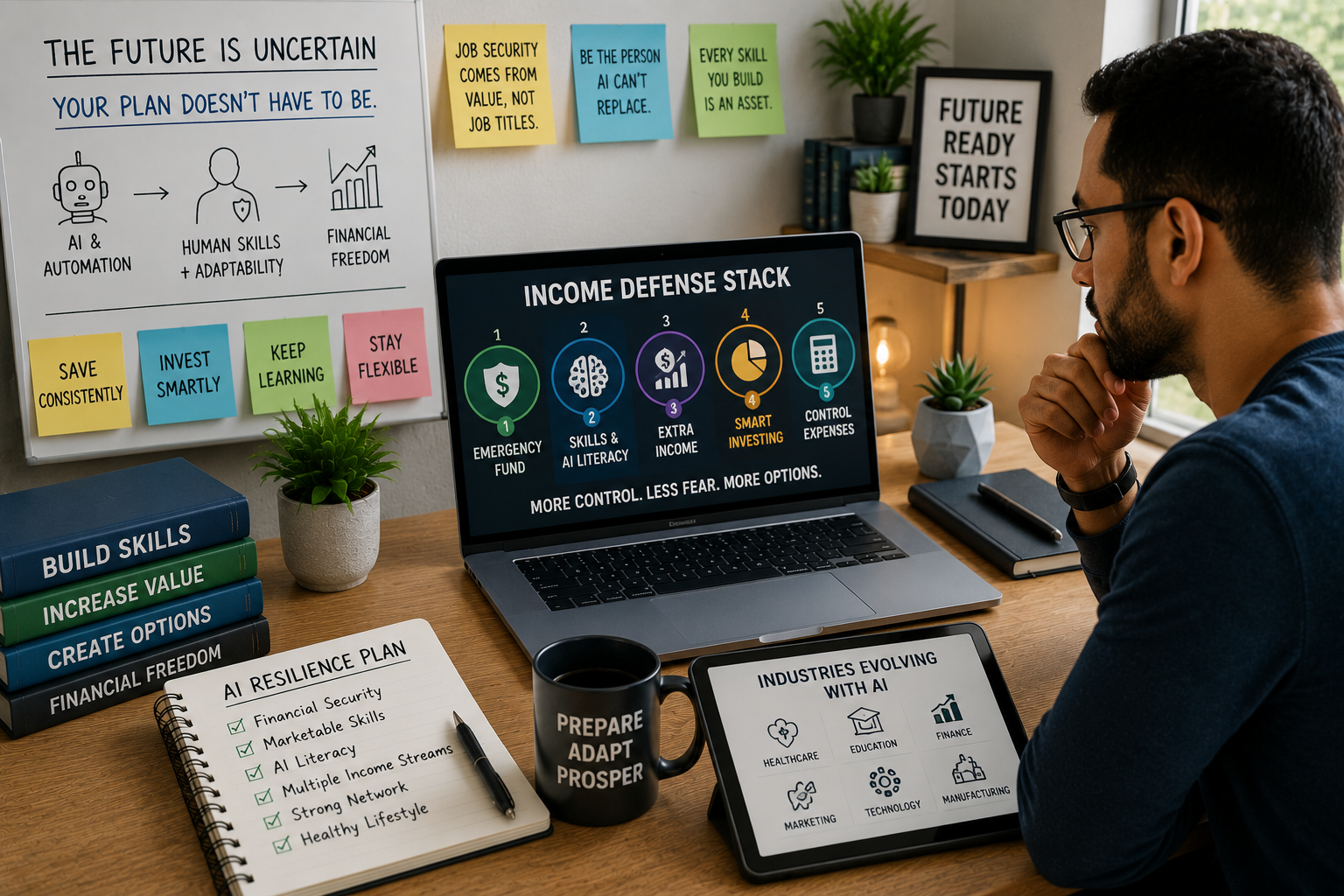
Artificial intelligence has created one of the biggest workplace fears of the decade.
People are asking:
“Will AI replace my job?”
“Should I learn coding?”
“Should I start a side hustle?”
“Am I already behind?”
“Do I need to completely change careers?”
The fear is understandable.
Technology has always changed the way people work, but artificial intelligence is different because it can perform tasks that previously required human judgment, writing, analysis, research, customer support and decision-making.
However, the biggest financial mistake people can make is reacting emotionally.
Panic creates poor decisions.
Some workers are quitting stable jobs without a plan.
Others are spending thousands of dollars on random courses hoping one new skill will guarantee future income.
Others are ignoring the change completely and assuming their current position will remain untouched forever.
The smarter approach is preparation.
That is where an AI job disruption money plan becomes important.
The goal is not predicting exactly which jobs will disappear.
Nobody knows that.
The goal is building financial protection so that regardless of how AI changes your industry, you have:
- More income options
- More valuable skills
- More savings flexibility
- Less dependence on one employer
- More confidence during career changes
AI does not have to be viewed only as a threat.
For many workers, it can become a productivity tool that helps them earn more, work faster and create new opportunities.
The people who may struggle the most are not necessarily those whose jobs change.
They are the people who refuse to adapt.
This guide will explain:
- What AI job disruption really means financially
- Why income protection matters more than job predictions
- How to build an “income defense stack”
- Which skills become more valuable
- How to use AI instead of competing against it
- How much emergency savings you need
- How to avoid panic career decisions
- How to create a financial backup plan
- The step-by-step AI resilience roadmap
No fear-based predictions.
No “AI will replace everyone” headlines.
Just a practical money strategy.
AI Job Disruption Money Plan: Why Income Protection Matters More Than Job Predictions
Many people are focused on one question:
“Will AI replace my job?”
A better question is:
“How prepared am I if my job changes?”
The difference is important.
A person can spend years trying to predict the future and still be wrong.
A person can spend the same years becoming financially stronger and be prepared for multiple outcomes.
Imagine two workers.
Worker A
- Depends on one employer
- Has $500 emergency savings
- Has not updated skills in five years
- Has no professional network
- Has no backup income
Worker B
- Has six months of expenses saved
- Uses AI tools to improve productivity
- Updates skills annually
- Maintains professional relationships
- Has investments
- Has a small additional income stream
Even if AI affects both careers, Worker B has more options.
Financial resilience is not about knowing exactly what happens next.
It is about reducing how much one unexpected change can damage your life.
The Real AI Risk: Income Shock
Many people think about AI only in terms of job loss.
But financial damage often begins earlier.
The first impact may be:
- Reduced overtime
- Slower promotions
- Fewer available positions
- Lower freelance rates
- Increased competition
- More productivity expectations
- Less bargaining power
- Job restructuring
A worker does not need to lose their job to experience financial pressure.
Suppose someone earns:
- Salary: $75,000
- Annual overtime: $10,000
Total income:
$85,000
If AI automation reduces overtime opportunities by 50%, the worker loses:
$5,000 annually
That may affect:
- Mortgage payments
- Retirement contributions
- Debt payoff
- Savings goals
- Family expenses
The financial preparation must begin before a crisis.
The AI Income Defense Stack
A strong AI job disruption money plan is built with multiple layers.
Think of it like financial insurance.
The goal is not relying on one solution.
Your income defense stack should include:
- Emergency savings
- Valuable skills
- AI literacy
- Professional visibility
- Multiple income options
- Controlled expenses
- Long-term investing
Each layer protects you differently.
Layer 1: Build an Emergency Fund Before Making Big Career Moves
Emergency savings is the foundation of career flexibility.
Without savings, every decision becomes urgent.
You may stay in a bad job because you cannot afford to leave.
You may accept poor opportunities because bills are due.
You may make desperate financial choices.
Emergency savings creates time.
A basic emergency fund target:
| Situation | Suggested savings |
|---|---|
| Stable job, low expenses | 3 months of expenses |
| Industry facing disruption | 6 months |
| Single-income household | 6–12 months |
| Self-employed worker | 9–12 months |
| High income but specialized role | 6–12 months |
AI job disruption money plan emergency savings guide showing how much cash workers may need based on job stability.
Suppose your essential expenses are:
- Housing: $2,000
- Food: $700
- Transportation: $500
- Insurance: $300
- Utilities: $300
- Other essentials: $200
Monthly essential expenses:
$4,000
Three-month emergency fund:
$12,000
Six-month emergency fund:
$24,000
Twelve-month emergency fund:
$48,000
The right amount depends on your situation.
The purpose is not creating fear.
The purpose is buying yourself decision-making time.
Layer 2: Become the Person Who Uses AI, Not the Person Competing Against AI
One of the biggest mistakes workers make is seeing AI as a replacement instead of a tool.
The most valuable employees may become those who combine:
Human judgment + AI productivity.
Examples:
Marketing professional
Before AI:
- Writes campaigns manually
- Researches competitors slowly
- Creates reports from scratch
With AI:
- Generates ideas faster
- Analyzes customer feedback
- Creates first drafts
- Tests more concepts
Accountant
Before AI:
- Manually reviews documents
- Performs repetitive calculations
With AI:
- Automates repetitive tasks
- Reviews exceptions
- Focuses on advisory work
Teacher
Before AI:
- Creates lessons manually
- Builds assessments from scratch
With AI:
- Personalizes materials
- Creates practice exercises
- Saves preparation time
The question is changing from:
“Can AI do my job?”
to:
“How can I use AI to become better at my job?”
That difference matters financially.
Workers who increase productivity often become more valuable.
Layer 3: Build AI Literacy Without Becoming a Programmer
Many people believe preparing for AI means learning advanced programming.
That is not true for everyone.
AI literacy means understanding:
- What AI tools can do
- What they cannot do
- How to write effective instructions
- How to verify results
- How to protect confidential information
- How to integrate AI into workflows
Useful skills include:
- Prompt writing
- Data interpretation
- Automation tools
- AI-assisted research
- Digital organization
- Communication
- Critical thinking
- Industry-specific AI applications
The most valuable combination is often:
Your existing expertise + AI capability
A nurse who understands healthcare and AI tools may be more valuable than someone who only knows AI.
A salesperson who understands customers and uses AI efficiently may outperform someone who only knows software.
Do not throw away your experience.
Add technology to it.
AI Job Disruption Money Plan: The Skills That Become More Valuable
AI may increase the value of certain human abilities.
These include:
Communication
People who explain complicated ideas clearly remain valuable.
Relationship building
Trust is difficult to automate.
Leadership
Organizations still need humans making decisions.
Creativity
AI generates options.
Humans decide which ideas matter.
Problem-solving
Companies pay people who solve expensive problems.
Emotional intelligence
Understanding customers, employees and relationships remains important.
Judgment
AI can produce answers.
Humans evaluate consequences.
The future may not belong only to technical workers.
It may belong to workers who combine technology with uniquely human strengths.
Skills Comparison Table
| Skill category | AI replacement risk | Future value |
| Repetitive data entry | Higher | Learn automation and analysis |
| Basic content creation | Moderate | Add strategy and expertise |
| Customer support scripts | Moderate | Develop relationship skills |
| Data interpretation | Lower | Learn AI-assisted analysis |
| Leadership | Lower | Continue developing people skills |
| Sales relationships | Lower | Combine AI tools with trust |
| Creative strategy | Lower | Use AI for speed, human judgment for direction |
| Skilled trades | Lower in many areas | Combine technical skill with technology |
AI job disruption money plan skills comparison showing which abilities become more valuable as automation grows.
Layer 4: Create a Backup Income Option
A backup income stream does not need to replace your salary.
It simply reduces dependence on one employer.
Examples:
- Freelance work
- Consulting
- Teaching
- Digital products
- Local services
- Online businesses
- Rental income
- Contract work
- Specialized skills
The mistake is believing every side income must become a million-dollar business.
A $500 monthly backup income can matter.
Example:
Monthly expenses:
$4,000
Emergency income:
$500
A job-loss situation changes from:
“I have no income.”
to:
“I have $500 coming in while I search.”
That difference creates psychological and financial stability.
However, do not build a backup income that creates burnout.
The goal is resilience.
Not creating a second full-time job.
Layer 5: Protect Your Primary Income
Your current job is still your largest financial asset.
Many people become so focused on future threats that they neglect their current opportunity.
Protect your income by:
- Improving performance
- Learning new tools
- Documenting achievements
- Building relationships
- Asking for challenging assignments
- Understanding company priorities
- Becoming known as someone who solves problems
The safest employee is rarely the person who simply completes tasks.
It is often the person who makes the organization better.
AI may automate tasks.
Companies still need people who create value.
Layer 6: Control Your Lifestyle Before You Need To
Financial flexibility comes from the gap between income and expenses.
A worker earning $120,000 but spending $118,000 has little flexibility.
A worker earning $80,000 and spending $55,000 has more options.
Before income disruption happens:
Review:
- Housing
- Car payments
- Subscriptions
- Insurance
- Dining
- Shopping
- Debt payments
You do not need to live like a monk.
But a lower fixed-cost lifestyle gives you more freedom.
Your expenses determine how much income you must replace.
Reducing monthly obligations is a form of financial insurance.
The Career Shock Preparation Checklist
Use this checklist every six months.
| Question | Yes/No |
| Do I have at least three months of expenses saved? | |
| Have I learned a new valuable skill recently? | |
| Do I know how AI affects my industry? | |
| Can I explain my value to an employer? | |
| Do I have professional relationships outside my company? | |
| Could I earn money outside my current job? | |
| Is my resume updated? | |
| Is my LinkedIn profile current? | |
| Do I track my monthly expenses? | |
| Would I survive six months without my current paycheck? |
AI job disruption money plan career readiness checklist for protecting income.
Avoid Panic Spending on AI Courses
The AI education market is exploding.
Thousands of people are selling:
- AI certifications
- Prompt courses
- Automation programs
- Career transformation packages
Some are useful.
Some are not.
Before paying for training, ask:
Does this solve a real workplace problem?
A course that teaches a skill your industry needs is valuable.
A random certificate may not change your income.
Can I practice this immediately?
Knowledge without application has limited value.
Will this improve my current job?
The fastest return may come from improving your existing role.
Is there evidence the skill creates opportunities?
Research job postings.
Talk to professionals.
Look at real requirements.
Do not spend $3,000 because you are afraid.
Spend because the skill has a clear return.
The AI Opportunity: Increasing Your Income
AI is not only about protection.
It may create opportunities.
Workers can use AI to:
- Complete tasks faster
- Serve more customers
- Create products
- Start small businesses
- Improve marketing
- Automate administration
- Learn faster
A freelance writer may use AI for research.
A small-business owner may use AI for customer communication.
A real-estate agent may use AI for market analysis.
A job seeker may use AI to improve resumes and interview preparation.
The goal is not replacing your judgment.
The goal is increasing your output.
Higher productivity can create:
- Better performance reviews
- Higher rates
- More customers
- New opportunities
The 12-Month AI Resilience Plan
Months 1–3: Understand
- Learn how AI affects your industry
- Identify repetitive tasks
- Test useful AI tools
- Update your resume
- Review expenses
Months 4–6: Build
- Learn one valuable AI-related skill
- Create examples of your work
- Improve professional visibility
- Start emergency savings if needed
Months 7–9: Expand
- Create a backup income option
- Network intentionally
- Take relevant training
- Improve your workplace value
Months 10–12: Strengthen
- Review progress
- Increase savings
- Update career strategy
- Decide your next skill investment
Do not try to transform your entire life in 30 days.
Consistency beats panic.
AI and Retirement Planning
Career disruption can affect retirement plans.
If income decreases:
- Retirement contributions may stop
- Employer matches may disappear
- Investment growth may slow
- Withdrawals may happen earlier than planned
That is why retirement preparation matters.
Use tax-advantaged accounts when appropriate.
The IRS provides current contribution limits and retirement-account guidance that can help workers plan contributions over time.
Review your retirement strategy regularly, especially during career changes.
Protect Against Identity and Data Risks
Using AI tools creates another financial consideration:
Data protection.
Before entering information into AI systems, avoid sharing:
- Social Security numbers
- Customer private information
- Employer confidential documents
- Financial account details
- Protected health information
A productivity tool should not create a security problem.
Review:
- Employer AI policies
- Tool privacy settings
- Data retention practices
- Company-approved applications
Your income depends not only on skills.
It also depends on trust.
External Resource
Review the U.S. Department of Labor’s official resources on workforce development, training and adapting skills for changing labor markets:
https://www.dol.gov/agencies/eta
Continue Building Your Financial Knowledge
Read more practical income, career and wealth-building strategies on the True Wealth Moves blog:
https://truewealthmoves.com/wealth-blog
Use the True Wealth Moves resources page for financial tools, guides and calculators:
Final Verdict: Build an AI Job Disruption Money Plan Before You Need One
AI will change many workplaces.
That does not mean everyone will lose their job.
It means the definition of valuable work will continue changing.
The workers who prepare early give themselves more options.
A strong AI job disruption money plan includes:
- Emergency savings
- Valuable skills
- AI literacy
- Professional relationships
- Flexible expenses
- Backup income options
- Long-term investing
- Continuous learning
Do not wait until your employer announces layoffs.
Do not panic and abandon a career without research.
Do not spend thousands chasing every new AI trend.
Instead:
Learn.
Adapt.
Save.
Invest.
Build options.
The purpose of financial planning is not predicting every future event.
It is creating enough strength that unexpected events do not control your life.
AI may change the workplace.
But your financial preparation determines how much power that change has over you.
That is the True Wealth Moves conclusion:
The safest career in an AI world is not the one that never changes. It is the one backed by skills, savings and the ability to adapt.
Looking for More Finance Topics?
Use the search box below to explore hundreds of articles on True Wealth Moves — we’ve probably already written about what you’re looking for.





