
High-Yield Savings Account Fine Print: Why the Highest APY May Not Pay You the Most
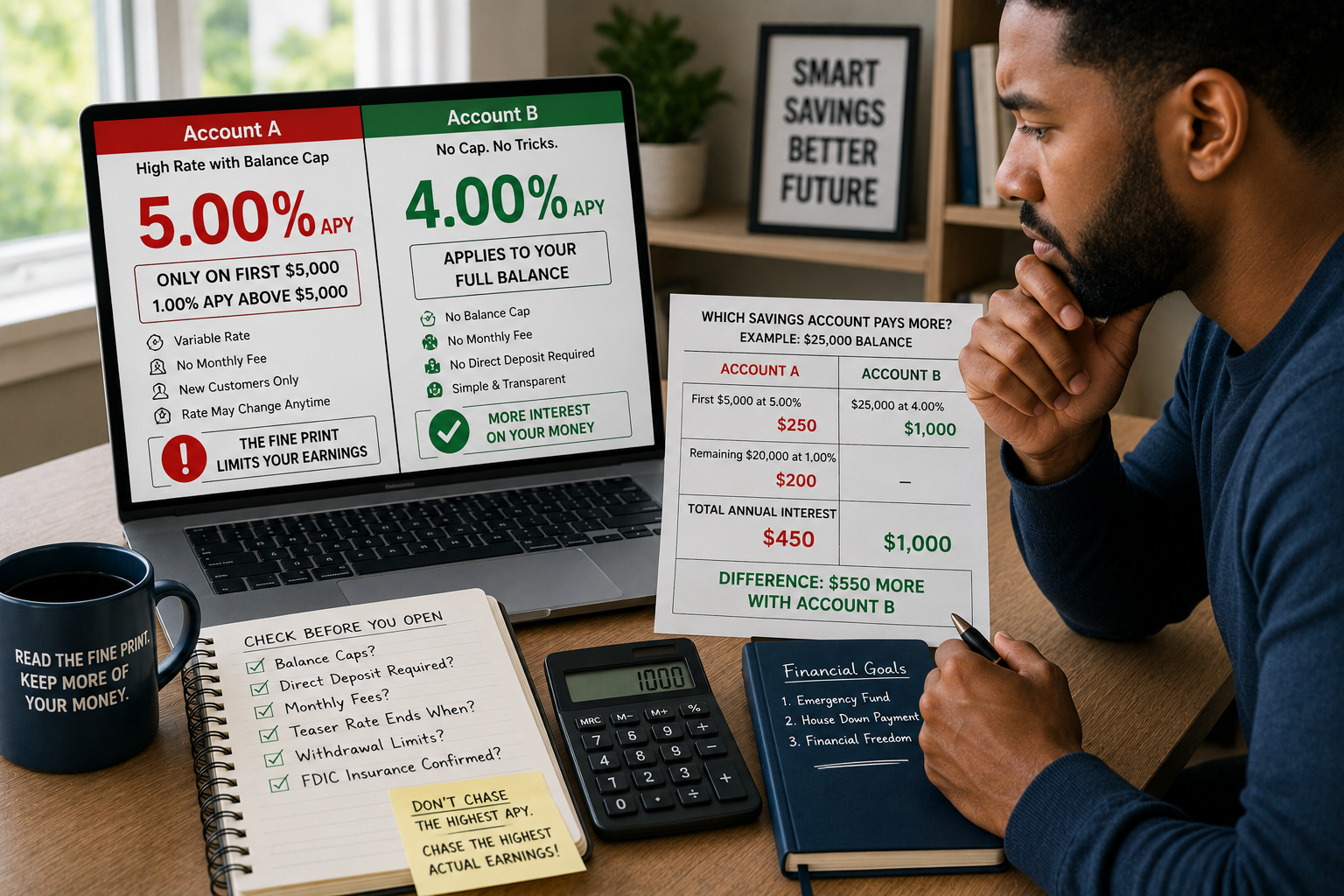
A high-yield savings account should be one of the simplest financial products you own.
You deposit money.
The bank pays interest.
Your savings grows.
But the account with the highest advertised annual percentage yield is not always the account that puts the most money in your pocket.
That is because the headline rate may come with conditions hidden inside the high-yield savings account fine print.
A bank may advertise 4.50% APY, 5.00% APY or even more, but that rate could apply only:
- To the first $5,000 in the account
- After qualifying direct deposits
- When you make a certain number of monthly transactions
- During a short promotional period
- To new customers only
- When you maintain another account
- When you avoid withdrawals
- When your balance falls within a specific tier
- After paying a monthly membership fee
The large number attracts your attention.
The smaller conditions determine your actual earnings.
That does not mean high-yield savings accounts are bad.
They can be excellent places for:
- Emergency funds
- Home down-payment savings
- Tax reserves
- Medical sinking funds
- Travel funds
- Short-term goals
- Cash you do not want exposed to market risk
The mistake is assuming the highest APY automatically creates the highest return.
This guide will explain:
- How APY works
- Why balance caps matter
- How direct-deposit conditions change the value
- Why teaser rates can disappoint
- How monthly fees erase interest
- What tiered rates mean
- Why account access matters
- How FDIC insurance works
- How to compare two accounts correctly
- The exact calculation to use before moving your money
No chasing shiny rates.
No opening five accounts for tiny differences.
Just the math.
High-Yield Savings Account Fine Print: What Does APY Really Mean?
APY stands for annual percentage yield.
It represents the amount of interest an account may earn over one year, including the effect of compounding, assuming the rate remains unchanged and the balance stays in the account.
That last part matters.
Savings-account rates are usually variable.
A bank can raise or lower the rate after you open the account.
So a 4.50% APY does not guarantee you will earn 4.50% for the next 12 months unless the bank specifically promises a fixed promotional period.
The basic APY idea is simple:
- A higher APY generally means more interest.
- More frequent compounding can slightly increase earnings.
- Your actual balance determines the dollar return.
- Fees and conditions can reduce what you keep.
- Variable rates can change at any time.
Suppose you deposit $10,000 into an account earning 4.00% APY.
If the rate remained constant for one year and you made no withdrawals, you might earn approximately $400 before taxes.
At 4.50%, the approximate annual interest would be:
$10,000 × 4.50% = $450
Difference:
$450 − $400 = $50
That extra half-percentage point is worth only about $50 per year on a $10,000 balance.
This is why you should not move money recklessly for a small APY difference when the new account creates:
- Transfer delays
- Complicated conditions
- Monthly fees
- Poor customer support
- Withdrawal restrictions
- A temporary promotional rate
A higher number is valuable only when you can actually earn and keep it.
The Balance-Cap Trap
Some accounts advertise a very high rate but apply it only to a limited portion of your balance.
Example:
- 5.00% APY on balances up to $5,000
- 1.00% APY on balances above $5,000
A saver with exactly $5,000 may receive an attractive return.
A saver with $25,000 may earn much less than expected.
Let us calculate it.
First $5,000 at 5.00%:
$5,000 × 5% = $250
Remaining $20,000 at 1.00%:
$20,000 × 1% = $200
Estimated total annual interest:
$250 + $200 = $450
Effective return on the full $25,000:
$450 ÷ $25,000 = 1.80%
The advertisement says 5.00%.
The saver effectively earns approximately 1.80% across the full balance.
Now compare that with a simple no-cap account paying 4.00% on the entire $25,000.
Estimated annual interest:
$25,000 × 4% = $1,000
Difference:
$1,000 − $450 = $550
The account with the lower advertised rate could pay $550 more.
That is why balance caps are one of the most important parts of the high-yield savings account fine print.
Always ask:
- Does the advertised APY apply to the entire balance?
- Is there a maximum qualifying balance?
- What rate applies above the cap?
- Is the account tiered?
- Does the bank calculate interest using separate balance levels?
Do not stop at the biggest number on the page.
High-Yield Savings Account Fine Print Comparison Table
| Account structure | Headline APY | Important condition | Approximate result on $25,000 |
|---|---|---|---|
| High rate with $5,000 cap | 5.00% | 1.00% above $5,000 | About $450 annually |
| Flat-rate account | 4.00% | Rate applies to entire balance | About $1,000 annually |
| Direct-deposit account | 4.25% | Requires qualifying deposits | About $1,062 if conditions are met |
| Teaser-rate account | 4.50% | Guaranteed for only 60 days | Future earnings uncertain |
| Fee-based account | 4.20% | $10 monthly fee | About $930 after annual fee |
| Tiered balance account | Up to 4.50% | Different rates by balance | Depends on each tier |
High-yield savings account fine print comparison showing how balance caps, direct deposit, teaser rates and fees affect actual earnings.
The Direct-Deposit Requirement
Some accounts require qualifying direct deposits to earn the highest APY.
That may mean:
- Payroll deposits
- Government benefit deposits
- Pension payments
- Employer payments coded through the ACH system
A regular transfer from another bank may not qualify.
Suppose an account offers:
- 4.25% APY with qualifying direct deposit
- 1.00% APY without qualifying direct deposit
If you move your paycheck and meet the rules, the account may be competitive.
If you miss the requirement for one month, your earnings could fall sharply.
Before opening the account, ask:
- What qualifies as direct deposit?
- Is there a minimum monthly amount?
- Must the deposit arrive every calendar month?
- Does the rate change immediately if the requirement is missed?
- Can you split your paycheck between banks?
- Are self-employed payments eligible?
- Do transfers from payment apps qualify?
- Is the higher rate restored automatically later?
Direct deposit creates value for the bank because it makes the account more likely to become your primary financial relationship.
That may be acceptable.
But do not move your entire paycheck without understanding the consequences.
Changing direct deposit can affect:
- Bill timing
- Automatic transfers
- Employer payroll processing
- Account bonuses at another institution
- Your access to cash during the transition
A slightly higher APY may not justify unnecessary banking complexity.
The Teaser-Rate Problem
Some accounts offer an attractive rate for:
- 30 days
- 60 days
- 90 days
- Six months
- One year
After the promotional period, the APY may fall.
The account may still be worthwhile.
But you need to calculate the full-year result rather than assuming the promotional rate continues.
Example:
- First three months: 5.00% APY
- Remaining nine months: 3.00% APY
- Deposit: $20,000
Approximate first-quarter interest:
$20,000 × 5% × 3/12 = $250
Approximate remaining nine-month interest:
$20,000 × 3% × 9/12 = $450
Estimated full-year interest:
$250 + $450 = $700
Approximate full-year effective return:
$700 ÷ $20,000 = 3.50%
The advertised rate is 5.00%.
The approximate first-year return is 3.50%.
A competing account paying a steady 4.00% could produce:
$20,000 × 4% = $800
The lower advertised rate wins again.
Check:
- How long the promotional APY lasts
- What rate applies afterward
- Whether the offer is guaranteed
- Whether the bank can change the standard rate
- Whether existing customers qualify
- Whether new deposits receive different treatment
Do not build your annual savings plan around a short-term teaser.
Variable Rates Can Change Without Your Permission
High-yield savings rates often move with broader interest-rate conditions.
When market rates fall, banks may reduce savings APYs.
When banks no longer need as many deposits, they may also lower rates.
That means your job is not finished after opening the account.
You should review the account periodically.
A practical schedule is:
- Check the APY once per quarter
- Compare competitors twice per year
- Review immediately after a major rate change
- Read notices from the bank
- Monitor whether a promotional period is ending
Do not obsess over every 0.05% movement.
But do not leave money earning 1% when comparable accounts are paying around 4%.
Use a meaningful-switch rule.
For example:
Consider moving when:
- The difference is at least 0.50 to 1 percentage point
- The balance is large enough for the difference to matter
- The new account has no meaningful fee
- The access and insurance are comparable
- The rate is not a temporary gimmick
Monthly Fees Can Erase Your Interest
A high APY does not protect you from monthly fees.
Suppose an account pays 4.20% APY but charges $10 per month.
Annual fee:
$10 × 12 = $120
If you deposit $2,000, approximate annual interest is:
$2,000 × 4.20% = $84
Net result:
$84 − $120 = negative $36
You lose money.
How much would you need just to recover the fee?
Use:
Break-even balance = Annual fee ÷ APY
$120 ÷ 4.20% = approximately $2,857
You need around $2,857 just to earn enough interest to cover the fee, before taxes.
A free account paying 3.75% may be better.
Always review:
- Monthly maintenance fee
- Minimum-balance fee
- Paper-statement fee
- Excess-withdrawal fee
- Inactivity fee
- Outgoing wire fee
- Check fee
- ATM fee
- Account-closure fee
A fee that seems small can consume months of interest.
The Minimum-Balance Requirement
Some banks require a minimum balance to:
- Earn interest
- Earn the highest rate
- Avoid a monthly fee
- Keep the account open
- Qualify for a promotional tier
There are several different balance measurements:
- Daily balance
- Average daily balance
- Minimum daily balance
- Statement-cycle balance
- Combined household balance
These are not interchangeable.
Suppose the bank requires a minimum daily balance of $5,000.
Your account begins the month with $6,000.
You withdraw $1,500 for an emergency.
The balance falls to $4,500.
Even if you replace the money two days later, you may lose the fee waiver or rate for that statement cycle.
Read the exact wording.
Emergency savings should be accessible.
An account that punishes you for using the emergency fund may not fit the purpose.
Tiered APYs Can Work Both Ways
A tiered-rate account applies different interest rates to different balance ranges.
One structure may reward larger balances:
- 3.50% on balances under $10,000
- 4.00% from $10,000 to $50,000
- 4.25% above $50,000
Another may reward smaller balances and pay less on larger amounts:
- 5.00% on the first $5,000
- 2.00% from $5,001 to $25,000
- 0.50% above $25,000
You need to know whether the bank uses:
Blended tiers
Each portion of the balance earns its tier’s rate.
Whole-balance tiers
The entire balance earns the rate associated with the balance range.
These methods can produce very different results.
Do not attempt to calculate a tiered account from the headline alone.
Use the bank’s disclosure or interest calculator.
Withdrawal Access Matters More Than People Think
The highest APY is not useful when accessing your money is difficult.
Ask:
- How long do outgoing transfers take?
- Is there an ATM card?
- Can you transfer instantly to checking?
- Is same-day access available?
- Are outgoing transfers limited?
- Is there a daily transfer cap?
- Does the bank charge for wires?
- Can you link multiple external accounts?
- Is customer support available on weekends?
Emergency funds need liquidity.
A high-yield account that takes five business days to release money may create problems during:
- Medical emergencies
- Car repairs
- Urgent travel
- Housing issues
- Insurance deductibles
- Job loss
You do not need every emergency dollar instantly available.
A practical structure might be:
- Small immediate buffer in checking
- Larger emergency fund in high-yield savings
- Longer-term cash in CDs or Treasury securities
Interest matters.
Access matters too.
High-Yield Savings Account Fine Print and Withdrawal Fees
Federal rules no longer require banks to impose the old universal six-withdrawal limit in the same way, but banks may still set their own transaction rules and fees.
A bank may charge when you:
- Make too many transfers
- Drop below a minimum balance
- Request checks
- Use an ATM
- Send a wire
- Close the account too soon
Review the fee schedule before opening.
Do not assume “no monthly fee” means “no fees.”
The CFPB requires institutions to disclose important account terms, including APY, minimum-balance requirements and fee schedules.
Your responsibility is to read them.
FDIC and NCUA Insurance
A competitive interest rate is meaningless if you do not understand where the money is held.
At an FDIC-insured bank, eligible deposit accounts are generally insured up to applicable legal limits.
At a federally insured credit union, similar protection is generally provided through the National Credit Union Share Insurance Fund administered by the NCUA.
Eligible deposit products usually include:
- Checking accounts
- Savings accounts
- Money market deposit accounts
- Certificates of deposit
Investment products are different.
Stocks, bonds, mutual funds and cryptocurrency are not FDIC-insured simply because they appear in the same financial app.
The standard insurance limit is generally $250,000 per depositor, per insured bank, for each account-ownership category.
That wording matters.
Having several accounts at the same bank does not automatically multiply insurance coverage.
If you have:
- $200,000 in savings
- $100,000 in checking
- Both individually owned at the same bank
Your combined deposits may exceed the standard insurance limit for that ownership category.
Before depositing a large amount, verify:
- The legal bank name
- Whether the institution is FDIC-insured
- Whether the app uses a partner bank
- How pass-through insurance works
- Whether all funds have reached the insured bank
- Whether multiple brand names belong to the same institution
Do not rely only on a logo inside an app.
Confirm the legal deposit structure.
Online Bank vs Traditional Bank
Online banks often pay higher rates because they may have:
- Fewer branches
- Lower real-estate costs
- More automated service
- Lower staffing overhead
Traditional banks may provide:
- Branch access
- Cash deposits
- In-person assistance
- Cashier’s checks
- Faster internal transfers
- Broader product relationships
The best choice depends on how you use the account.
An online high-yield account may work well for an emergency fund.
A local bank may still be useful for:
- Cash deposits
- Business needs
- Immediate cashier’s checks
- Complex support issues
You do not have to keep all banking at one institution.
Many households use:
- Local checking for bills and cash access
- Online savings for higher interest
- A separate investment account for long-term growth
The goal is not banking loyalty.
The goal is financial efficiency.
The Tax Reality
Savings-account interest is generally taxable income.
If you earn $1,000 in interest, you may owe federal and possibly state income taxes depending on your situation.
This does not make the high-yield account a bad choice.
Earning interest and paying tax is usually better than earning almost nothing.
But compare returns on an after-tax basis when evaluating alternatives.
Suppose:
- Savings APY: 4.00%
- Marginal combined tax rate: 25%
Approximate after-tax yield:
4.00% × (1 − 25%) = 3.00%
That may still be appropriate for emergency cash because the account provides:
- Stability
- Liquidity
- Insurance
- No market volatility
Do not compare a savings account only with investments based on return.
They serve different purposes.
The $10,000 Account Comparison
Consider two accounts.
Account A
- 4.50% advertised APY
- Applies only to first $5,000
- 1.00% above $5,000
- No monthly fee
Estimated annual interest:
- First $5,000 at 4.50% = $225
- Next $5,000 at 1.00% = $50
- Total = $275
Account B
- 4.00% APY on entire balance
- No balance cap
- No monthly fee
Estimated annual interest:
$10,000 × 4.00% = $400
Difference:
$400 − $275 = $125
Account B has the lower headline rate.
Account B pays more.
That single example explains the entire article.
The 10-Question Savings Account Test
Before opening an account, answer these questions.
1. Does the APY apply to the full balance?
Check caps and tiers.
2. Is the rate variable or guaranteed?
Know whether it can change tomorrow.
3. Is it a teaser rate?
Write down the expiration date.
4. Is direct deposit required?
Confirm the qualifying amount and transaction type.
5. Are there monthly fees?
Calculate their annual cost.
6. Is there a minimum balance?
Understand exactly how it is measured.
7. How quickly can you access the money?
Test transfer times before an emergency.
8. Is the institution insured?
Verify the legal bank or credit union.
9. What rate applies when conditions are missed?
The fallback rate may be extremely low.
10. Is the account better than a simple no-condition alternative?
Compare actual dollars, not advertisements.
The True Wealth Moves High-Yield Savings System
Use this process.
Step 1: Decide the account’s job
Examples:
- Emergency fund
- Down payment
- Taxes
- Travel
- Medical expenses
Step 2: Estimate the average balance
The best account for $3,000 may not be best for $50,000.
Step 3: Calculate expected annual interest
Use the real tier structure.
Step 4: Subtract fees
Include membership and transaction costs.
Step 5: Verify access and insurance
Do this before transferring money.
Step 6: Automate savings
Set recurring transfers after payday.
Step 7: Review quarterly
Check rates, conditions and fees.
Do not rate-chase every week.
But do not ignore an account that has quietly become uncompetitive.
External Resource
Review the FDIC’s official deposit-insurance information to understand which savings products are covered and how coverage generally applies:
https://www.fdic.gov/resources/deposit-insurance
Continue Building Your Financial Knowledge
Read more practical saving, banking and wealth-building strategies on the True Wealth Moves blog:
https://truewealthmoves.com/wealth-blog
Use the True Wealth Moves resources page for financial tools, guides and calculators:
Final Verdict: Read the High-Yield Savings Account Fine Print
A high-yield savings account can be one of the safest and simplest ways to earn more from cash.
But the highest advertised APY may not produce the highest return.
The high-yield savings account fine print determines whether you receive the headline rate.
Watch for:
- Balance caps
- Tiered rates
- Direct-deposit requirements
- Promotional periods
- Monthly fees
- Minimum balances
- Withdrawal fees
- Slow transfers
- Rate changes
- Unclear deposit insurance
The correct strategy is not finding the largest percentage.
It is finding the best combination of:
- Competitive yield
- No unnecessary fees
- Easy access
- Clear requirements
- Appropriate insurance
- Reliable customer service
- A rate that applies to your actual balance
A 5.00% account on only $5,000 can pay less than a 4.00% account covering your entire balance.
A 4.20% account with a monthly fee can pay less than a free 3.75% account.
A 4.50% teaser rate can produce less over one year than a stable 4.00% rate.
The advertisement tells you what is possible.
The disclosure tells you what is probable.
That is the True Wealth Moves conclusion:
Do not chase the highest APY. Chase the highest amount of interest you can realistically keep.
Looking for More Finance Topics?
Use the search box below to explore hundreds of articles on True Wealth Moves — we’ve probably already written about what you’re looking for.





