Gold vs Bitcoin 2026: What Actually Protects Your Wealth?
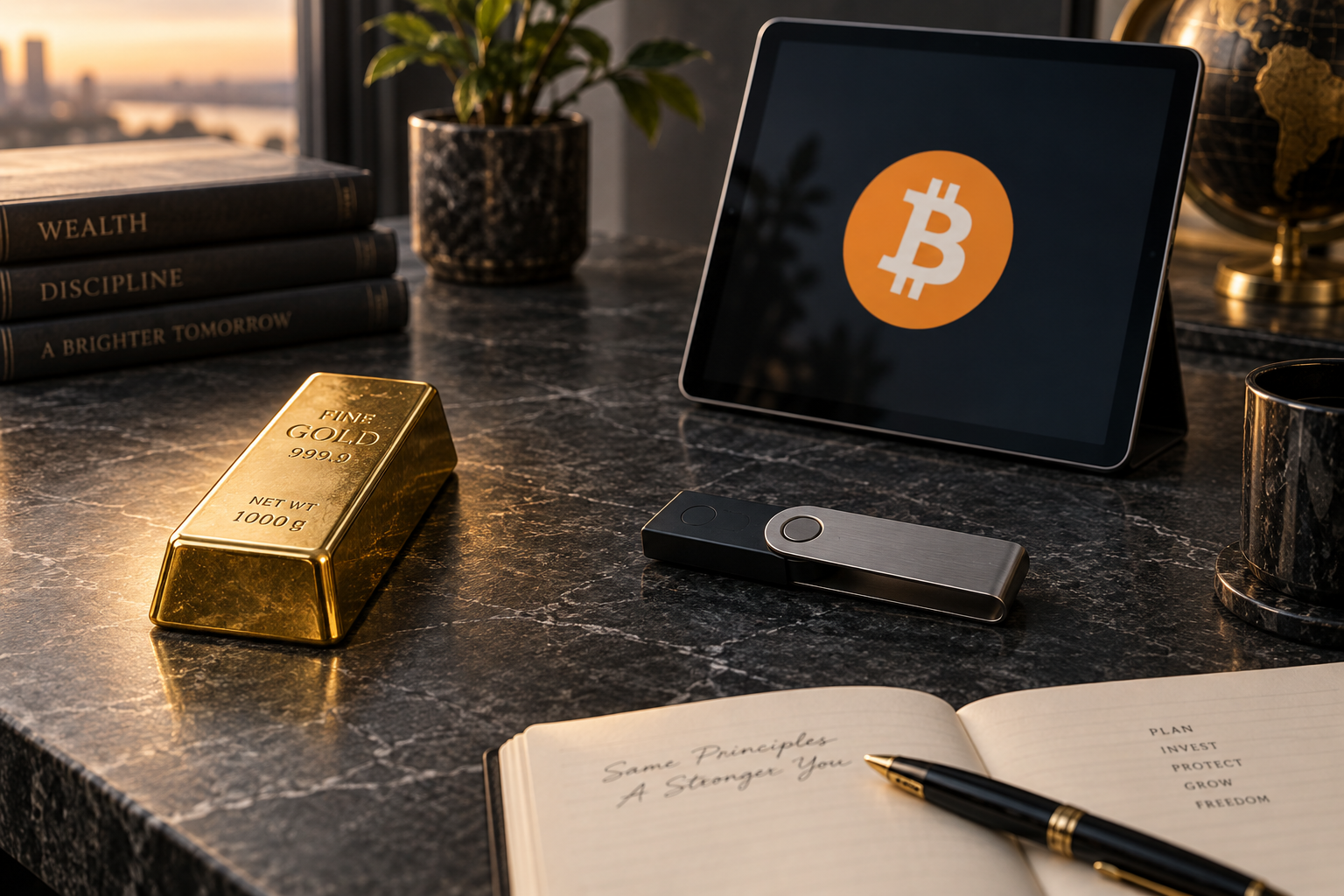
You work hard to build your savings.
Then inflation reduces what those savings can buy. Markets become unsettled. Government borrowing makes headlines. Someone tells you to buy gold.
Someone else says Bitcoin is the better answer.
Both describe their preferred asset as protection.
But protection from what?
A rising grocery bill? A stock-market decline? A weaker currency? A banking disruption? The fear of missing another rally?
Those are different problems.
The gold vs Bitcoin 2026 debate becomes much more useful when you begin with the financial problem you want to solve.
Gold has a long history as a store of value and reserve asset. Bitcoin offers a digitally transferable asset with a limited issuance schedule under its current rules.
Neither guarantees that the money you invest today will retain its value when you need it.
The practical question is how each might fit into your finances—and how much uncertainty you can afford along the way.
Gold vs Bitcoin 2026: Start With the Job You Need Done
Before comparing returns, decide what “protecting wealth” means for you.
You may want to preserve money needed next month. You may want an investment that behaves differently from your stocks. Or you may want exposure to an asset whose supply is not determined by a central bank.
One asset does not necessarily perform all those jobs well.
| Financial objective | Main requirement | Question to ask |
|---|---|---|
| Emergency savings | Reliable access and limited short-term value changes | Can I cover an unexpected bill without selling at a loss? |
| Long-term diversification | Different sources of risk and return | Does this improve my overall portfolio? |
| Purchasing-power protection | Returns that keep pace with costs over time | What happens after inflation, fees, and taxes? |
| Speculative growth | Willingness and ability to absorb losses | Can I afford a disappointing outcome? |
| Direct ownership outside a brokerage | Secure storage and practical access | Can I manage custody responsibly? |
That first row deserves particular attention.
An investment can be attractive over a long period and still be unsuitable for next month’s rent.
Why Gold and Bitcoin Get Compared
Both appeal to investors concerned about the purchasing power of conventional currencies.
Neither is a share in an operating business. Neither directly promises a dividend or interest payment simply because you hold it.
Their investment returns depend primarily on what other buyers will pay, after ownership costs.
But their similarities have limits.
Gold is a physical commodity with investment, jewelry, and industrial uses. Bitcoin is a digital asset whose value depends on demand, network confidence, access, and continued adoption.
Gold supply responds to mining and recycling. Bitcoin’s issuance follows its protocol rules.
Scarcity can support an investment argument.
It does not establish the price you should pay.
Gold vs Bitcoin 2026: The Main Differences
| Feature | Gold | Bitcoin |
|---|---|---|
| Form | Physical metal or exposure through financial products | Digital asset or exposure through financial products |
| Track record | Centuries of monetary and investment use | Much shorter market history |
| Price behavior | Can experience substantial declines | Has experienced especially large price swings |
| Natural cash income | None from bullion itself | None from simply holding Bitcoin |
| Direct ownership | Requires authentication and secure physical storage | Requires secure management of digital access |
| Trading access | Depends on dealer, market, or investment product | Direct markets generally operate continuously; brokerage products have trading hours |
| Ownership costs | Dealer spreads, storage, insurance, or product fees | Trading spreads, transaction costs, custody, or product fees |
| Key decision | Whether its diversification role justifies the cost and allocation | Whether potential benefits justify substantial price and operational risk |
The choice is not necessarily either-or.
Some investors hold both. Others reasonably hold neither.
The right answer depends on the rest of the portfolio and the purpose of the money.
Gold Can Help Diversify Without Being Stable
Gold’s reputation can make it sound calmer than its price actually is.
A long history does not prevent a sharp decline or an extended period of disappointing returns.
Its price can respond to interest rates, currency movements, investor demand, and expectations about economic conditions.
That means gold can fall while inflation remains uncomfortable.
It can also be sold during market stress when investors need cash.
A potential diversifier does not have to rise every time another asset falls. What matters is how it behaves across different conditions and how that affects the whole portfolio.
Avoid confusing a useful role with a guarantee.
Bitcoin’s Scarcity Does Not Guarantee Its Purchasing Power
Bitcoin’s limited supply is central to its investment story.
But supply alone cannot determine value.
Demand can rise or fall. Access can change. Investors can become more or less willing to hold a volatile asset.
A scarce asset can still be expensive at the price you pay.
The SEC’s investor bulletin on Bitcoin exchange-traded products emphasizes that Bitcoin remains highly speculative even when accessed through an exchange-traded product.
A brokerage wrapper can simplify ownership. It does not remove the underlying price risk.
That distinction matters if you are considering Bitcoin because buying it has become more convenient.
Ease of access and financial suitability are separate questions.
A Store-of-Value Argument Needs a Time Horizon
Suppose you invest $10,000 to preserve purchasing power.
The investment falls 30% before recovering several years later.
If you can hold through that period, the eventual outcome may meet your goals.
If you need the money during the decline, you have only $7,000 available before selling costs and taxes.
The long-term argument cannot pay the short-term bill.
What different declines do to $10,000
| Decline | Value remaining | Gain needed to recover |
|---|---|---|
| 10% | $9,000 | About 11.1% |
| 20% | $8,000 | 25% |
| 30% | $7,000 | About 42.9% |
| 50% | $5,000 | 100% |
| 70% | $3,000 | About 233.3% |
Mathematical illustrations, not forecasts for either asset. Fees and taxes excluded.
The recovery percentages explain why avoiding a forced sale matters.
Before investing, identify when you might need the money and what you would do if its value fell substantially.
Inflation Protection Is More Complicated Than the Label
An asset does not need to rise every month that consumer prices rise to provide some long-term purchasing-power protection.
However, calling something an “inflation hedge” can create unrealistic expectations.
What matters to your household is the return over your actual holding period, measured against your actual costs.
Consider a hypothetical investment that gains 5% over a year while the relevant cost of living rises 3%.
Its inflation-adjusted gain is approximately:
1.05 ÷ 1.03 − 1 = 1.94%.
Now consider a 15% investment loss with the same inflation increase.
The inflation-adjusted result is approximately:
0.85 ÷ 1.03 − 1 = −17.48%.
The asset’s reputation does not change that result.
For a closer look at purchasing power, see TWM’s inflation versus wage growth guide.
Do Not Build a Portfolio Around One Correlation Chart
Correlation measures how two sets of returns move together over a particular period.
The selected dates and measurement frequency matter.
Gold and Bitcoin moving together for several months does not make them interchangeable. Bitcoin moving differently from stocks for a period does not prove that relationship will persist during the next selloff.
A useful diversification decision considers several conditions and the reasons behind the behavior.
Also remember that low correlation does not mean low risk.
Two volatile assets can move independently while each exposes you to substantial losses.
Ask whether adding an asset improves your portfolio’s overall risk rather than simply making the holdings list longer.
How Much You Own Can Matter More Than Which You Choose
Suppose Bitcoin represents 5% of a $100,000 portfolio.
If that position falls 60%, the direct portfolio loss is $3,000, or 3%, assuming everything else stays unchanged.
If Bitcoin represents 30%, the same decline produces an $18,000 loss.
Position size changes the result
| Portfolio allocation | Starting position | Loss if position falls 60% | Direct portfolio decline |
|---|---|---|---|
| 2% | $2,000 | $1,200 | 1.2% |
| 5% | $5,000 | $3,000 | 3% |
| 10% | $10,000 | $6,000 | 6% |
| 30% | $30,000 | $18,000 | 18% |
Hypothetical stress test, not a recommended allocation or price forecast. Other holdings may also decline.
Use the same approach for gold with a range of possible losses.
Your allocation should reflect what a disappointing outcome would mean for your goals.
A percentage can look small until you translate it into rent payments, tuition, or years of saving.
Physical Gold: Understand the Full Buying and Selling Cost
Buying physical gold involves more than checking the quoted spot price.
You may pay a premium when purchasing and receive less than spot when selling. Storage, insurance, shipping, and authentication can add costs.
Consider a hypothetical item containing $2,000 worth of gold at the reference price.
You pay $2,100 after the purchase premium.
If the gold price stays unchanged and a dealer offers $1,960 to buy it back, your immediate loss would be $140, or about 6.7%.
Those figures are illustrative, not standard dealer terms.
Ask for both the selling price and the dealer’s current buyback terms before purchasing.
Also distinguish ordinary bullion from collectible coins. Collectible value introduces a different set of assumptions.
Bitcoin Custody: Decide Who Controls Access
Direct Bitcoin ownership requires a custody decision.
With self-custody, you are responsible for protecting the information needed to access and authorize transactions.
Losing that access can have serious consequences.
Using a custodian changes the arrangement. You rely on its systems, terms, and ability to provide access.
Neither choice should be treated casually.
Understand withdrawal procedures, account security, recovery arrangements, and what happens if the provider experiences problems.
A physical souvenir bearing the Bitcoin symbol is not Bitcoin itself.
The investment exists digitally; the ownership arrangement determines how you control it.
Exchange-Traded Products Change the Mechanics
A gold or Bitcoin product held in a brokerage account can make buying, selling, and recordkeeping more familiar.
But read what the product actually owns.
A bullion-backed gold product differs from a gold-mining stock fund. Mining companies also face operating costs, management decisions, debt, and business risks.
Similarly, direct Bitcoin exposure differs from a product using futures or shares in crypto-related businesses.
Review the prospectus, fees, trading spread, and how closely the product seeks to follow the underlying asset.
Owning shares in a product also does not necessarily entitle you to take delivery of metal or withdraw Bitcoin.
Choose the structure that matches the exposure you intend to buy.
Neither Asset Produces Income Just Because You Hold It
A bar of gold does not pay interest.
Bitcoin held without an additional arrangement does not generate a contractual yield.
If someone offers income on either asset, identify what creates that income.
The arrangement may involve lending, another counterparty, or additional investment activity.
That introduces risks beyond the asset’s own price.
Do not compare an advertised yield with an insured savings account as though the two arrangements provide the same protection.
For money assigned to near-term expenses, reliable access matters more than an exciting return story.
A Practical Decision Framework
Start by answering these questions in writing.
What job would this holding perform? Be specific about diversification, speculation, or direct ownership.
What loss could I absorb? Consider both your finances and your likely reaction.
When might I need the money? Use the earliest realistic date.
What will ownership cost? Include spreads, fees, storage, and applicable taxes.
How will I access or sell it? Understand the mechanics before buying.
What would make me change my mind? Identify evidence rather than relying on price excitement.
If the answers remain unclear, keeping the asset on a watchlist is a valid decision.
You do not lose the ability to build wealth by declining a purchase you do not understand.
Build the Financial Foundation First
Before adding either asset, review your essential bills, expensive debt, and accessible reserves.
A household with no emergency savings may need liquidity more urgently than an alternative investment.
That does not require reaching an arbitrary level of perfection before investing.
It means recognizing which problem creates the greatest immediate vulnerability.
TWM’s first $10,000 system provides a practical starting point for building that foundation.
A portfolio works better when ordinary emergencies do not force you to sell its most volatile holdings.
Your 30-Day Gold vs Bitcoin 2026 Review
| Timing | Action | Useful outcome |
|---|---|---|
| Week 1 | Define the purpose and review emergency reserves | Know whether the money can accept risk |
| Week 2 | Compare direct ownership and investment products | Understand costs and custody |
| Week 3 | Run loss scenarios for possible allocations | Translate volatility into dollars |
| Week 4 | Decide whether to invest and set review rules | Create a repeatable process |
If you choose to invest, decide how you will review the allocation.
A large gain can make a small position dominate the portfolio. A decline can tempt you to keep adding money without reconsidering the original assumptions.
Periodic reviews help keep the investment connected to its intended role.
Which One Actually Protects Wealth?
For a potential portfolio diversifier with a much longer history, gold generally has the stronger case.
For exposure to a scarce digital asset with substantial upside uncertainty and substantial downside risk, Bitcoin presents a different proposition.
For money needed soon, neither should be treated as a reliable substitute for accessible cash.
Those distinctions are more useful than declaring a universal winner.
The gold vs Bitcoin 2026 decision should begin with your goal, time horizon, ownership costs, and capacity for loss.
Before buying either, complete this sentence:
“I am adding this asset because it helps my financial plan by…”
If the answer is only that the price might rise, recognize the decision for what it is: a bet on future demand.
Then size it accordingly.
Looking for More Finance Topics?
Use the search box below to explore hundreds of articles on True Wealth Moves — we’ve probably already written about what you’re looking for.