
Your First $10,000 System: The Step-By-Step Wealth Blueprint for People Who Feel Stuck
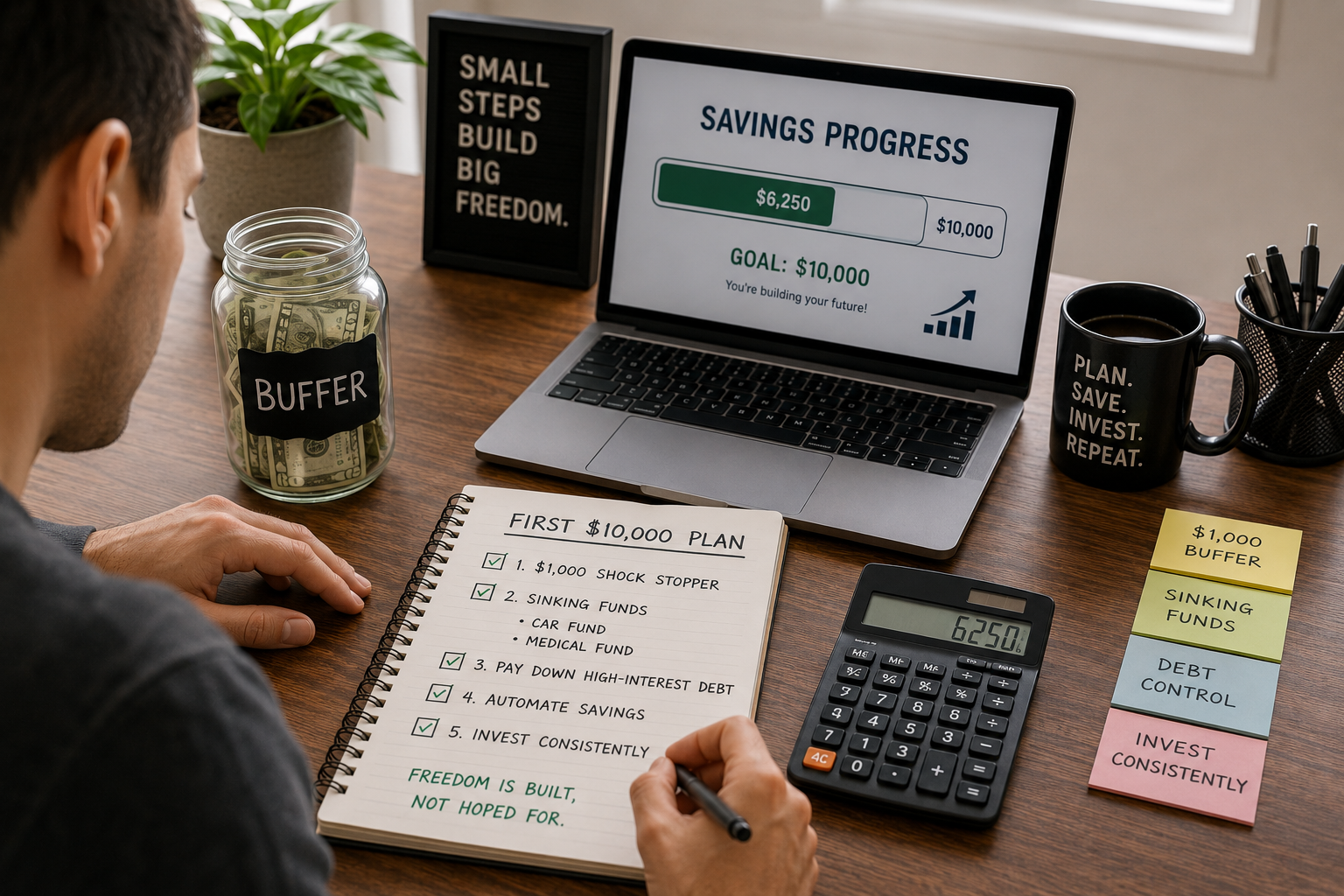
If you’ve ever looked at your bank account and thought, “I’m working, but I’m not moving,” you’re not lazy.
You’re stuck in what I call the “noise zone” — where life is loud, bills are constant, and money disappears without building anything.
That’s exactly why you need a first $10,000 system.
Not a motivational quote.
Not a “just stop buying coffee” lecture.
A system.
Because the first $10,000 is more than a number — it’s a turning point:
- it breaks the cycle of paycheck panic,
- it gives you options,
- and it creates the confidence that wealth is actually possible.
This post is your True Wealth Moves blueprint to get your first $10,000 (or your next $10,000) using a clear, repeatable system.
We’re going to cover:
- why the first $10,000 is psychologically harder than later wealth
- the 5 biggest reasons people stay stuck (even when they’re trying)
- the “3-bucket” system that makes saving real
- a step-by-step plan you can follow week-by-week
- a table roadmap you can screenshot
- and how to keep your progress from getting erased by one bad month
No shame.
No hustle fantasy.
Just a plan that works.
Why the first $10,000 feels so hard
Because early wealth-building is fighting three enemies at once:
1) No margin (every surprise hits hard)
2) High fixed costs (rent, insurance, car, subscriptions)
3) Behavioral fatigue (you’re tired of “trying” with no results)
Once you have savings, you can invest, handle emergencies, and avoid debt.
But before you have savings, one surprise expense can reset everything.
That’s why the first $10,000 system must focus on:
- margin
- stability
- and automation
Not willpower.
What the first $10,000 is for (so you don’t spend it emotionally)
The first $10,000 is not for “feeling rich.”
It’s for becoming stable.
Your first $10,000 should cover:
- a starter emergency buffer
- debt-proofing your month (so you stop using credit cards for surprises)
- sinking funds for predictable pain (car repairs, medical, insurance renewals)
- and the foundation of investing consistency
This is how you stop rebuilding from zero.
The 5 reasons people stay stuck (even when they try)
Let’s name the real reasons.
1) Their money is leaking through tiny spending
Not one big purchase — 50 small ones:
snacks, apps, delivery fees, impulse buys.
2) Their fixed costs are too high for their income
Rent, car note, insurance, subscriptions.
If fixed costs are oversized, saving becomes impossible.
3) They don’t have a system (only intentions)
Intentions are fragile.
Systems are durable.
4) They save “what’s left” instead of paying themselves first
What’s left is usually nothing.
5) Their progress keeps getting erased
A car repair, medical bill, premium increase — and boom, back to $0.
The first $10,000 system solves all five.
The True Wealth Moves “First $10,000 System” (3 buckets)
You’re going to build your first $10,000 using three buckets:
Bucket 1: Stability (Emergency buffer)
Bucket 2: Predictable pain (Sinking funds)
Bucket 3: Growth (Investing consistency)
Most people skip bucket 2.
That’s why they keep resetting.
Because life is predictable:
insurance renewals, car maintenance, medical costs, school expenses.
Those aren’t emergencies — they’re calendar events.
Step-by-step: How to build your first $10,000
Let’s make it real.
Step 1: Find your monthly gap (the number you avoid)
Your gap is what you could save if you stopped leaking money.
Quick method:
Look at the last 30 days and identify:
- subscriptions and recurring junk
- delivery fees
- convenience spending
- impulse purchases
Most people find $150–$400/month without changing their personality.
Just by cutting autopilot spending.
Step 2: Do the fixed-cost lockdown (this is where the big savings live)
You don’t get to $10,000 on coffee cuts alone if your fixed costs are bloated.
Your fixed-cost lockdown targets:
- auto insurance re-shop
- phone/internet plan reduction
- subscription purge
- car payment pressure (refi or downgrade if needed)
This is how you create real breathing room.
Step 3: Automate a weekly transfer (small beats perfect)
Automation is everything.
Start with:
$25/week if money is tight.
$50–$100/week if you can.
Then increase every 30 days.
You’re building the habit and identity of saving.
Step 4: Build the $1,000 shock stopper first
Your first milestone is not $10,000.
It’s $1,000.
Because $1,000 stops the most common financial spiral:
surprise expense → credit card → interest → stress → no saving.
So you build $1,000 first, then scale.
Step 5: Create sinking funds for predictable expenses
Once you have $1,000:
you stop pretending surprises are emergencies.
Create 2 sinking funds:
- Car fund
- Medical fund
Even $25/week split between them reduces future damage.
This step prevents the reset.
Step 6: Attack high-interest debt (but don’t kill your buffer)
If you carry high APR debt, you still build savings — because savings prevents relapse.
The right order for many people:
- build $1,000 buffer
- then pay down high APR debt
- while continuing small savings
You’re building stability + progress at the same time.
Step 7: Start investing consistency (even small)
Once you have the buffer and sinking funds started,
you begin investing consistently.
Because wealth requires growth.
But growth requires stability first.
Even $25/week invested consistently builds confidence and momentum.
The table roadmap: first $10,000 system
First $10,000 system table roadmap showing milestones, where money goes, and what each milestone protects
| Milestone | Target | Where the money goes | What it protects |
|---|---|---|---|
| Phase 1 | $1,000 | Emergency shock stopper | Stops credit card emergencies |
| Phase 2 | $2,500 | Add car + medical sinking funds | Prevents monthly resets |
| Phase 3 | $5,000 | Expand sinking funds + buffer | Handles real-life surprises calmly |
| Phase 4 | $7,500 | Debt payoff acceleration + investing consistency | Builds progress + confidence |
| Phase 5 | $10,000 | Full stability stack + growth lane | Options, resilience, wealth momentum |
This is the simplest way to stop feeling stuck.
The 30-day plan (for immediate momentum)
If you want to feel progress fast, do this:
Week 1:
- cancel 3 subscriptions
- set weekly auto transfer
Week 2:
- shop auto insurance
- lower phone/internet if possible
Week 3:
- plan groceries (cut leaks)
- start a car sinking fund
Week 4:
- save a “no spend weekend”
- put the savings into your buffer
Momentum is a wealth strategy.
One evergreen external link
Use the CFPB emergency fund guide (evergreen, practical, consumer authority):
https://www.consumerfinance.gov/an-essential-guide-to-building-an-emergency-fund/
Two True Wealth Moves internal links (exactly two)
https://truewealthmoves.com/wealth-blog/
https://truewealthmoves.com/resources/
Final truth
The first $10,000 isn’t about being perfect.
It’s about being consistent.
Build the shock stopper.
Build sinking funds.
Lock down fixed costs.
Automate saving.
Start investing small.
That’s how people who feel stuck start moving — and keep moving.






2 Comments