
US Consumer Debt 2026: The $18.25 Trillion Problem—and Why Credit Cards Are Quietly Taking Over Household Budgets
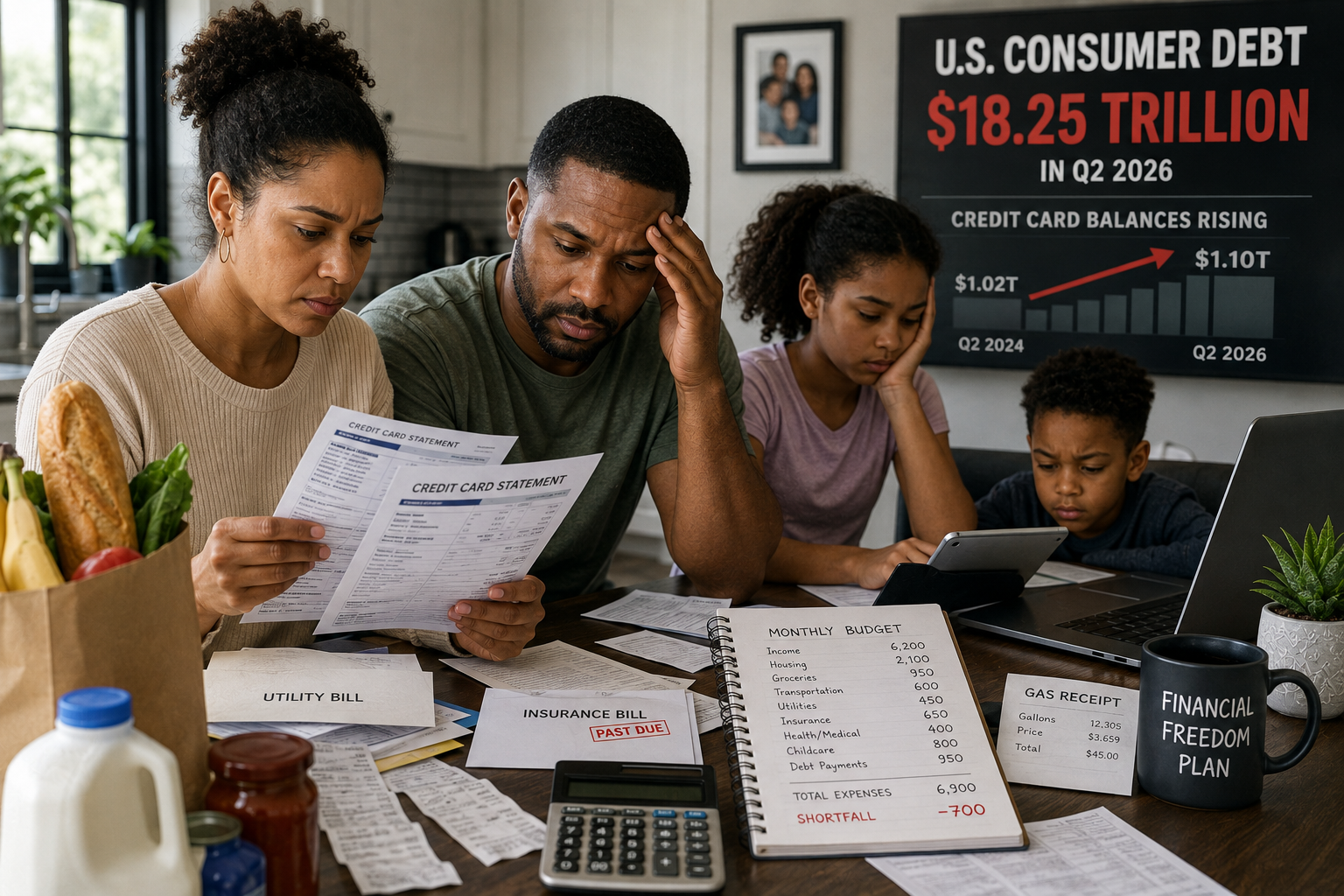
Something important is changing inside the American household budget.
It is not simply that Americans owe more money.
Americans have carried mortgages, auto loans, student loans and credit-card balances for decades.
The more worrying change is what kind of debt is growing—and why people appear to be using it.
New second-quarter data from Equifax shows total U.S. consumer debt reaching approximately $18.25 trillion in Q2 2026, roughly $400 billion higher than a year earlier.
Mortgages still represent the overwhelming majority of that debt.
But one category deserves special attention:
Revolving credit-card debt.
Equifax reports bankcard balances of approximately $1.1 trillion, up about 8.2% from roughly $1.02 trillion in June 2024.
That growth has outpaced inflation over the same period.
And that creates a very different personal-finance problem.
People are not necessarily borrowing only to:
- Buy homes
- Attend college
- Purchase vehicles
- Build businesses
More households may increasingly be using revolving credit simply to make monthly budgets work.
Groceries.
Gas.
Insurance.
Utilities.
Childcare.
Medical expenses.
Ordinary household purchases that used to come directly from checking accounts are easier to put on credit cards when income does not stretch far enough.
At first, this can feel harmless.
You charge $300 this month.
You tell yourself you will catch up next month.
But next month brings another insurance bill.
Another grocery run.
Another utility payment.
Another tank of gas.
Soon, the problem is no longer:
“I made a few expensive purchases.”
It becomes:
“My normal lifestyle now requires borrowed money.”
That is the hidden danger behind US consumer debt 2026.
This article is not another generic lecture telling people to “stop using credit cards.”
Credit cards themselves are not automatically the problem.
The bigger question is whether credit is becoming part of your household operating budget.
Because when debt moves from financing occasional purchases to financing normal living expenses, something fundamental has changed.
This guide will show you:
- What the $18.25 trillion debt number actually means
- Why credit-card balances deserve special attention
- How to identify “budget dependence” on credit
- Why minimum payments can hide the problem
- How high interest turns temporary shortages into long-term debt
- Which debt should concern you most
- How to build a credit-dependence exit plan
- When balance transfers and consolidation make sense
- How to protect your credit score during payoff
- The 12-month TWM household debt reset
No shame.
No moralizing.
Just the math.
US Consumer Debt 2026: What Does $18.25 Trillion Actually Mean?
The headline number is enormous.
$18.25 trillion.
It is difficult to relate a number that large to one household.
So first, understand what it represents.
Consumer debt includes major categories such as:
- Mortgages
- Home equity borrowing
- Auto loans
- Credit cards
- Student loans
- Personal loans
- Other consumer credit
Mortgage debt remains the largest category by far.
That is important because not all debt has the same financial meaning.
A $300,000 mortgage on a home is fundamentally different from a $20,000 credit-card balance created by groceries and everyday spending.
Both are liabilities.
But:
- The interest rates differ
- The repayment periods differ
- The assets behind them differ
- The reasons for borrowing differ
- The financial risk differs
This is why the total debt number is only the beginning of the story.
The composition of US consumer debt 2026 matters more.
And revolving credit deserves close attention because credit cards are among the most expensive forms of mainstream household borrowing.
Credit-Card Debt Is Different From Most Household Debt
A mortgage usually:
- Has a fixed repayment schedule
- Finances a long-lived asset
- Carries a lower interest rate than credit cards
- Has a defined maturity
An auto loan generally:
- Finances a specific vehicle
- Has a fixed payment
- Has a scheduled payoff date
A credit card is different.
It is revolving.
You can:
- Borrow
- Repay
- Borrow again
- Carry a balance indefinitely
There may be no natural stopping point.
And minimum payments can create the illusion that the debt is affordable.
Suppose you owe:
$10,000
At:
24% APR
Your approximate first-year interest, if the balance stayed near $10,000, could approach:
$2,400
That is $200 per month simply for the privilege of carrying the debt.
You could pay:
$350 every month
and still make surprisingly slow progress if new purchases continue entering the account.
That is why credit-card debt becomes especially dangerous when it is used to cover ongoing living costs.
You are not paying for one past purchase.
You are financing a lifestyle gap.
The Real Problem: Credit Is Becoming Part of the Monthly Budget
Imagine this household.
Monthly take-home income:
$6,000
Normal monthly expenses:
$6,400
Shortfall:
-$400
The family does not immediately feel a crisis because they have available credit.
So the $400 gap goes onto a card.
Month 1:
$400
Month 2:
$800
Month 3:
$1,200
After one year, before interest:
$4,800
Now add interest.
The family may believe:
“We have a credit-card problem.”
But the credit card did not create the original problem.
The original problem was:
Expenses exceeded income by $400 every month.
The card simply allowed the household to postpone confronting it.
This distinction matters enormously.
If you pay off the $4,800 balance but leave the $400 monthly deficit unchanged, the debt will return.
That is why the first step is not always “pay debt faster.”
The first step is:
Stop creating new debt.
US Consumer Debt 2026 and the Credit Dependence Test
Ask yourself these questions.
1. Do you regularly use credit cards for groceries because checking is low?
Using a rewards card for groceries and paying it in full is different.
The warning sign is needing the card because cash is unavailable.
2. Do you carry purchases into the next month?
If normal monthly spending cannot be fully covered when the statement arrives, your budget may already depend on credit.
3. Do you make a payment and immediately reuse the available credit?
Example:
You pay:
$800
Then spend:
$700
Your balance technically decreased.
But your debt barely changed.
4. Do you wait for payday before making minimum payments?
This can indicate little financial margin.
5. Are everyday expenses increasing your balance?
Watch for:
- Food
- Fuel
- Utilities
- Insurance
- Medication
- Childcare
6. Would one broken appliance force you to borrow?
If yes, the household may need a starter emergency fund before aggressive debt payoff.
7. Do you know the exact balance of every card?
Avoidance itself can be a warning sign.
If you answered yes to several questions, the problem may be larger than individual purchases.
You may be experiencing credit dependence.
US Consumer Debt 2026: The Household Debt Traffic-Light Test
| Situation | Status | What it means |
|---|---|---|
| Card used for rewards and paid in full monthly | Green | Credit is functioning primarily as a payment tool |
| Occasional balance after emergency | Yellow | Manageable if repayment plan is clear |
| Balance carried for several months | Orange | Interest is beginning to undermine cash flow |
| Normal living expenses charged because cash is unavailable | Red | Household budget may depend on borrowing |
| New debt added while making only minimum payments | Red | Balance can become structurally difficult to escape |
| Multiple cards used to create available room | Critical | Household may need immediate budget restructuring |
US consumer debt 2026 credit dependence test showing green, yellow, orange and red warning levels for household credit-card use.
The goal is not to make someone feel guilty.
The goal is to identify the problem early enough to fix it.
Why Minimum Payments Hide the Real Cost
Credit-card statements make large debt balances psychologically manageable by showing small minimum payments.
Imagine:
Balance:
$12,000
Minimum payment:
$360
The brain sees:
“I only need $360 this month.”
But the correct number is:
$12,000 owed at a potentially very high interest rate.
The minimum payment is not the cost of the debt.
It is the amount required to keep the account current.
If you pay only the minimum:
- Interest continues
- Repayment can take years
- Total interest can become enormous
- New spending can erase progress
Minimum payments are designed for account maintenance.
They are not a wealth-building strategy.
The Interest Snowball
Consider two people who both owe $10,000.
Person A
Interest rate:
10%
Approximate annual interest at a constant balance:
$1,000
Person B
Interest rate:
25%
Approximate annual interest:
$2,500
Same debt balance.
Completely different financial burden.
That is why every debt plan should list APRs.
Do not organize debt only by balance.
Create this table:
| Debt | Balance | APR | Minimum payment |
| Card A | $3,500 | 29.99% | $120 |
| Card B | $7,000 | 24.49% | $210 |
| Personal loan | $9,000 | 11.5% | $290 |
| Auto loan | $22,000 | 6.5% | $430 |
US consumer debt 2026 debt inventory showing balances, APRs and minimum monthly payments.
Now you can see where money is burning fastest.
Good Debt vs Bad Debt Is Too Simple
You have probably heard:
“Mortgage debt is good debt.”
“Credit cards are bad debt.”
Reality is more complicated.
Debt should be judged by several factors:
- Interest rate
- Purpose
- Repayment ability
- Asset financed
- Opportunity created
- Term
- Household cash flow
A mortgage can become dangerous when the payment consumes 60% of take-home income.
A credit card can be harmless when used for rewards and paid in full.
A student loan may finance a career with strong income growth.
A personal loan may eliminate even more expensive credit-card debt.
Instead of asking:
“Is this good debt or bad debt?”
Ask:
“Does this debt improve or weaken my future cash flow?”
That is a better test.
The Most Dangerous Debt Is Debt That Keeps Rebuilding
Suppose you receive a tax refund and pay:
$5,000
toward a credit card.
Huge progress.
Six months later, the balance is:
$4,200
again.
You may conclude:
“I am terrible with money.”
Not necessarily.
Investigate why the debt returned.
Was it:
- Lifestyle overspending?
- Medical bills?
- Car repairs?
- Housing costs?
- Income reduction?
- Food inflation?
- Childcare?
- Lack of emergency savings?
Payoff events do not fix structural budget problems.
Before sending every available dollar to debt, determine whether your monthly cash flow is positive.
Create the Household Cash-Flow Number
Use:
Monthly take-home income − required monthly expenses = monthly margin
Example:
Income:
$6,200
Expenses:
$5,950
Margin:
$250
Positive.
Now suppose expenses are:
$6,450
Margin:
-$250
That household cannot sustainably pay down debt yet.
Why?
Because every month creates another $250 deficit.
Before aggressive payoff begins, the family needs to:
- Reduce expenses
- Increase income
- Or both
Debt payoff without cash-flow repair is like emptying water from a boat without fixing the leak.
Step 1: Stop Adding New Debt
This sounds obvious.
But it is the hardest part.
If possible, move recurring everyday expenses back to:
- Checking
- Debit
- Cash
Not because debit cards are inherently better.
The purpose is to force the monthly budget to operate on actual income.
If you cannot cover normal spending without credit, identify the shortage immediately.
Do not hide it.
Step 2: Build a Small Emergency Buffer
Some people try to pay debt with absolutely no savings.
Then:
- Tire blows
- Child gets sick
- Appliance breaks
Back to the credit card.
Consider maintaining a starter emergency reserve before sending every extra dollar to debt.
Possible initial targets:
- $1,000
- One insurance deductible
- One month of basic expenses
The right amount depends on your situation.
The point is to prevent predictable emergencies from reversing payoff progress.
Step 3: Choose Avalanche or Snowball
There are two popular payoff methods.
Debt Avalanche
Pay minimums on everything.
Send all extra money to the highest APR.
Mathematically, this usually minimizes interest.
Example order:
- 29.99%
- 24.49%
- 18%
- 10%
Debt Snowball
Pay minimums on everything.
Attack the smallest balance first.
This may provide faster psychological victories.
Example:
- $800
- $2,000
- $5,000
- $11,000
Which is best?
The one you will actually finish.
If motivation is not a problem, avalanche is generally stronger mathematically.
If quick wins help you stay consistent, snowball may be useful.
The Hybrid Method
TWM readers can also use a hybrid.
Example:
You have:
- $600 card at 18%
- $5,000 card at 29%
- $9,000 card at 23%
Pay off the $600 card quickly.
You get:
- One account gone
- One minimum payment eliminated
- Psychological momentum
Then switch to the highest-rate debt.
Personal finance should use math and human behavior.
Not one at the expense of the other.
Balance Transfers: Helpful Tool or Delayed Problem?
A 0% balance-transfer offer can be useful.
Suppose you transfer:
$8,000
Transfer fee:
3%
Fee:
$240
Total balance:
$8,240
Promotional period:
18 months
Required monthly payment to eliminate it:
$8,240 ÷ 18 = approximately $458
If you can pay approximately $458 monthly, the transfer could save significant interest.
But it becomes dangerous when someone:
- Transfers the debt.
- Keeps the original card.
- Begins spending on the original card again.
- Ends with two balances.
A balance transfer changes where debt lives.
It does not eliminate debt.
Use one only with a written payoff plan.
Personal Loans and Consolidation
Debt consolidation may reduce:
- Interest rate
- Number of payments
- Financial complexity
But compare:
- APR
- Origination fee
- Loan term
- Total interest
- Monthly payment
A lower monthly payment can be misleading when it comes from extending the loan for many additional years.
Example:
Current payment:
$600
New consolidated payment:
$350
Feels better.
But if the new loan runs much longer, total interest may still be significant.
Always compare total repayment cost.
US Consumer Debt 2026 and Buy Now, Pay Later
Credit dependence does not appear only on traditional credit cards.
Households increasingly encounter installment options at checkout.
A purchase becomes:
“Only four payments of $47.”
The smaller payment can hide total spending.
Three different purchases may create:
- $47 payment
- $65 payment
- $80 payment
Total:
$192 every cycle
Soon, future paychecks are already committed before they arrive.
Treat all installment payments as debt.
Track them in one place.
If you cannot easily list every obligation attached to next month’s paycheck, you may be overextended.
Protect Your Credit Score While Paying Down Debt
Debt payoff can improve your financial position substantially.
To protect your credit profile during the process:
Never miss payments
Payment history is extremely important.
Set automatic minimum payments as a backup.
Reduce utilization
Credit utilization generally improves as revolving balances fall.
Avoid unnecessary new applications
Do not open several accounts impulsively.
Keep old accounts thoughtfully
Paying off a card does not automatically mean you must close it.
However, if an open card creates serious spending temptation, behavioral protection may matter more than maximizing a scoring strategy.
Review credit reports
Look for:
- Incorrect balances
- Unknown accounts
- Payment errors
- Fraud
Your credit score is useful.
But remember:
The goal is not building a perfect score while remaining deeply in debt.
The goal is building financial strength.
The Credit-Card Payoff Math
Suppose:
Balance:
$15,000
APR:
24%
Now compare different payment levels.
| Monthly payment | Approximate effect |
| Minimum only | Very slow payoff and substantial interest |
| $500 | Meaningful progress but still long repayment |
| $750 | Faster principal reduction |
| $1,000 | Much more aggressive payoff |
| $1,500 | Potentially dramatic interest savings |
US consumer debt 2026 credit-card payoff table showing how larger monthly payments accelerate debt elimination.
Exact payoff periods depend on:
- APR
- Minimum-payment formula
- New purchases
- Compounding
- Fees
Use an actual debt calculator for precise results.
The principle remains:
Every extra dollar sent to high-interest principal prevents future interest from being charged on that dollar.
Do Not Drain Retirement Accounts Automatically
Debt can feel so uncomfortable that people consider cashing out:
- 401(k)
- IRA
- Other retirement investments
Be cautious.
Early withdrawals can involve:
- Taxes
- Potential penalties
- Lost future compounding
- Permanent reduction in retirement assets
High-interest debt is serious.
But raiding retirement money can create another long-term problem.
Review alternatives first.
Income May Be the Missing Piece
You can only cut so far.
If the household budget remains negative after reasonable reductions, the long-term solution may require more income.
Options may include:
- Salary negotiation
- Changing employers
- Overtime
- Freelance work
- Selling unused items
- Temporary side income
- Skill development
- Reducing underused assets
But avoid creating side-hustle burnout.
The goal is a temporary or sustainable income boost that helps close the deficit—not working 90 hours weekly forever.
The TWM Credit Dependence Exit Plan
Phase 1: Stabilize
Goals:
- Stop balance growth
- Make all minimum payments
- Create starter emergency savings
- Track every debt
Phase 2: Create Margin
Reduce or renegotiate:
- Insurance
- Phone
- Internet
- Subscriptions
- Dining
- Transportation expenses
Increase income where appropriate.
Target:
Positive monthly cash flow.
Phase 3: Attack
Choose:
- Avalanche
- Snowball
- Hybrid
Automate extra principal payments.
Phase 4: Protect
As debt falls:
Do not immediately increase lifestyle spending.
Redirect former payments to:
- Emergency fund
- Retirement
- Investments
- Sinking funds
The payment that made the credit-card company wealthy can eventually make you wealthy.
The $800 Debt Payment Transformation
Imagine you eventually eliminate debt that required:
$800 monthly
Do not let the $800 disappear.
Redirect:
$300 → Emergency/sinking funds
$300 → Retirement/investing
$100 → Future large purchases
$100 → Lifestyle
Annual wealth-building contribution:
Savings/investment portion:
$700 × 12 = $8,400
The debt payoff does more than eliminate interest.
It releases cash flow.
That is where the real transformation begins.
Create Sinking Funds So Debt Does Not Return
Many “emergencies” are not actually unexpected.
You know eventually you will need:
- Tires
- Car repairs
- Home repairs
- Medical expenses
- Holidays
- School supplies
- Insurance deductibles
Create sinking funds.
Example:
Annual car maintenance:
$1,200
Monthly sinking fund:
$100
Annual holiday spending:
$1,800
Monthly fund:
$150
Insurance deductible reserve:
$1,500
Build gradually.
Sinking funds convert future emergencies into planned expenses.
That keeps purchases off credit cards.
US Consumer Debt 2026: The 12-Month Household Reset
Months 1–3: Stop the Bleeding
- List every debt
- Record every APR
- Stop new revolving balances
- Build starter emergency savings
- Find monthly deficit
Months 4–6: Create Margin
- Renegotiate recurring expenses
- Increase income if needed
- Choose payoff method
- Automate payments
Months 7–9: Accelerate
Use:
- Bonuses
- Tax refunds
- Extra income
- Sale of unused items
toward principal when appropriate.
Months 10–12: Build the Replacement System
Begin funding:
- Emergency savings
- Car maintenance
- Medical expenses
- Holidays
- Home repairs
The goal is not merely becoming debt-free.
It is becoming debt-resistant.
Why Falling Delinquencies Do Not Mean Everyone Is Fine
One interesting feature of current credit data is that some delinquency measures have stabilized or improved even while total balances remain very large.
That is good news.
But do not interpret it as:
“Consumer debt is no longer a problem.”
A borrower does not need to be delinquent to be financially stressed.
Someone can:
- Make every payment on time
- Have a 750 credit score
- Carry $25,000 in revolving debt
- Have almost no emergency savings
Technically current.
Financially fragile.
Delinquency tells us whether payments are late.
It does not tell us whether the household is building wealth.
External Resource
Review Equifax’s Q2 2026 U.S. Consumer Credit Trends report for the latest data on total consumer debt, bankcard balances and delinquency trends:
Continue Building Your Financial Knowledge
Read more practical debt, saving and wealth-building strategies on the True Wealth Moves blog:
https://truewealthmoves.com/wealth-blog
Use the True Wealth Moves resources page for financial tools, guides and calculators:
Final Verdict: US Consumer Debt 2026 Is Really a Household Cash-Flow Warning
The $18.25 trillion US consumer debt 2026 number is enormous.
But the headline alone is not what concerns me most.
Mortgages account for the majority of American consumer debt.
The more important personal-finance warning is the continuing growth of revolving credit.
Bankcard debt has increased substantially in recent years and is now around the trillion-dollar level in major consumer-credit datasets.
That does not automatically mean every borrower is in trouble.
Many households use credit responsibly and pay balances in full.
The warning sign is different:
When borrowed money becomes necessary to maintain ordinary life.
When groceries require debt.
When gas requires debt.
When utility bills require debt.
When a credit-card payment creates available room that immediately gets spent again.
At that point, the issue is no longer merely a credit-card balance.
It is a household cash-flow problem.
The solution is not shame.
It is a system.
Remember the order:
- Find the monthly deficit.
- Stop adding new revolving debt.
- Build a small emergency buffer.
- Renegotiate major recurring expenses.
- Increase income when cutting is no longer enough.
- Attack high-interest debt systematically.
- Create sinking funds.
- Redirect former debt payments into wealth.
Do not make becoming debt-free the only goal.
Become debt-resistant.
Build enough margin that your normal life no longer depends on borrowing from next month’s paycheck.
That is the True Wealth Moves conclusion:
The most dangerous credit-card balance is not the biggest one. It is the balance your household cannot stop rebuilding.
Looking for More Finance Topics?
Use the search box below to explore hundreds of articles on True Wealth Moves — we’ve probably already written about what you’re looking for.





