
Reselling Blueprint 2026: How to Flip Items Safely (Fees, Returns, and Profit Math)
Reselling sounds simple:
“Buy low, sell high.”
But most beginners don’t lose money because they can’t find an item to sell.
They lose money because they don’t understand the hidden killers:
- platform fees,
- shipping costs,
- returns,
- scams,
- and pricing mistakes that erase profit.
So this post is your True Wealth Moves Reselling Blueprint — a safe, realistic plan for flipping items using:
- Amazon (carefully),
- and local marketplaces (Facebook Marketplace/OfferUp/Nextdoor),
without turning your money into chaos.
We’ll cover:
- the smartest categories to flip (and the riskiest ones)
- how to calculate profit the right way (so you don’t “think” you made money)
- how to avoid returns and chargebacks
- how to price items so they sell without racing to the bottom
- the exact listing and negotiation scripts that work
- and the 30–60–90 day plan to build a small reselling income stream
No scams.
No fake “$10k a month” promises.
Just a repeatable system.
Reselling vs flipping vs arbitrage (quick clarity)
People use these words differently, so let’s define them:
- Reselling: selling items you already own, or sourcing locally and reselling.
- Flipping: same idea, but usually implies finding undervalued items and selling for profit quickly.
- Arbitrage: buying from one place and selling on another for a margin (riskier on Amazon).
True Wealth Moves rule:
Start with reselling what you already own.
That gives you profit with the least risk.
The #1 rule: profit is not what’s left in your PayPal
Real profit is what remains after:
- platform fees
- shipping and packaging
- taxes (depending on volume)
- returns
- your time cost (optional, but honest)
- and “dead inventory” (items that never sell)
If you don’t count all of that, you don’t know if you’re actually profiting.
The best beginner strategy: start locally, then scale
Amazon can be powerful, but it’s not beginner-friendly the way influencers imply.
Amazon has:
- stricter buyer expectations
- higher return risk
- policy complexity
- and account risk if you mess up
Local marketplaces are simpler:
- cash-based
- no shipping
- fewer fees
- faster learning
So your best path is:
Local first → proof of profit → then expand.
What to flip: the “low-return, high-demand” categories
Beginners should target items that are:
- easy to test
- easy to photograph
- easy to explain
- hard to dispute
- and cheap to store
Great beginner categories:
- small household appliances (tested)
- furniture (local pickup only)
- baby gear (clean, safe, branded, in good condition)
- tools (working, branded)
- kitchen equipment (working, clean)
- sealed items (but avoid restricted categories)
- sports equipment (seasonal, high demand)
- home organization items
Risky categories for beginners:
- high-end electronics (returns/scams)
- luxury items (authenticity disputes)
- cosmetics (restricted and trust issues)
- anything “used but untestable”
- branded items that trigger IP complaints on Amazon
True Wealth Moves rule:
If you can’t test it, don’t sell it.
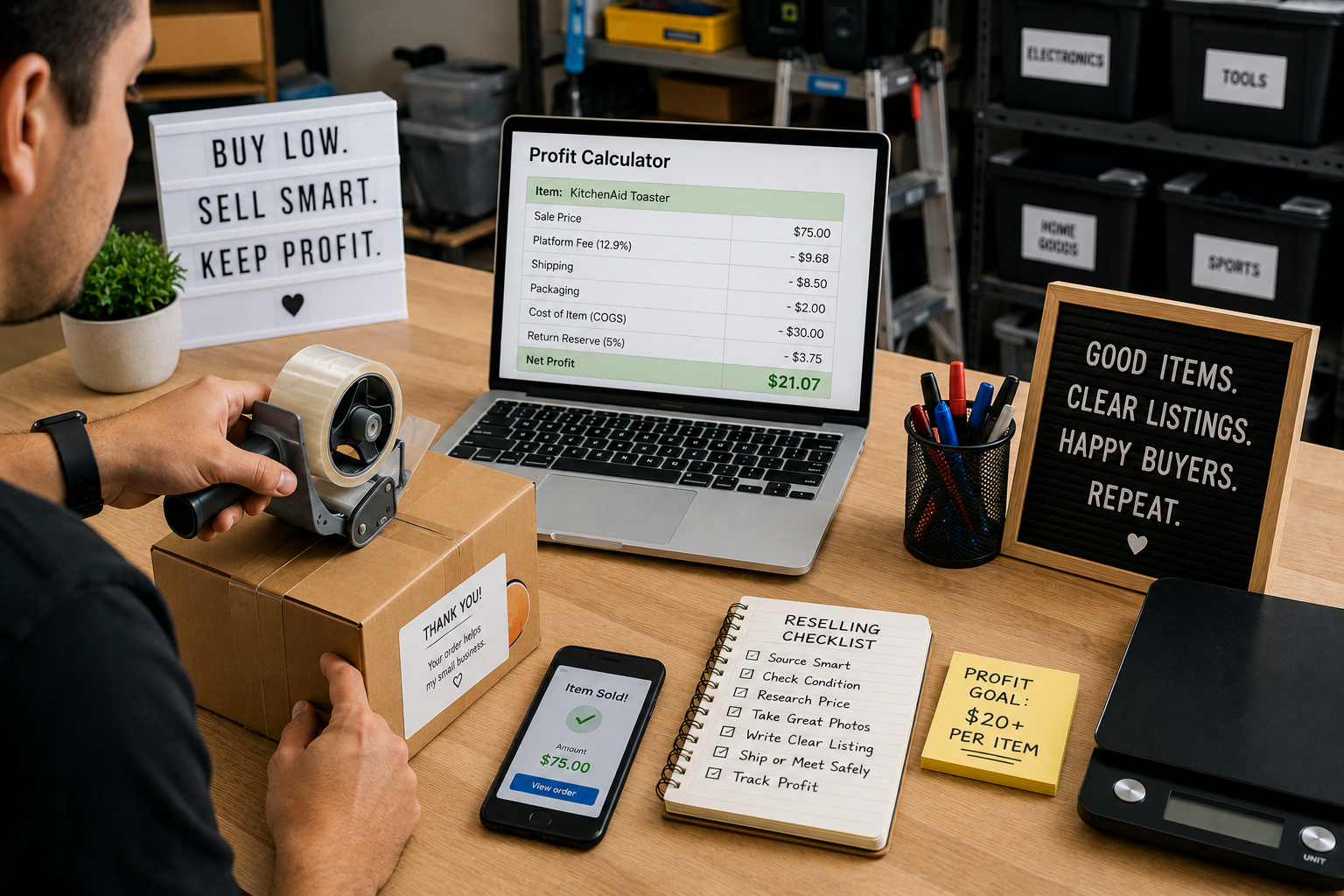
The Reselling Profit Formula (copy this)
Use this profit formula every time:
Sale Price
- Platform Fee
- Shipping
- Packaging
- Cost of Item (COGS)
- Return Reserve (a small % for online platforms)
= Net Profit
Then ask:
Is net profit worth your time?
Beginner profit targets (simple)
- If local pickup: aim for $20+ profit per item
- If shipped: aim for $15+ profit per item OR 30% margin (whichever is higher)
Tiny profits become wasted time fast.
The table: reselling profit math
Reselling blueprint profit math table showing the key cost deductions and realistic profit targets
| Cost you must subtract | Why it matters | Typical beginner mistake |
|---|---|---|
| Platform fees | eats margin quickly | ignoring fee percentage |
| Shipping | can erase profit | underestimating weight/size |
| Packaging | small costs add up | “it’s only $2” repeated |
| Returns | online selling risk | not reserving for returns |
| Time | your hidden cost | flipping for $5 profit |
This is how people stop guessing and start profiting.
How to avoid the biggest reselling disasters
Disaster #1: Returns you can’t afford
Online selling makes returns real.
Your protection:
- sell items with low defect risk
- describe accurately
- take clear photos
- keep proof of condition
- don’t oversell (“like new” when it’s not)
Disaster #2: Scams and chargebacks
Protection:
- local: cash or verified payment, meet in safe public locations
- online: ship with tracking, document packing, avoid suspicious buyers
Disaster #3: Dead inventory
Dead inventory is stuff that sits.
Sitting inventory is money trapped.
Your protection:
- buy only items you can sell within 14–30 days
- avoid “maybe someone will want it” items
- use seasonal timing wisely
The listing system that sells faster
A listing needs 5 things:
1) Clear title with brand + keyword
2) Great first photo (clean, bright)
3) 5–8 photos showing angles and proof it works
4) Short description with condition and reason for selling
5) Pickup/shipping clarity and response time
Listing template
Title:
“Brand + Item + Size/Model + Key feature”
Description:
“Condition: . Tested: .
Includes: . Pickup: .
Price firm/negotiable: __.”
This simple format prevents 50% of back-and-forth messaging.
Pricing strategy: how to price without losing margin
The mistake:
Pricing too high and sitting forever.
Or pricing too low and leaving money on the table.
The solution: “Three-price strategy”
- Price A: listed price
- Price B: your minimum acceptable
- Price C: your “quick sale” price
You list at Price A.
If no traction in 7 days, drop to Price B.
If you need cash fast, drop to Price C.
Never negotiate below Price B.
Amazon vs local: when Amazon makes sense
Amazon can make sense if:
- the item is new/sealed and allowed
- it’s a simple product with low return dispute risk
- you understand fees and shipping
- you have proof of authenticity (for brands that enforce it)
But if you’re a beginner, Amazon should be your second phase.
Start local to build confidence and avoid account risk.
The 30–60–90 day reselling blueprint
Days 1–30: Build proof with your own items
- sell 10 items you already own
- learn pricing, messaging, and pickup logistics
- track profit in one spreadsheet or note
Goal: proof that you can generate cash without spending money
Days 31–60: Source intentionally (small)
- buy 5–10 items max to flip
- target low-risk categories
- test everything
Goal: predictable profit without dead inventory
Days 61–90: Build a repeatable lane
- choose one category lane (tools, small appliances, baby gear, etc.)
- create a sourcing routine (one day/week)
- build a weekly posting schedule
Goal: repeatable income, not random wins
One evergreen external link (exactly one)
Use the FTC’s “shopping safely online” guidance as the one evergreen external link (it includes scam avoidance principles that apply directly to reselling):
https://consumer.ftc.gov/articles/how-shop-safely-online
Two True Wealth Moves internal links (exactly two)
https://truewealthmoves.com/wealth-blog/
https://truewealthmoves.com/resources/
Final truth
Reselling can be a real income stream if you treat it like math, not vibes.
The safest path:
- start with what you already own
- sell locally first
- track true profit (fees + shipping + returns)
- avoid high-scam categories early
- build a repeatable lane instead of chasing random flips
That’s how you flip items safely in 2026 — and keep the money you earn.
Looking for More Finance Topics?
Use the search box below to explore hundreds of articles on True Wealth Moves — we’ve probably already written about what you’re looking for.





