
Credit Card Welcome Bonus Trap: When “Free Money” Costs You More in 2026
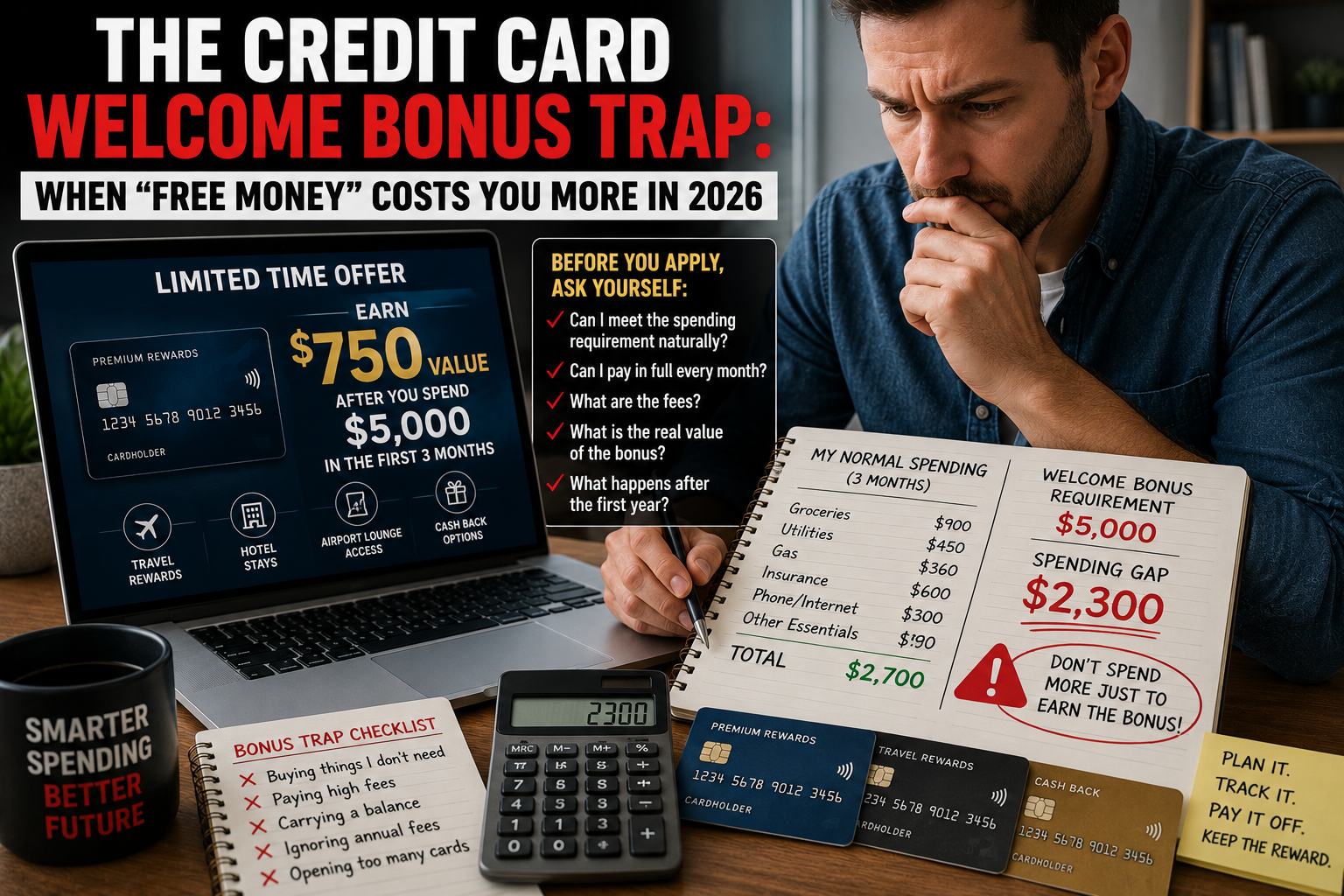
Credit-card companies know exactly how to get your attention.
They show you:
- $200 cashback
- 75,000 travel points
- 100,000 airline miles
- Free hotel nights
- Premium airport-lounge access
- Hundreds of dollars in advertised first-year value
The offer can feel like free money.
But the reward usually comes with a condition:
Spend a specific amount within a limited period.
That spending requirement is where the credit card welcome bonus trap begins.
A bonus may require you to spend:
- $500 within three months
- $3,000 within six months
- $4,000 within three months
- $5,000 within three months
- Or even $6,000 or more within a short promotional window
When that spending already fits your normal budget, a welcome bonus can create real value.
When the requirement causes you to shop more, move purchases forward, pay unnecessary fees or carry debt, the “free” bonus can become one of the most expensive rewards you ever earn.
That is the part credit-card advertisements rarely emphasize.
The reward is visible.
The behavior required to earn it is less visible.
This guide will explain:
- How credit-card welcome bonuses work
- How to calculate the real spending requirement
- Why minimum spending creates psychological pressure
- How interest and annual fees erase rewards
- When paying bills by credit card makes sense
- Why returns can cause you to lose a bonus
- How to avoid opening too many accounts
- The questions to ask before applying
- The exact system that makes a bonus financially worthwhile
No travel-hacking competition.
No pressure to open five cards.
No pretending every large bonus is automatically a good deal.
Just the math.
Credit Card Welcome Bonus Trap: How the Offer Really Works
A credit-card welcome bonus is a reward offered to eligible new cardholders after they complete specific requirements.
A typical offer might say:
Earn 75,000 bonus points after spending $5,000 on purchases within the first three months of account opening.
That offer has several separate parts:
- You must be approved for the card.
- You must be eligible for the offer.
- You must spend the required amount.
- The purchases must qualify.
- The spending must occur during the promotional period.
- Your account usually must remain open and in good standing.
- Returns or credits may reduce qualifying spending.
- Cash advances, balance transfers and fees generally do not count as purchases.
- The issuer may take time to post the bonus.
- The points may have different values depending on how they are redeemed.
The headline says 75,000 points.
The terms determine whether you receive them and what they are worth.
This is why you should never apply based only on the advertisement.
Read the offer terms before submitting the application.
The Minimum-Spend Math Most People Skip
Before applying, convert the requirement into monthly, weekly and daily numbers.
Suppose the card requires $5,000 in purchases within three months.
That equals approximately:
- $1,667 per month
- $385 per week
- $56 per day
Now compare that requirement with your normal credit-card spending.
If you usually spend $900 per month on expenses you can safely charge and pay off, your estimated three-month spending is:
$900 × 3 = $2,700
You would be approximately $2,300 short of the requirement.
That gap is the danger.
To close it, you might feel pressure to:
- Buy a television early
- Upgrade your phone
- Prepay services
- Purchase gift cards
- Pay bills with large processing fees
- Offer to pay for family members
- Move future spending into the promotional period
- Buy things you plan to return
- Carry a balance you cannot immediately repay
The reward has now started changing your behavior.
That is the clearest sign of the credit card welcome bonus trap.
A welcome bonus should fit your spending.
Your spending should not expand to fit the bonus.
Credit Card Welcome Bonus Trap Example: Spending $1,000 to Earn $200
Imagine a card offers $200 cashback after spending $3,000 in three months.
Your normal planned spending during that period is $2,000.
You are $1,000 short.
To earn the bonus, you buy:
- $300 in clothes
- A $400 electronic device
- $300 in restaurant meals and entertainment
You meet the requirement and receive $200.
But the bonus did not make you $200 richer.
You spent an additional $1,000 to receive $200.
Your net financial position is:
$200 bonus − $1,000 extra spending = $800 lost
You may argue that you received products and experiences for the $1,000.
That is true.
But if you would not have bought them without the bonus, the promotion influenced you to exchange $1,000 for $200.
The credit-card company won.
You did not.
The “I Was Going to Buy It Eventually” Excuse
One of the most common justifications is:
“I was going to buy it eventually.”
Eventually is not the same as now.
Buying early can create costs.
You may:
- Lose the opportunity to compare prices later
- Miss a better sale
- Reduce your emergency savings
- Increase your statement balance
- Give up months of interest on your cash
- Buy before you truly understand what you need
- Replace a functioning item too soon
Suppose you move a $1,200 laptop purchase forward by six months to qualify for a bonus.
That may be reasonable when:
- Your current laptop is failing
- You already budgeted for the replacement
- You have the cash available
- The current price is competitive
- You can pay the card in full
It is not reasonable when:
- Your existing laptop works well
- You need to pull money from emergency savings
- You are hoping future income will cover the bill
- You are buying mainly because the bonus deadline is approaching
“Eventually” should never become an excuse for damaging today’s cash flow.
Interest Can Destroy the Entire Bonus
This is the most important rule in the article:
A welcome bonus is not worth chasing when you will carry the balance.
Suppose you earn a bonus worth $750 after spending $5,000.
You cannot pay the full statement balance, so you carry an average balance of $4,000 at a 24% APR.
A rough year of interest on that balance could approach:
$4,000 × 24% = $960
The actual amount depends on changing balances and payment timing, but the lesson is clear.
You earned a $750 reward.
You paid approximately $960 in interest.
Your estimated net result is:
$750 reward − $960 interest = $210 lost
That calculation does not include:
- The annual fee
- Extra spending triggered by the offer
- Redemption losses
- Late fees
- Processing fees
- Possible interest on future purchases
A credit-card company can afford to give you a large bonus because many customers will pay more through interest, fees and long-term usage.
True Wealth Moves rule:
If you cannot pay the statement balance in full, your welcome bonus should be zero because you should not chase one.
Credit Card Welcome Bonus Trap Comparison Table
| Situation | Bonus value | Spending required | Hidden cost | Likely result |
|---|---|---|---|---|
| Normal expenses already exceed requirement | $500 | $4,000 | $0 extra spending | Bonus may be valuable |
| Spending increased by $1,000 | $200 | $3,000 | $1,000 unnecessary purchases | Approximately $800 lost |
| Balance carried at high APR | $750 | $5,000 | Approximately $960 interest | Bonus erased |
| Rent paid with 3% fee | $600 | $4,000 | $120 processing fee | May still work if planned carefully |
| Premium card kept without using benefits | $800 first-year value | $6,000 | $695 annual fee | Weak value after year one |
| Returns reduce qualifying spending | $500 | $4,000 | Bonus requirement missed | Bonus may be denied |
Credit card welcome bonus trap comparison showing how spending, interest, processing fees and returns can erase a signup reward.
Annual Fees Change the Real Value
Some welcome bonuses are attached to cards with no annual fee.
Others come with fees of:
- $95
- $250
- $395
- $550
- $695
- Or more
A 100,000-point offer may sound enormous.
But you must subtract the annual fee.
Use this formula:
First-year net bonus value = Realistic bonus value + benefits actually used − annual fee − fees paid − extra spending − interest
Suppose:
- Welcome bonus value: $1,000
- Annual travel credit you will use: $300
- Lounge access value to you: $100
- Annual fee: $695
- Processing fees paid to meet spending: $120
Estimated first-year value:
$1,000 + $300 + $100 − $695 − $120 = $585
That may still be a good offer.
But it is not worth the advertised $1,400.
You should also think beyond the first year.
Many people keep expensive cards because:
- They forget the renewal date
- They do not want to lose points
- They believe closing a card always destroys credit
- The card feels prestigious
- They hope to use the benefits later
A card that delivers strong first-year value can become a recurring money leak in year two.
Set a calendar reminder 30 to 60 days before the annual fee posts.
At renewal, calculate the card’s value again without including the one-time welcome bonus.
Points Are Not Worth Their Marketing Value Automatically
An issuer may advertise:
- 75,000 points worth $900 toward travel
- 100,000 points worth up to $1,500
- Miles that can unlock premium flights
- Hotel points worth several free nights
The word up to matters.
Your points may be worth more when used for:
- Travel booked through a specific portal
- Transfers to selected airline partners
- Hotel redemptions
- Premium-cabin flights
They may be worth less when used for:
- Cashback
- Merchandise
- Gift cards
- Statement credits
- Poor-value travel bookings
Suppose you earn 75,000 points.
At 1 cent per point, the value is:
75,000 × $0.01 = $750
At 1.25 cents per point:
75,000 × $0.0125 = $937.50
At 0.6 cents per point:
75,000 × $0.006 = $450
The same points balance can produce very different outcomes.
Do not use an influencer’s premium-flight valuation unless you will realistically make that type of redemption.
Use the value you are likely to receive.
Unexpected Promotional Conditions Can Cost You the Bonus
The CFPB has documented consumer complaints involving unexpected promotional conditions and rewards that were denied even when consumers believed they had completed the requirements.
Common conditions may include:
- Applying through a specific page
- Being excluded because you previously held the card
- Not qualifying because you received a similar bonus recently
- Completing the spending within a strict deadline
- Keeping the account in good standing
- Avoiding returned purchases that reduce net spending
- Using eligible purchase categories
- Receiving a targeted offer rather than a public offer
- Meeting business-card eligibility requirements
Before applying, save:
- A screenshot of the offer
- The application URL
- The date
- The exact bonus language
- The minimum spending requirement
- The promotional deadline
- The annual fee
- Any eligibility restrictions
- The approval confirmation
Do not assume the offer will remain visible later.
Documentation gives you evidence if the bonus does not post correctly.
Credit Card Welcome Bonus Trap: Returns Can Reduce Your Spending
Imagine you need to spend $4,000.
You make $4,050 in purchases.
Then you return a $300 item.
Your net qualifying spending may fall to:
$4,050 − $300 = $3,750
You may now be $250 short of the bonus requirement.
This can happen even when:
- The original purchase occurred during the promotional window
- The return occurred later
- You believed the requirement had already been met
- The app temporarily showed progress
Do not aim to finish the requirement by only a few dollars.
Build a small cushion using normal planned purchases.
For example, if the requirement is $4,000, consider targeting approximately $4,150 to $4,250 in legitimate qualifying spending, provided it fits your normal budget.
Do not create a huge cushion.
The goal is to protect against:
- Returns
- Merchant credits
- Transactions that post late
- Ineligible purchases
- Adjustments
Track net purchases, not just charges.
Do Rent, Taxes and Tuition Count?
Large bills can make a minimum-spend requirement easier to meet.
Examples include:
- Rent
- Property taxes
- Income taxes
- Tuition
- Insurance premiums
- Medical bills
- Contractor invoices
But these payments may include card-processing fees.
Suppose you pay a $2,000 bill with a 3% fee.
Processing fee:
$2,000 × 3% = $60
Whether that makes sense depends on the bonus.
If the $60 fee helps you earn a $750 bonus that you would otherwise miss, it may be reasonable.
If the payment earns only normal 1% cashback:
$2,000 × 1% = $20
You would pay $60 to earn $20.
You lose $40.
Use this formula:
Net payment benefit = Bonus value unlocked + normal rewards − processing fee − interest
Never pay a fee simply because the transaction earns points.
Calculate the result.
Manufactured Spending Creates Risk
Some people attempt to meet minimum spending through complicated methods involving:
- Gift cards
- Money orders
- Refund cycling
- Payment services
- Person-to-person transfers
- Cash-like transactions
These strategies can create:
- Cash-advance fees
- Account shutdowns
- Frozen rewards
- Bonus denial
- Fraud reviews
- Lost gift cards
- Tax confusion
- Violations of issuer terms
This article is not teaching manufactured spending.
For normal households, the best method is simple:
Use the card for planned expenses you would already make and can fully pay.
A bonus should simplify your financial life.
It should not force you into a maze of transactions.
Do Not Volunteer to Pay Everyone’s Bills Without Protection
A common strategy is offering to pay for friends or relatives and asking them to reimburse you.
This can work.
It can also go badly.
Risks include:
- The person pays late
- The person disputes the amount
- You need to pay the statement before reimbursement arrives
- The transaction is refunded to your card after you have been repaid
- The purchase creates a warranty or return issue
- The person assumes you can wait
Never charge another person’s large purchase unless:
- You trust them
- The repayment terms are clear
- You can cover the bill without their money
- You receive reimbursement before the statement due date
- You understand who controls returns and refunds
Your welcome bonus is not worth damaging a relationship.
Opening Too Many Cards Can Create a Bigger Problem
Credit-card bonus culture can become addictive.
You earn one bonus.
Then you see another.
Soon, you are tracking:
- Five spending deadlines
- Several annual fees
- Multiple due dates
- Different reward currencies
- Travel credits
- Merchant offers
- Cardholder anniversary dates
The rewards may grow.
So does the complexity.
Opening new accounts can also affect:
- Credit inquiries
- Average account age
- Available credit
- Future approval eligibility
- Your temptation to spend
- Mortgage or auto-loan applications
You should be especially cautious about opening cards before applying for a major loan.
A welcome bonus is not more important than securing affordable financing for a home or vehicle.
True Wealth Moves rule:
Do not open a new credit card when an important loan application is approaching unless you have considered the credit impact carefully.
The Credit Utilization Problem
Suppose your new card has a $5,000 limit.
You charge $4,000 to complete the bonus requirement.
Before you pay, the issuer reports the balance to the credit bureaus.
Your utilization on that card may appear as:
$4,000 ÷ $5,000 = 80%
Even if you pay by the due date, a high reported balance can temporarily affect your credit profile.
Possible solutions include:
- Making an early payment before the statement closes
- Splitting payments throughout the month
- Monitoring the statement date
- Keeping overall utilization low
- Avoiding a large application immediately afterward
Do not confuse the due date with the reporting date.
Paying in full avoids interest.
Paying before the statement closes may also reduce the balance that gets reported.
How to Build a Safe Minimum-Spend Plan
Before applying, list your normal expenses for the promotional period.
Example three-month plan:
| Planned expense | Three-month amount |
| Groceries | $1,500 |
| Fuel and transportation | $450 |
| Utilities | $600 |
| Insurance | $450 |
| Phone and internet | $300 |
| Medical and prescriptions | $250 |
| Planned travel | $600 |
| Total planned spending | $4,150 |
If the card requires $4,000 in three months, this household may be able to qualify without increasing spending.
The plan appears safe when:
- Every category accepts credit cards without large fees
- The household has cash available to pay the charges
- No purchases create debt
- The cardholder tracks returns
- The expenses would occur anyway
Credit card welcome bonus trap prevention plan showing how normal expenses can safely meet a $4,000 spending requirement.
Do not include uncertain spending.
Examples:
- “Maybe I will travel”
- “I may buy furniture”
- “I can probably help someone pay a bill”
- “I might get a work reimbursement”
Base your decision on reliable expenses.
The 10-Question Credit Card Welcome Bonus Test
Before applying, answer these questions.
1. What is the exact spending requirement?
Write down the amount and deadline.
2. How much do I normally spend during that period?
Use actual statements rather than memory.
3. Can I meet the requirement without buying anything extra?
If not, stop.
4. Can I pay every statement in full?
If not, stop.
5. What is the realistic value of the bonus?
Use your likely redemption, not the maximum advertised value.
6. What is the annual fee?
Subtract it from the reward.
7. Are there processing fees?
Calculate rent, tax, tuition or bill-payment fees.
8. Am I eligible?
Review prior-card and prior-bonus restrictions.
9. What happens after the first year?
Decide whether the ongoing rewards justify the card.
10. Will this interfere with another financial goal?
Consider mortgage applications, debt payoff and emergency savings.
If the answers remain favorable, the bonus may be worth pursuing.
The True Wealth Moves Welcome-Bonus System
Use this five-step system.
Step 1: Apply only for a planned purpose
Examples:
- Upcoming normal household spending
- A scheduled home repair
- Planned travel
- Annual insurance premiums
- A business expense with expected reimbursement
Step 2: Create a spending tracker
Track:
- Purchase date
- Merchant
- Amount
- Whether it qualifies
- Returns or credits
- Net progress
- Days remaining
Step 3: Pay throughout the month
Do not wait for one giant bill when that creates stress.
Step 4: Stop using the card after meeting the requirement if needed
There is no prize for continuing to spend.
Step 5: Confirm the bonus and review the card before renewal
Track:
- When the reward posts
- How you will redeem it
- When the annual fee renews
- Whether the card deserves a permanent place in your wallet
External Resource
Review the Consumer Financial Protection Bureau’s official report on credit-card rewards problems, including unexpected promotional conditions, devaluation, redemption issues and reward revocation:
https://www.consumerfinance.gov/data-research/research-reports/issue-spotlight-credit-card-rewards
Continue Building Your Financial Knowledge
Read more practical credit, saving and wealth-building strategies on the True Wealth Moves blog:
https://truewealthmoves.com/wealth-blog
Use the True Wealth Moves resources page for financial tools, guides and calculators:
Final Verdict: How to Avoid the Credit Card Welcome Bonus Trap
Credit-card welcome bonuses can be valuable.
A well-chosen offer can provide:
- Cashback
- Travel
- Hotel stays
- Airline miles
- Emergency savings
- Statement credits
- Lower first-year costs
But the bonus works only when you control the spending.
The credit card welcome bonus trap begins when the offer causes you to:
- Spend more than planned
- Move purchases forward unnecessarily
- Carry a balance
- Pay more in fees than the reward is worth
- Keep an expensive card after the value disappears
- Open too many accounts
- Risk an important loan application
- Ignore eligibility restrictions
- Count returned purchases toward the requirement
- Value points at a redemption rate you will never receive
The correct strategy is simple:
- Calculate the monthly and weekly spending requirement.
- Compare it with your normal expenses.
- Apply only when the requirement fits without lifestyle inflation.
- Pay the statement balance in full.
- Subtract the annual fee and processing costs.
- Save the offer terms.
- Track net purchases after returns.
- Redeem the bonus intentionally.
- Review the card before the second annual fee.
- Walk away from any offer that needs you to manufacture spending.
The bonus is not free money.
It is an incentive designed to influence your financial behavior.
Your job is to accept the reward without allowing the reward to control your spending.
That is the True Wealth Moves conclusion:
A welcome bonus should reward the life you already live—not make you spend money to prove you deserve it.
Looking for More Finance Topics?
Use the search box below to explore hundreds of articles on True Wealth Moves — we’ve probably already written about what you’re looking for.





