
Walmart+ Worth It in 2026? The Fuel Discount Math + Hidden Savings for Families
Walmart+ can be either:
- a real monthly savings engine, or
- another subscription that quietly drains you.
Same membership.
Two outcomes.
The difference is whether you do the math and use it like a system.
Because Walmart+ isn’t just “free delivery.”
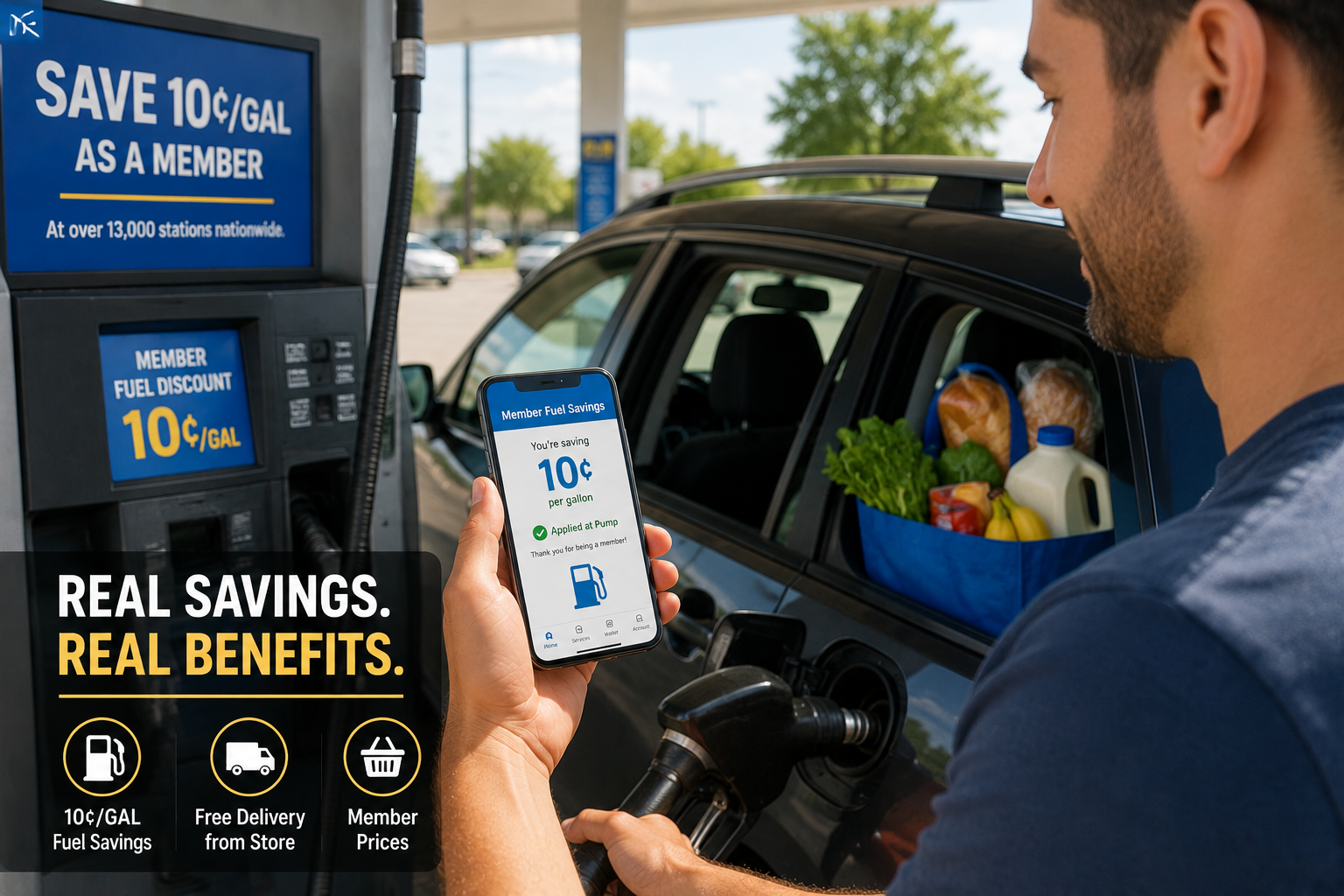
For a lot of households, the biggest measurable benefit is fuel savings — and Walmart says Walmart+ members save 10¢ per gallon at more than 13,000 stations, including Exxon, Mobil, Walmart & Murphy stations (with a note that Alabama has 5¢ savings). (walmart.com)
But fuel discounts alone don’t automatically make Walmart+ worth it.
You need to answer one question:
Does it reduce your total spending — or just make you shop more often?
This post is your True Wealth Moves “Walmart+ Worth It?” breakdown:
- how the fuel discount actually works (and the common misunderstandings)
- the break-even math (with real household examples)
- how Walmart+ pricing works in 2026 (monthly vs annual)
- what hidden savings can be real (and what is usually just “subscription noise”)
- how to avoid the subscription trap (spending more because delivery feels free)
- and the simplest routine that turns Walmart+ into a controlled savings tool
No hype. No affiliate fluff. Just the math.
The 2026 Walmart+ cost (keep it simple)
Walmart’s help page lists Walmart+ membership pricing as:
- $98/year (annual)
- $12.95/month (monthly)
plus applicable tax. (walmart.com)
So your break-even question is:
Can you reliably save at least $98/year (or $12.95/month) from benefits you would use anyway — without increasing spending?
If yes, Walmart+ can be worth it.
If no, it becomes another “quiet bill.”
What the Walmart+ fuel discount really is
Walmart’s official support page says Walmart+ members save 10¢/gal at over 13,000 stations nationwide, including Exxon, Mobil, Walmart & Murphy stations (with Alabama noted at 5¢). (walmart.com)
ExxonMobil’s own page also explains that Walmart+ members save 10¢/gal at Exxon and Mobil stations using the Walmart app to pay, and walks through how it works. (exxonmobilfuels.com)
Translation:
This isn’t a random coupon.
It’s a recurring benefit — if you actually use participating stations.
The most important truth: fuel discounts are only valuable if you buy gas anyway
It sounds obvious, but it’s where people get fooled.
Savings only count if:
- you already buy gas
- you can access participating stations conveniently
- you don’t drive extra just to chase the discount
Driving 10 miles out of your way to save $1.20 is not savings.
That’s time and fuel loss.
So the first filter is:
Do you live near stations where the discount applies?
The break-even math (the part people skip)
Let’s do the clean math.
Step 1: Determine your gallons per month
Use this:
Monthly miles ÷ MPG = gallons per month
Example:
1,000 miles/month ÷ 25 MPG = 40 gallons/month
Step 2: Multiply by the discount
If discount is 10¢/gal:
40 gallons × $0.10 = $4/month savings
Step 3: Compare to membership cost
Walmart+ monthly: $12.95/month. (walmart.com)
If you only save $4/month on fuel, fuel alone won’t justify Walmart+.
But if you save $15–$25/month on fuel, that changes the story.
Fuel break-even thresholds (quick reference)
To break even on fuel alone:
Monthly plan ($12.95/month)
At 10¢/gal, you need:
$12.95 ÷ $0.10 = 129.5 gallons/month
That’s a lot.
Most households won’t break even on fuel alone unless they drive heavily.
Annual plan ($98/year)
Annual break-even gallons:
$98 ÷ $0.10 = 980 gallons/year
Monthly break-even:
980 ÷ 12 ≈ 81.7 gallons/month
Still substantial, but more realistic for:
- long commuters
- families with multiple drivers
- gig workers
- delivery drivers
- people who drive a lot for work
The table: Walmart+ fuel discount math (break-even guide)
Walmart+ fuel discount math table showing gallons needed to break even on monthly and annual membership costs at 10 cents per gallon
| Plan type | Cost | Fuel discount | Gallons needed to break even | Who this fits best |
|---|---|---|---|---|
| Walmart+ Monthly | $12.95/mo (walmart.com) | $0.10/gal (walmart.com) | ~130 gal/mo | heavy drivers only (or fuel + other benefits) |
| Walmart+ Annual | $98/yr (walmart.com) | $0.10/gal (walmart.com) | ~82 gal/mo | commuters, families, gig drivers |
So for most people, Walmart+ value is fuel + shopping benefits combined.
Now let’s talk about the rest of the stack.
Walmart+ savings beyond fuel (what’s real vs what’s “subscription noise”)
Walmart+ can create savings in three real ways:
1) Fewer impulse trips (if you use delivery correctly)
This sounds backwards, but it’s real:
If delivery reduces “run to the store” trips, you can save:
- fuel
- impulse spending (snacks, random extras)
- time
But only if you shop with lists and caps.
2) Lower delivery costs vs alternatives
If you currently pay delivery fees (or tip-heavy services), Walmart+ can reduce total delivery spending — especially for routine grocery orders.
3) Fuel discount consistency
Fuel is measurable.
If you fuel up often at participating stations, you’ll see it.
Where people get fooled is:
They join Walmart+ thinking delivery will save money…
Then they order more frequently and spend more overall.
So the benefit depends on behavior.
The #1 Walmart+ trap: “Free delivery” causes more shopping
When delivery feels free, people buy:
- small orders
- more frequently
- with less planning
That increases:
- impulse spending
- “add-on” items
- and total monthly consumption
True Wealth Moves rule:
Free delivery only saves money if it reduces your trips and reduces impulse.
If Walmart+ increases your purchase frequency, it can become an expensive subscription.
The “Walmart+ Savings System” (how to use it like a CFO)
Here’s the system that turns Walmart+ into a tool instead of a habit.
Step 1: Set a Walmart+ order schedule
Pick one of these:
- 1 order per week
- 1 order per pay period
If you allow unlimited random ordering, you’ll overspend.
Step 2: Use a list + cap method
Before checkout:
- list essentials first
- set a cart cap
Example caps:
- $80/week for a single adult
- $150–$250/week for families (depending on size and region)
This is not deprivation.
This is budget protection.
Step 3: Group orders to reduce “delivery temptation”
Instead of ordering whenever you remember something, keep a running list for your next scheduled order.
That reduces:
- small frequent checkouts
- “since I’m ordering anyway…” spending
Step 4: Use the fuel discount only when it’s convenient
You’re not chasing pennies.
You’re collecting consistent savings on routes you already drive.
If a participating station is on your commute, great.
If it’s out of the way, skip it.
Step 5: Track your actual monthly savings
Most people never do this, which is why they don’t know whether the membership is worth it.
Track:
- fuel savings (gallons × discount)
- delivery fees avoided (if relevant)
- impulse trips avoided (estimated)
If you can’t measure it, you can’t manage it.
Walmart+ InHome: what it is and what it costs
Walmart’s membership help page says InHome (delivery into your home/garage, tips included, no delivery fees, no item markups) is an add-on for Walmart+ members:
- $40/year
- or $7/month
plus applicable tax. (walmart.com)
Walmart’s InHome landing page also lists the bundled monthly/annual pricing for the InHome version (noting a trial and then pricing). (walmart.com)
Do you need InHome?
Only if:
- you use delivery frequently enough,
- you strongly value inside-the-home delivery,
- and it replaces other delivery services you’d pay for anyway.
If you rarely use delivery, InHome can become expensive “just in case” spending.
Household break-even examples (real-life math)
Let’s do 3 quick cases.
Case A: Moderate commuter (typical household)
- 900 miles/month
- 25 MPG
= 36 gallons/month
Fuel savings at 10¢:
36 × $0.10 = $3.60/month
Conclusion:
Fuel alone doesn’t justify Walmart+ monthly or annual.
You’d need shopping/delivery savings to make it worth it.
Case B: Two-driver family
- 2,200 miles/month combined
- 24 MPG average
= 91.7 gallons/month
Fuel savings:
91.7 × $0.10 = $9.17/month
Conclusion:
Fuel covers most of annual break-even (annual needs ~82 gal/mo), but still short for monthly plan.
Annual plan is more realistic if you truly use the discount consistently.
Case C: Gig/commute heavy
- 3,500 miles/month
- 22 MPG
= 159 gallons/month
Fuel savings:
159 × $0.10 = $15.90/month
Conclusion:
Fuel alone can justify monthly plan — IF stations are convenient.
This is why Walmart+ is often best for:
- heavy drivers
- families
- people near participating stations
- people who already do Walmart grocery runs
The “Walmart+ worth it?” decision table
Walmart+ worth it decision table showing who benefits most from fuel savings and delivery habits
| If you are… | Walmart+ is more likely worth it if… | Walmart+ is less likely worth it if… |
|---|---|---|
| Heavy driver/commuter | you can use fuel discount frequently and conveniently | you’d drive out of the way |
| Family household | you can consolidate grocery orders weekly | you do small daily orders |
| Budget-focused shopper | you use lists + caps + scheduled ordering | you browse and impulse-buy |
| Delivery user | it replaces paid delivery fees/services | you rarely use delivery |
| Close to participating stations | stations are on your normal routes | stations are inconvenient |
How people accidentally lose money with Walmart+
Here are the top ways:
1) Subscription stacking
Walmart+ + other delivery memberships + streaming + “small subscriptions” = fixed cost bloat.
2) Ordering too often
You spend more because you shop more.
3) Buying more convenience items
Convenience categories are expensive (snacks/drinks/ready meals).
4) Ignoring refund/return discipline
Returns that aren’t completed become “permanent overspending.”
The 30-day Walmart+ trial strategy (best practice)
If you’re deciding:
Use the trial period like a test, not like a shopping spree.
During the trial:
- place 2–4 planned grocery orders
- track your total spend compared to your normal month
- use fuel discount consistently when convenient
- check whether you ordered more frequently than normal
At the end, ask:
“Did my total spending go down?”
If it didn’t, cancel.
If it did, keep it — but keep the system.
Your one evergreen external link (exactly one)
Use Walmart’s official Member Prices on Fuel page as the single external link in this post:
https://www.walmart.com/help/article/walmart-benefits-fuel-discounts/b85623bb273a41979488aa9cbdb1b4c9
Two True Wealth Moves internal links (exactly two)
https://truewealthmoves.com/wealth-blog/
https://truewealthmoves.com/resources/
Final truth
Walmart+ is worth it when it reduces your total spending, not when it increases your shopping frequency.
Fuel savings can be real — Walmart states 10¢/gal at over 13,000 stations — but most households won’t break even on fuel alone. (walmart.com)
So the winning strategy is:
- use annual plan if you commit
- order on a schedule (not constantly)
- shop with a list + cart cap
- use fuel discount only when convenient
- and track savings like a CFO
That’s how Walmart+ becomes a savings tool — not another subscription leak.
Looking for More Finance Topics?
Use the search box below to explore hundreds of articles on True Wealth Moves — we’ve probably already written about what you’re looking for.





