
US Economic Slowdown 2026: The Economy Looks Fine—Until You Look Underneath
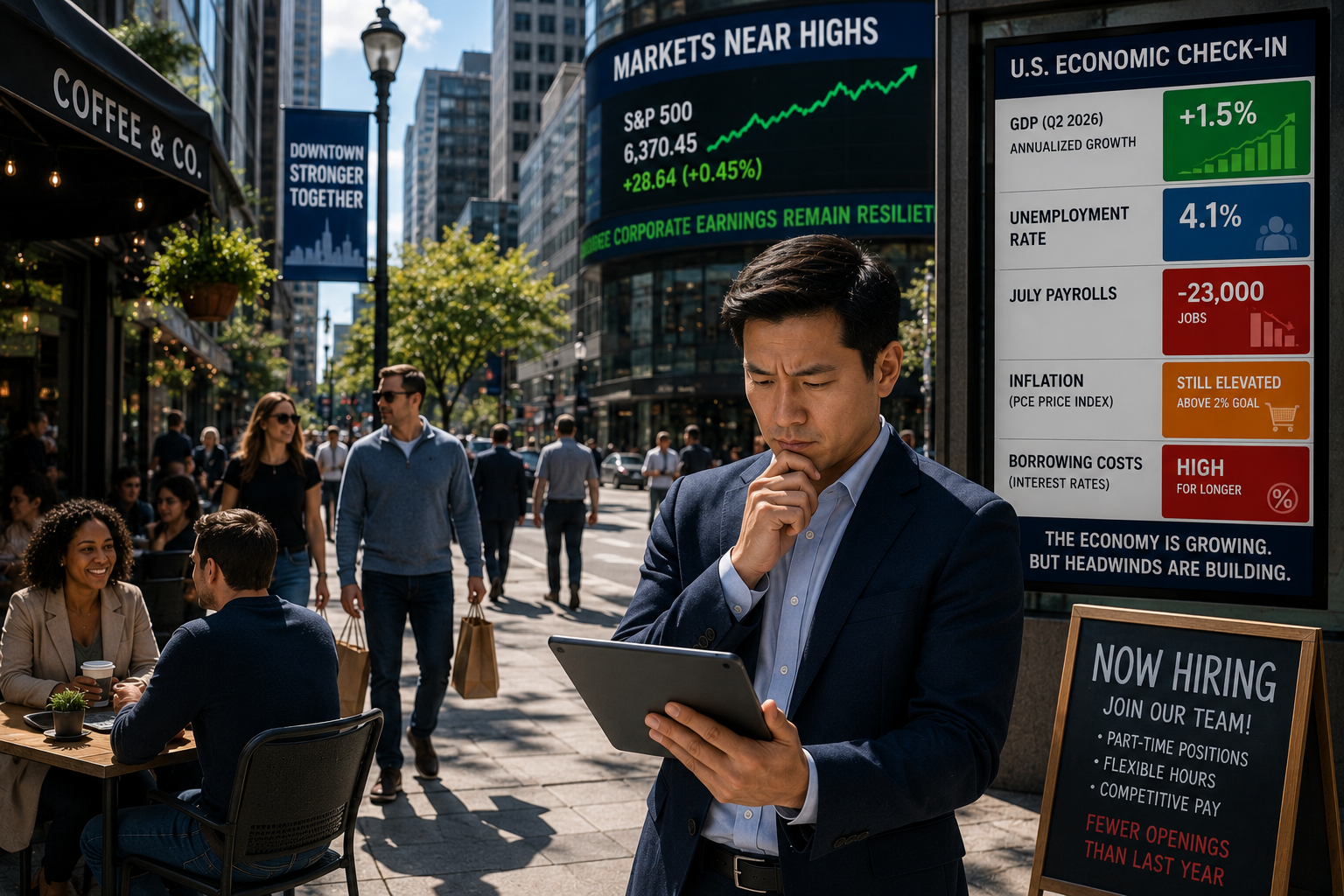
The U.S. economy is sending Americans two completely different messages.
One message says things are fine.
The economy is still growing.
The unemployment rate remains relatively low.
Consumers are still spending.
Businesses are still investing.
The stock market has remained remarkably strong.
There has been no official declaration of a recession.
Then there is the second message.
Hiring has weakened.
Economic growth has slowed.
Inflation is still uncomfortable.
Interest rates remain expensive.
Credit-card balances are enormous.
Some households are increasingly relying on debt.
Consumer confidence has softened.
And many workers feel considerably less secure about finding another job if they lose the one they have.
That contradiction is what makes the US economic slowdown 2026 so important for household financial planning.
This is not necessarily a recession.
It may never become one.
But waiting for economists to officially use the word “recession” before protecting your finances misses the point.
Your household does not need a recession declaration to experience financial stress.
If:
- Your company stops hiring
- Your overtime disappears
- Your annual bonus shrinks
- Your insurance premium rises
- Your credit-card APR remains above 20%
- Your grocery bill keeps increasing
your personal economy may already feel like a downturn.
The latest economic data reflects this uncomfortable middle ground.
Real U.S. gross domestic product increased at an annualized rate of approximately 1.5% during the second quarter of 2026, after growing about 2.1% in the first quarter.
The economy is growing.
But more slowly.
At the same time, July payroll employment decreased by approximately 23,000 jobs, while unemployment remained around 4.1%.
Meanwhile, inflation continues to run above the Federal Reserve’s long-term 2% goal, leaving policymakers reluctant to aggressively lower interest rates.
Put everything together and the result is an economy that is:
Not booming.
Not collapsing.
Not cheap to borrow in.
Not easy to understand.
That environment requires a different money strategy.
This guide will show you:
- What an economic slowdown actually means
- Why GDP can grow while households feel worse
- Why the job market deserves more attention than unemployment alone
- How consumers can prepare without panic
- Why high-interest debt becomes more dangerous during slower growth
- How much emergency savings may make sense
- What homeowners and homebuyers should consider
- How investors should respond to mixed economic signals
- Why stock-market records do not prove the household economy is healthy
- The TWM “slowdown without recession” money plan
No predicting an economic crash.
No telling you to sell everything.
No fear.
Just preparation.
US Economic Slowdown 2026: What Does “Slowdown” Actually Mean?
An economic slowdown simply means the economy continues growing, but at a slower rate.
Imagine a car traveling:
70 miles per hour
Then slowing to:
45 miles per hour
The car is still moving forward.
It simply is not moving as quickly.
Economic growth can behave the same way.
Suppose GDP grows:
- 3.0% one year
- 2.1% next
- 1.5% afterward
The economy did not necessarily shrink.
Growth simply weakened.
That distinction matters because recession and slowdown are not interchangeable.
A slowdown can last:
- Several quarters
- Several years
without becoming a severe downturn.
But slower growth can still affect:
- Hiring
- Raises
- Business profits
- Loan availability
- Consumer spending
And those changes can reach households long before economists use the word recession.
Why GDP Can Grow While You Feel Poorer
GDP measures the value of goods and services produced throughout the economy.
It does not measure your personal financial comfort.
Economic growth can continue while households experience:
- Higher rent
- Higher insurance
- More expensive groceries
- Expensive borrowing
- Slower wage growth
Imagine GDP increases 1.5%.
Great.
But your household experiences:
- Rent +5%
- Insurance +12%
- Groceries +4%
- Paycheck +3%
You may be losing purchasing power even while the national economy expands.
This explains one of the biggest contradictions in the US economic slowdown 2026.
Economic statistics can be positive while household sentiment remains negative.
Both can be correct.
The Four Economies You Should Track
Instead of obsessing over one national number, watch four separate economies.
1. The Growth Economy
Measured partly through GDP.
Question:
Is America producing more?
2. The Employment Economy
Measured through:
- Payrolls
- Unemployment
- Hiring
- Job openings
Question:
Can workers find and keep jobs?
3. The Household Economy
Measured through:
- Income
- Debt
- Spending
- Savings
Question:
Can families maintain their standard of living?
4. The Financial Market Economy
Measured through:
- Stocks
- Bonds
- Interest rates
Question:
What do investors believe comes next?
These four economies can move differently.
That is exactly what creates confusion.
US Economic Slowdown 2026 Dashboard
| Indicator | Current message | Household interpretation |
|---|---|---|
| GDP | Still growing | Economy is not broadly contracting |
| Hiring | Weakening | Job-switching may become harder |
| Unemployment | Still relatively low | Most workers remain employed |
| Inflation | Still above ideal | Household costs remain pressured |
| Interest rates | Still elevated | Borrowing remains expensive |
| Stock market | Strong | Investors remain optimistic about profits |
| Consumer confidence | Softer | Households remain cautious |
US economic slowdown 2026 dashboard comparing GDP jobs inflation interest rates stocks and consumer confidence.
The danger comes from reacting to only one row.
The Job Market Can Weaken Before Unemployment Explodes
Unemployment is one of the most watched economic statistics.
But it is a lagging indicator.
Companies often begin adjusting long before they start mass layoffs.
First they may:
- Freeze hiring
- Stop replacing workers who quit
- Reduce contractors
- Cut overtime
- Delay promotions
- Reduce bonuses
Employees remain technically employed.
Yet the job market becomes weaker.
This matters because job security is not only:
“Do I currently have a job?”
It is also:
“How quickly could I replace my income if I lost this job?”
That second question deserves much more attention during a slowdown.
The Replacement-Income Test
Ask yourself:
If my employer eliminated my position tomorrow, how long would replacing my income realistically take?
Possible answer:
- 30 days
- 3 months
- 6 months
- 12 months
The more specialized or highly compensated your position, the longer replacement may take.
That means a high-income professional may need a larger emergency fund than someone assumes.
A six-figure salary does not guarantee financial security.
Sometimes it creates:
- Larger mortgage
- More expensive cars
- Higher fixed expenses
while job replacement takes longer.
Build Your Emergency Fund Around Replacement Time
A generic rule says:
“Save three to six months of expenses.”
That is useful.
But customize it.
Three months may work when:
- Two-income household
- Stable careers
- Low debt
- Strong job market
- Flexible expenses
Six months may be stronger when:
- Single-income household
- Specialized career
- High fixed expenses
- Industry slowing
Nine to twelve months may make sense when:
- Self-employed
- Commission-based
- Executive-level employment
- Highly cyclical industry
Your emergency fund is not a competition.
It is time.
Cash buys time to make better decisions.
Calculate Essential Expenses, Not Lifestyle Expenses
Suppose monthly household spending is:
$8,000
But essential expenses are:
- Housing: $2,500
- Groceries: $900
- Insurance: $500
- Transportation: $700
- Utilities: $400
- Minimum debt payments: $800
- Healthcare: $300
Total essentials:
$6,100
Six-month emergency target:
$36,600
You do not necessarily need:
$48,000
based on the full $8,000 lifestyle.
In an emergency, optional spending can temporarily fall.
That makes the target more achievable.
US Economic Slowdown 2026: Debt Becomes More Dangerous When Income Becomes Less Certain
Debt that feels manageable during strong economic conditions can become dangerous when income weakens.
Suppose:
Take-home income:
$7,000
Debt payments:
$1,300
Debt-payment ratio:
Approximately 19%
Manageable.
Now a job change or reduced hours lowers take-home income to:
$5,000
Same debt payments:
$1,300
Debt burden:
26%
Nothing changed about the loans.
Income changed.
This is why reducing high-interest debt before an economic downturn creates financial resilience.
Attack Variable and High-Interest Debt First
Priority often belongs to:
- Credit cards
- Variable-rate personal loans
- HELOCs
- Expensive private loans
A fixed 3% mortgage is not normally the same emergency as a 28% credit-card balance.
List debts by:
- Balance
- APR
- Monthly payment
- Fixed or variable
Then determine where financial risk is highest.
The Slowdown Debt Table
| Debt | Slowdown risk | Why |
| Credit card | Very high | Expensive, often variable |
| HELOC | High | Payments can respond to rates |
| Personal loan | Moderate-high | Unsecured fixed obligation |
| Auto loan | Moderate | Fixed payment, vehicle depreciates |
| Low-rate mortgage | Lower | Long-term fixed financing |
| Federal student loan | Situation-dependent | Flexible repayment may exist |
US economic slowdown 2026 debt-risk table comparing credit cards HELOCs auto loans mortgages and student loans.
The goal is not becoming debt-free overnight.
It is reducing the obligations that could become dangerous if income falls.
Stop Using Credit to Hide a Monthly Deficit
This is especially important now.
Suppose household income:
$6,500
Normal expenses:
$6,800
Monthly shortfall:
$300
Credit cards cover it.
After 12 months:
$3,600
before interest.
That is not primarily a debt problem.
It is a $300 monthly cash-flow problem.
During slower economic growth, relying on future raises or bonuses to fix the deficit becomes riskier.
Fix the gap now.
Find the “Recession Version” of Your Budget
You need two budgets.
Normal Budget
Your current lifestyle.
Defense Budget
What spending would look like after:
- Job loss
- Reduced hours
- Income decline
Do not wait for an emergency to decide what gets cut.
Example Defense Budget
| Category | Normal | Defense |
| Dining | $500 | $100 |
| Entertainment | $250 | $50 |
| Travel fund | $500 | $0 temporarily |
| Subscriptions | $150 | $50 |
| Shopping | $400 | $75 |
| Groceries | $900 | $750 |
| Monthly savings | $1,675 |
US economic slowdown 2026 defense budget showing how optional expenses can be reduced during an income emergency.
You are not making these cuts today.
You are identifying your emergency levers.
That reduces panic if circumstances change.
The Stock Market Can Rise During an Economic Slowdown
This confuses many people.
They think:
“Stocks are near records, so the economy must be great.”
Not necessarily.
The stock market is forward-looking.
Investors care about future:
- Corporate profits
- Interest rates
- Productivity
- AI investment
Large stock indexes are also heavily influenced by major corporations.
The financial experience of a giant technology company can be completely different from the financial experience of a family in Ohio or California.
Wall Street and Main Street are connected.
They are not identical.
Never Use Stock Prices as Your Emergency Indicator
Do not say:
“The S&P 500 is doing great, so I don’t need emergency savings.”
A stock-market rally does not guarantee:
- Your job
- Your bonus
- Your employer
Your personal risk depends on your household.
Not today’s index level.
US Economic Slowdown 2026 and Investing
A slowdown often causes investors to make emotional decisions.
They hear:
“Recession risk.”
They sell stocks.
Then markets rise.
They buy back.
Then stocks decline.
This creates:
Buy high. Sell low. Repeat.
Long-term investors should focus on:
- Time horizon
- Diversification
- Contribution consistency
- Asset allocation
If retirement is 25 years away, one slow economic year is unlikely to determine your entire outcome.
Do Not Stop 401(k) Contributions Automatically
If cash flow remains healthy, continue long-term saving.
At minimum, consider capturing the full employer match when possible.
Stopping retirement investing may be necessary after an actual household emergency.
But stopping simply because economic headlines feel uncomfortable can be costly.
Economic uncertainty is normal.
Your investment system should expect it.
Cash Is Different From Investing
Money needed within:
- 12 months
- 2 years
- 3 years
should generally not depend heavily on stock-market performance.
Examples:
- Emergency fund
- Home down payment soon
- Tuition
- Car purchase
Keep short-term money appropriately liquid.
Long-term investment money can accept more volatility.
Giving money the correct time horizon reduces panic.
Homebuyers Should Stress-Test Income, Not Only Mortgage Rates
During a slowdown, homebuyers often focus heavily on interest rates.
But income security may matter even more.
Suppose monthly mortgage:
$3,200
Household income:
$10,000
Looks manageable.
But one spouse earns:
$6,500
If that job disappears, remaining income:
$3,500
Now the mortgage nearly consumes the household income.
Before buying, run a:
One-income stress test.
Ask:
Could we survive temporarily if one paycheck disappeared?
You may still buy.
But know the vulnerability.
The Homebuyer Slowdown Test
Before purchasing, answer:
- Do we have closing costs without draining emergency savings?
- Do we have three to six months after closing?
- Could one income temporarily support essential bills?
- Is the payment comfortable at today’s rate?
- Are we depending on future refinancing?
If the plan requires every future assumption to go perfectly, the home may be too expensive.
Car Buyers Should Do the Same
Slow economies are not the time to maximize debt simply because a lender approves it.
Consider:
- Vehicle price
- Interest rate
- Insurance
- Maintenance
A $900 monthly car payment reduces your ability to respond to income shocks.
Approval is not affordability.
The lender asks:
Can you probably pay us?
You should ask:
Can I still build wealth while paying this?
Different question.
Businesses May Become More Cautious
Slower growth can cause employers to delay:
- Hiring
- Expansion
- Equipment purchases
This can affect households indirectly.
A small business does not need to close to affect workers.
Management might:
- Remove overtime
- Reduce bonuses
- Delay wage increases
That is why employees should watch company-specific signals.
Watch Your Employer Like an Investor
You do not need confidential information.
Observe:
- Hiring freezes
- Leadership changes
- Budget cuts
- Lost customers
- Reduced hours
One change means little.
Several together may justify increasing your cash reserve.
Your paycheck is one of your biggest financial assets.
Monitor the source.
Build Career Liquidity
Financial liquidity means cash you can access.
Career liquidity means your ability to access another job.
Improve it by maintaining:
- Updated résumé
- LinkedIn profile
- Professional certifications
- Industry contacts
- Current skills
- Portfolio
Do not wait until a layoff to reconnect with everyone you know.
Networking works better before you desperately need something.
US Economic Slowdown 2026: Protect Income Before Chasing Side Hustles
A slower economy creates endless advice:
“Start a side hustle.”
Extra income can help.
But do not sacrifice a strong primary career for a low-value second job.
If your main salary is:
$90,000
and side income:
$6,000
protect the $90,000 engine first.
Improve:
- Job skills
- Performance
- Visibility
A side hustle should diversify risk.
Not create exhaustion that weakens your main income.
Consumer Spending Can Keep the Economy Alive—Until It Can’t
Consumer spending represents a huge part of economic activity.
People continue buying:
- Food
- Services
- Cars
- Travel
This supports growth.
But economists watch whether spending is supported by:
income
or increasingly by:
debt.
A household spending $5,000 because it earns $6,000 is different from a household spending $5,000 while earning $4,500 and borrowing $500.
Both create economic activity today.
Only one is financially sustainable.
That distinction matters.
Consumer Confidence Matters Because Expectations Change Behavior
If families feel uncertain, they may delay:
- Cars
- Furniture
- Vacations
Businesses see weaker demand.
They then reduce:
- Hiring
- Investment
That can create a feedback loop.
Confidence does not determine the economy alone.
But expectations influence behavior.
Your personal response should not be panic.
It should be optionality.
The Best Slowdown Asset Is Financial Margin
People search for:
“The best recession investment.”
Often the most useful household asset is simpler:
Margin.
Margin means:
Income:
$7,000
Spending:
$5,500
Difference:
$1,500
That $1,500 allows you to:
- Save
- Invest
- Absorb inflation
- Pay debt
A household with no margin feels every economic shock.
The TWM 10% Margin Goal
If possible, work toward at least:
10% of take-home income
not committed to fixed lifestyle expenses.
Income:
$6,000
10%:
$600
That creates room.
20% is stronger.
Not everyone can reach it immediately.
Start where you are.
Do Not Make Extreme Cuts Before Anything Happens
There is another mistake.
Someone hears:
“Economic slowdown.”
They stop:
- Travel
- Dining
- Entertainment
and hoard every dollar.
That may be unnecessary.
Preparation is not punishment.
If:
- Job is stable
- Emergency savings is funded
- Debt is manageable
- Retirement investing continues
you can still enjoy your money.
Financial planning should reduce fear.
Not increase it.
The Slowdown Traffic-Light System
GREEN
- 6+ months savings
- Stable employment
- Low expensive debt
- Strong monthly margin
Action:
Continue normal plan.
YELLOW
- 3 months savings
- Industry slowing
- Credit-card balance
- Small monthly margin
Action:
Increase reserves and reduce expensive debt.
RED
- Less than one month savings
- Income unstable
- Revolving debt growing
- Monthly deficit
Action:
Immediate budget restructuring.
US Economic Slowdown 2026 Household Table
| Household condition | Priority |
| Strong job + no debt | Keep investing and build options |
| Strong job + card debt | Attack high-interest debt |
| Weak industry + low savings | Build cash aggressively |
| Planning home purchase | Stress-test payment and income |
| Retired household | Protect liquidity and spending plan |
| Variable income | Increase reserve |
| Monthly deficit | Fix cash flow before investing more |
US economic slowdown 2026 household action table showing priorities based on employment savings debt and cash flow.
The 90-Day Slowdown Plan
Days 1–30: Measure
Calculate:
- Essential expenses
- Emergency savings
- Debt
- Monthly margin
Days 31–60: Strengthen
- Move emergency money to appropriate savings
- Reduce high-interest debt
- Cancel low-value recurring costs
- Update résumé
Days 61–90: Stress-Test
Run scenarios:
- 20% income loss
- One job lost
- $2,000 emergency
- Higher insurance premium
Can your household absorb them?
If not, keep strengthening.
The 12-Month Slowdown Without Recession Plan
Months 1–3
Build emergency savings.
Months 4–6
Attack expensive debt.
Months 7–9
Improve career options.
Months 10–12
Increase investing and savings as financial margin improves.
Do not wait for perfect economic clarity.
You will never get it.
What If a Recession Actually Starts?
Your plan does not suddenly become useless.
It becomes more valuable.
During a downturn:
Prioritize:
- Housing
- Food
- Insurance
- Utilities
- Transportation
- Minimum debt obligations
Then:
- Pause discretionary spending
- Use emergency savings strategically
- Apply for unemployment benefits when eligible
- Contact lenders early if payments become difficult
Do not wait until you miss payments to ask for help.
What If the Economy Reaccelerates Instead?
Excellent.
You still benefit.
You now have:
- More savings
- Less debt
- Better skills
- Stronger finances
Preparation has very little downside.
That is why we are not betting on recession.
We are building resilience.
External Resource
For official U.S. economic growth data, including GDP, consumer spending and investment, review the Bureau of Economic Analysis:
https://www.bea.gov/news/2026/gdp-advance-estimate-2nd-quarter-2026
Continue Building Your Financial Knowledge
Read more practical saving, debt and investing strategies on the True Wealth Moves blog:
https://truewealthmoves.com/wealth-blog
Use the True Wealth Moves resources page for financial tools, guides and calculators:
Final Verdict: US Economic Slowdown 2026 Does Not Require a Recession to Affect Your Money
The U.S. economy is not currently telling one simple story.
Growth remains positive.
But growth has slowed.
Unemployment remains relatively low.
But hiring has weakened.
Consumers continue spending.
But many households remain worried about prices.
Stocks remain strong.
But expensive borrowing continues squeezing budgets.
That is what makes US economic slowdown 2026 unusual.
The biggest financial mistake is waiting for someone on television to announce:
“America is officially in recession.”
Your household should not need that declaration.
You already know the numbers that matter most.
Your:
- Income
- Expenses
- Savings
- Debt
- Job security
- Monthly margin
If those are strong, you can handle a slowdown.
If those are weak, even a growing national economy may not protect you.
So build the household before predicting the economy.
Create emergency savings.
Reduce high-interest debt.
Know your defense budget.
Keep your career skills current.
Do not take on payments that require perfect income.
Continue long-term investing when your cash flow allows it.
And remember:
You do not need to predict whether GDP next quarter will be 1%, 2% or negative.
You need enough financial flexibility that the answer does not destroy your plan.
That is the True Wealth Moves conclusion:
You do not prepare for an economic slowdown because you know a recession is coming. You prepare because financial strength is valuable whether a recession comes or not.
Looking for More Finance Topics?
Use the search box below to explore hundreds of articles on True Wealth Moves — we’ve probably already written about what you’re looking for.





