
Samsung Galaxy Card vs Apple Card: Which One Actually Saves You More in 2026?
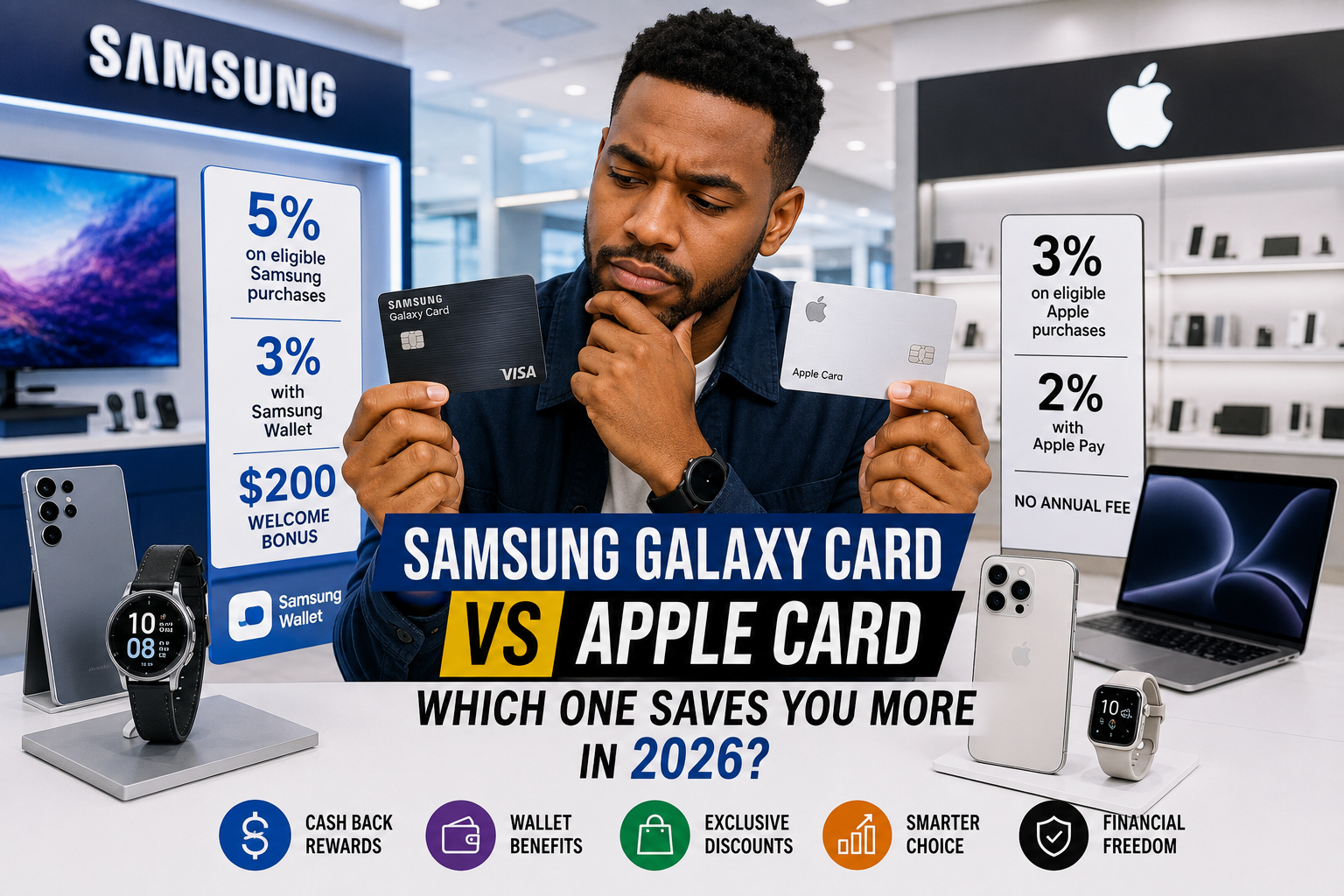
Credit cards connected to technology brands are designed to feel like natural extensions of the phones, watches, apps and devices you already use.
That convenience can be valuable.
It can also make brand loyalty more expensive than you realize.
Samsung has introduced its first U.S. consumer credit card, creating a new comparison for millions of people already familiar with Apple Card. The Samsung Galaxy Card is connected to Samsung Wallet and rewards customers more heavily for eligible Samsung purchases. Apple Card is built around Apple Wallet, Apple Pay and purchases inside the Apple ecosystem.
At first glance, Samsung appears to offer the stronger rewards:
- 5% cash rewards on eligible purchases made directly with Samsung
- 3% cash rewards on purchases made through Samsung Wallet
- 2% cash rewards on eligible streaming services
- 1% cash rewards on other purchases
Apple Card generally offers:
- 3% Daily Cash on eligible Apple purchases
- 3% Daily Cash at selected participating merchants through Apple Pay
- 2% Daily Cash on purchases made with Apple Pay
- 1% Daily Cash when the physical titanium card is used
That makes the Samsung Galaxy Card vs Apple Card comparison look simple.
Samsung has the bigger percentages, so Samsung must be better.
But that conclusion can be misleading.
Credit-card value is not decided by the largest percentage printed in an advertisement. It is decided by your actual spending, the card’s eligibility rules, your payment habits and whether the rewards cause you to buy more than you normally would.
This guide will compare rewards, mobile-wallet benefits, welcome bonuses, financing, fees and the hidden ecosystem traps that can erase every dollar you earn.
No brand arguments.
No ecosystem worship.
Just the money.
Samsung Galaxy Card vs Apple Card: What Is the Basic Difference?
Samsung Galaxy Card is Samsung’s first U.S. consumer credit card. Samsung says the card is issued by Barclays and operates on the Visa network. It is available as a virtual card and as a premium metal physical card.
Cardholders can manage the account and redeem cash rewards through Samsung Wallet.
Apple Card is designed primarily for iPhone users and is managed through Apple Wallet. Users can review transactions, make payments, monitor spending, receive Daily Cash and access Apple’s financial tools directly from an iPhone.
Apple Card uses the Mastercard network.
Although the two cards come from different technology companies, their business strategies are similar:
- Connect the credit card to a branded mobile wallet.
- Reward customers for buying products within the company’s ecosystem.
- make account management feel easy and convenient.
- Encourage customers to use the company’s payment system more frequently.
- Increase loyalty to the company’s phones, watches, tablets, computers and services.
That fifth point is where consumers need to be careful.
A card can reward loyalty while quietly making it harder to compare competing products.
How the Samsung Galaxy Card Rewards Work
Samsung’s announced rewards structure includes:
- 5% cash rewards on eligible purchases made directly with Samsung
- 3% cash rewards on purchases made with Samsung Wallet
- 2% cash rewards on eligible streaming services
- 1% cash rewards on other purchases
- A discount on Samsung VIP Advantage, plus additional rewards on eligible membership purchases or renewals
Samsung also announced a launch welcome offer of $200 in bonus cash rewards after spending $2,000 within the first 90 days, subject to eligibility and account terms.
That is an aggressive rewards structure.
Someone who already buys Samsung phones, televisions, appliances, watches, tablets and accessories could earn meaningful rewards.
However, the phrase eligible purchases matters.
Never assume every transaction involving a Samsung product earns 5%.
Before applying, confirm:
- Whether purchases must be made directly on Samsung’s website or app
- Whether Samsung products bought at Best Buy, Amazon or a wireless carrier qualify
- Whether gift-card purchases qualify
- Whether financed purchases earn rewards
- Whether returned purchases cause rewards to be reversed
- Whether Samsung Wallet rewards have earning caps
- Whether some merchant categories are excluded
The marketing page gives you the headline.
The card agreement gives you the truth.
How Apple Card Rewards Work
Apple Card offers 3% Daily Cash on eligible purchases made directly from Apple. This can include qualifying hardware, accessories, applications and selected Apple services.
Apple also offers 3% Daily Cash when Apple Card is used through Apple Pay at participating merchants. The current merchant list includes selected companies in categories such as travel, transportation, pharmacies, fuel and retail.
Most other purchases made through Apple Pay earn 2% Daily Cash.
Purchases made with the physical titanium Apple Card generally earn 1%.
Apple calls the reward Daily Cash because it usually becomes available after an eligible transaction posts rather than being held until the end of a monthly rewards cycle.
Users may be able to:
- Send Daily Cash to Apple Cash
- Apply it toward an Apple Card balance
- Deposit it into an eligible Apple Card Savings account
Apple Card’s biggest rewards weakness is the physical card.
The titanium card may look impressive, but its standard 1% reward makes it the least valuable way to use Apple Card.
Apple Card is most competitive when Apple Pay is accepted.
Samsung Galaxy Card vs Apple Card Rewards Comparison
| Spending category | Samsung Galaxy Card | Apple Card | Likely advantage |
|---|---|---|---|
| Direct brand purchases | 5% on eligible Samsung purchases | 3% on eligible Apple purchases | Samsung |
| Mobile-wallet purchases | 3% through Samsung Wallet | 2% through Apple Pay | Samsung |
| Selected streaming services | 2% | Usually 2% when paid through Apple Pay | Slight Samsung advantage |
| Selected partner merchants | Depends on final Samsung terms | 3% at participating merchants through Apple Pay | Apple in eligible categories |
| Other purchases | 1% | 1% with physical card or 2% through Apple Pay | Depends on payment method |
| Standard welcome offer | $200 after spending $2,000 in 90 days, subject to terms | No standard public offer listed | Samsung |
| Brand financing | Check eligible Samsung financing terms | Interest-free monthly installments on eligible Apple purchases | Compare the exact purchase |
The Samsung Galaxy Card vs Apple Card rewards comparison favors Samsung on paper.
But rewards only create value when they apply to purchases you were already going to make.
A 5% reward on an unnecessary purchase is still an unnecessary purchase.
The Samsung Welcome-Bonus Math
Samsung’s announced $200 welcome offer requires $2,000 in qualifying spending within the first 90 days.
That equals approximately:
- $667 per month
- $154 per week
- About $22 per day
If your normal planned expenses can meet the requirement, the bonus could be useful.
If you need to manufacture spending, upgrade a phone early or buy a television you did not need, the bonus becomes dangerous.
Consider this example.
You were already planning to spend $1,500 during the first 90 days.
To reach the $2,000 requirement, you buy an unnecessary $500 device.
You receive the $200 bonus.
Your net result is not positive $200.
You spent an extra $500 to receive $200.
You are down $300 before considering taxes, accessories or interest.
The correct welcome-bonus rule is simple:
Never spend an extra dollar solely to qualify for a credit-card bonus.
A bonus should reward normal spending already included in your budget.
It should not create the spending.
The Brand-Loyalty Trap Both Cards Create
The largest danger in this comparison may not be the interest rate or rewards percentage.
It is ecosystem pressure.
Suppose Samsung offers 5% back on a $1,500 television.
Your reward would be $75.
That sounds excellent.
But imagine a competing television with similar features and quality costs $1,250.
Buying the more expensive Samsung television to earn the reward would cost you an additional $250 to earn $75.
You would still lose $175.
The same logic applies to Apple.
A 3% reward on a $1,200 laptop gives you $36.
If another computer that meets your needs costs $900, the Apple reward does not make the $1,200 computer the better financial choice.
This is why consumers should compare the final net price rather than the reward percentage.
Use this formula:
Net purchase cost = Item price − immediate discount − card reward − trade-in value + taxes, fees and required accessories
Brand loyalty becomes expensive when you stop comparing the full market.
How Much Could Each Card Earn in One Year?
Consider a hypothetical consumer who spends:
- $1,500 annually with their preferred technology brand
- $8,000 through a mobile wallet
- $1,200 on eligible streaming services
- $6,000 on other purchases
Possible Samsung Galaxy Card rewards
Assuming all spending qualifies at the advertised rates:
- $1,500 in eligible Samsung purchases × 5% = $75
- $8,000 through Samsung Wallet × 3% = $240
- $1,200 in eligible streaming purchases × 2% = $24
- $6,000 in other purchases × 1% = $60
Estimated annual rewards: $399
Add the initial $200 welcome bonus, and estimated first-year rewards could reach $599.
That estimate assumes:
- Every purchase qualifies
- There are no applicable reward caps
- No purchases are returned
- The cardholder does not change their spending
- The full statement balance is paid every month
Possible Apple Card rewards
Assume:
- $1,500 in Apple purchases × 3% = $45
- $8,000 in Apple Pay purchases × 2% = $160
- $1,200 in other eligible Apple Pay purchases × 2% = $24
- $6,000 using the physical card × 1% = $60
Estimated annual rewards: $289
The difference is approximately $110 per year in Samsung’s favor under these assumptions.
But change one behavior and the result changes.
If the Apple Card user makes nearly all purchases through Apple Pay rather than using the physical card, Apple’s rewards increase.
If Samsung’s 3% Wallet category has exclusions or caps, Samsung’s rewards could decrease.
If either cardholder carries a balance, the rewards may become financially meaningless.
Samsung Galaxy Card vs Apple Card: Interest Can Erase the Rewards
This is the most important section of the entire post.
Apple has published variable annual percentage rates ranging from 17.49% to 27.74%, depending on creditworthiness, as of January 1, 2026.
Samsung Galaxy Card applicants should review the Barclays pricing disclosure shown during the application process because the final rate can depend on creditworthiness and current account terms.
Here is why that matters.
Suppose you carry an average $3,000 balance at 24% APR.
A rough annual interest cost could approach $720 if the balance remained around that level.
You could earn:
- $300
- $400
- Or even $600 in rewards
And still lose money after interest.
A rewards card is only a useful wealth-building tool when you pay the statement balance in full and on time.
Otherwise, it becomes an expensive loan with attractive branding.
True Wealth Moves rule:
Do not choose a credit card based on rewards if you regularly carry balances. Your first priority should be eliminating the interest.
Which Card Has the Better Fee Structure?
Apple says Apple Card has:
- No annual fee
- No foreign-transaction fee
- No over-limit fee
- No late fee
The absence of a late fee does not mean late payments are harmless.
Interest may continue to accrue, and missed payments can damage your credit history and make future borrowing more expensive.
Samsung announced the Galaxy Card without an annual fee and with no foreign-transaction fee. Applicants should still read the complete Barclays pricing disclosure before accepting the account.
Confirm:
- The purchase APR
- Any balance-transfer fee
- Any cash-advance fee
- Penalty terms
- Payment requirements
- Reward restrictions
- Promotional financing expiration rules
Do not interpret “no annual fee” as “no cost.”
For most cardholders, interest is a much larger potential expense than the annual fee.
Apple Monthly Installments vs Samsung Financing
Apple Card offers interest-free monthly installments on eligible Apple products purchased directly through Apple.
Eligible customers can also receive 3% Daily Cash on the qualifying purchase price.
Samsung says Galaxy Card includes financing options for eligible Samsung products, but consumers should compare the exact financing offer presented at checkout.
Financing can be helpful when:
- The rate is genuinely 0%
- The purchase was already planned
- The monthly payment fits comfortably within the budget
- You understand the repayment period
- You could afford the purchase without depending on a future raise or bonus
Financing becomes dangerous when:
- It makes a more expensive model appear affordable
- You stack several device payments
- You replace functioning technology early
- You forget that the payment reduces future cash flow
- Deferred interest or promotional terms are misunderstood
A $50 monthly payment does not mean the item costs $50.
It means you have committed part of several future paychecks.
Samsung Wallet vs Apple Wallet
Samsung Galaxy Card is designed to integrate with Samsung Wallet.
Users can manage the card, review activity and redeem rewards through the wallet. Samsung Wallet also supports compatible payment cards, passes, digital keys and selected identity features.
Apple Card is built directly into Apple Wallet on the iPhone.
Apple provides:
- Transaction details
- Spending summaries
- Payment tools
- Daily Cash management
- Apple Card Family features
- Access to eligible savings tools
The better wallet experience will largely depend on the phone you already own.
For a Samsung Galaxy user, Samsung Wallet integration may feel more natural.
For an iPhone user, Apple Card provides the deeper native experience.
Do not switch phone ecosystems merely to access a slightly higher card reward.
Replacing a phone, watch, tablet, accessories, apps and cloud services could easily cost more than several years of additional cashback.
Who May Benefit From Samsung Galaxy Card?
Samsung Galaxy Card may be appropriate for someone who:
- Already owns and prefers Samsung devices
- Plans substantial eligible purchases directly from Samsung
- Regularly uses Samsung Wallet
- Can meet the welcome-bonus requirement with normal spending
- Pays the statement balance in full
- Compares Samsung prices with competing retailers
- Will not upgrade devices solely because of rewards
The card may be especially useful during a planned Samsung appliance, television or device purchase if the transaction qualifies for 5%.
But always compare the direct Samsung price with the price available elsewhere.
A higher reward does not repair an inflated purchase price.
Who May Benefit From Apple Card?
Apple Card may be appropriate for someone who:
- Already uses an iPhone
- Makes most purchases through Apple Pay
- Buys Apple products or services regularly
- Values immediate Daily Cash
- Wants spending management inside Apple Wallet
- Uses eligible Apple Card Monthly Installments responsibly
- Pays the statement balance in full
Apple Card may also appeal to consumers who want Daily Cash automatically directed to Apple Cash or an eligible Apple Card Savings account.
Its 2% Apple Pay rate is useful but not automatically the best available reward.
Consumers should compare Apple Card with general cashback cards and cards that offer higher rewards in their largest spending categories.
When Neither Card Is the Best Choice
Neither card may be right for you when:
- You rarely buy products from Samsung or Apple
- You do not use Samsung Wallet or Apple Pay frequently
- Most of your spending is on groceries, dining, gas or travel
- Another card rewards your actual spending more effectively
- You are paying down existing card debt
- Opening another account would encourage more shopping
- You are applying mainly because the physical card looks impressive
- You tend to replace devices before they are necessary
The best credit card is not the one attached to your favorite phone.
It is the one that produces the highest net value from spending you already do while creating the least financial risk.
Samsung Galaxy Card vs Apple Card: The Five-Question Test
Before applying for either card, answer these questions honestly.
1. Which phone ecosystem do I already use?
Choose based on your present life, not a future upgrade fantasy.
2. How much did I actually spend with Samsung or Apple last year?
Review your bank and credit-card statements.
Do not estimate based on how loyal you feel.
3. How much normal spending can go through the matching wallet?
The wallet-reward categories are central to both cards.
Your local merchants and payment habits will affect the result.
4. Will I pay the statement balance in full every month?
If the answer is no, the reward comparison should not drive your decision.
5. Will the card encourage me to buy more technology?
This is the hardest question.
A card that increases your spending can make you poorer while continuing to show cashback in the app.
The True Wealth Moves Branded-Card Rule
Use a branded credit card only when it reduces the cost of a brand you had already chosen after comparing alternatives.
The correct order is:
- Identify the product you genuinely need.
- Compare competing products and retailers.
- Choose the best total value.
- Negotiate or apply any trade-in offers.
- Then use the payment method that provides the strongest reward.
Do not reverse that order.
Do not choose the product because the card rewards it.
That is how companies turn cashback into additional sales.
External Resource
Before applying, review the current Samsung Galaxy Card rewards, eligibility requirements and application information on Samsung’s official announcement page:
https://news.samsung.com/us/samsung-introducing-galaxy-card
Continue Building Your Financial Knowledge
Read more practical saving, credit and wealth-building strategies on the True Wealth Moves blog:
https://truewealthmoves.com/wealth-blog
Use the True Wealth Moves resources page for financial tools, guides and calculators:
Final Verdict: Samsung Galaxy Card vs Apple Card
Based on the announced rewards, Samsung Galaxy Card is the stronger cashback card on paper.
Its advertised 5% rate on eligible direct Samsung purchases and 3% rate through Samsung Wallet exceed Apple Card’s standard 3% Apple-purchase rate and 2% Apple Pay rate.
Samsung also introduced a $200 welcome offer after meeting the qualifying spending requirement.
Apple Card, however, has a longer operating history and offers:
- A simple Daily Cash system
- Strong iPhone integration
- Interest-free installments on eligible Apple purchases
- Spending-management tools
- Apple Card Family
- A clearly established no-fee structure
The practical result is:
- Samsung-heavy household: Samsung Galaxy Card may provide more rewards.
- Apple-heavy household: Apple Card may provide the better integrated experience.
- Samsung Wallet user: Samsung’s 3% wallet rate could be valuable if purchases qualify.
- Apple Pay user: Apple’s 2% rate remains useful and widely accessible.
- Consumer carrying debt: Neither rewards structure matters until the balance is controlled.
- Consumer who upgrades too often: Either card could encourage overspending.
- Consumer who rarely buys either brand: A general cashback card may be better.
Samsung wins the headline rewards comparison.
Apple may still win for some users based on familiarity, financial tools, merchant acceptance and ecosystem integration.
Your actual winner is whichever card rewards the purchases you were already planning without changing what you buy.
That is the True Wealth Moves rule:
Use the ecosystem. Do not let the ecosystem use you.
Looking for More Finance Topics?
Use the search box below to explore hundreds of articles on True Wealth Moves — we’ve probably already written about what you’re looking for.





