
Global Trade War 2026: Why “Made Somewhere Else” Is Becoming a Money Risk for American Households
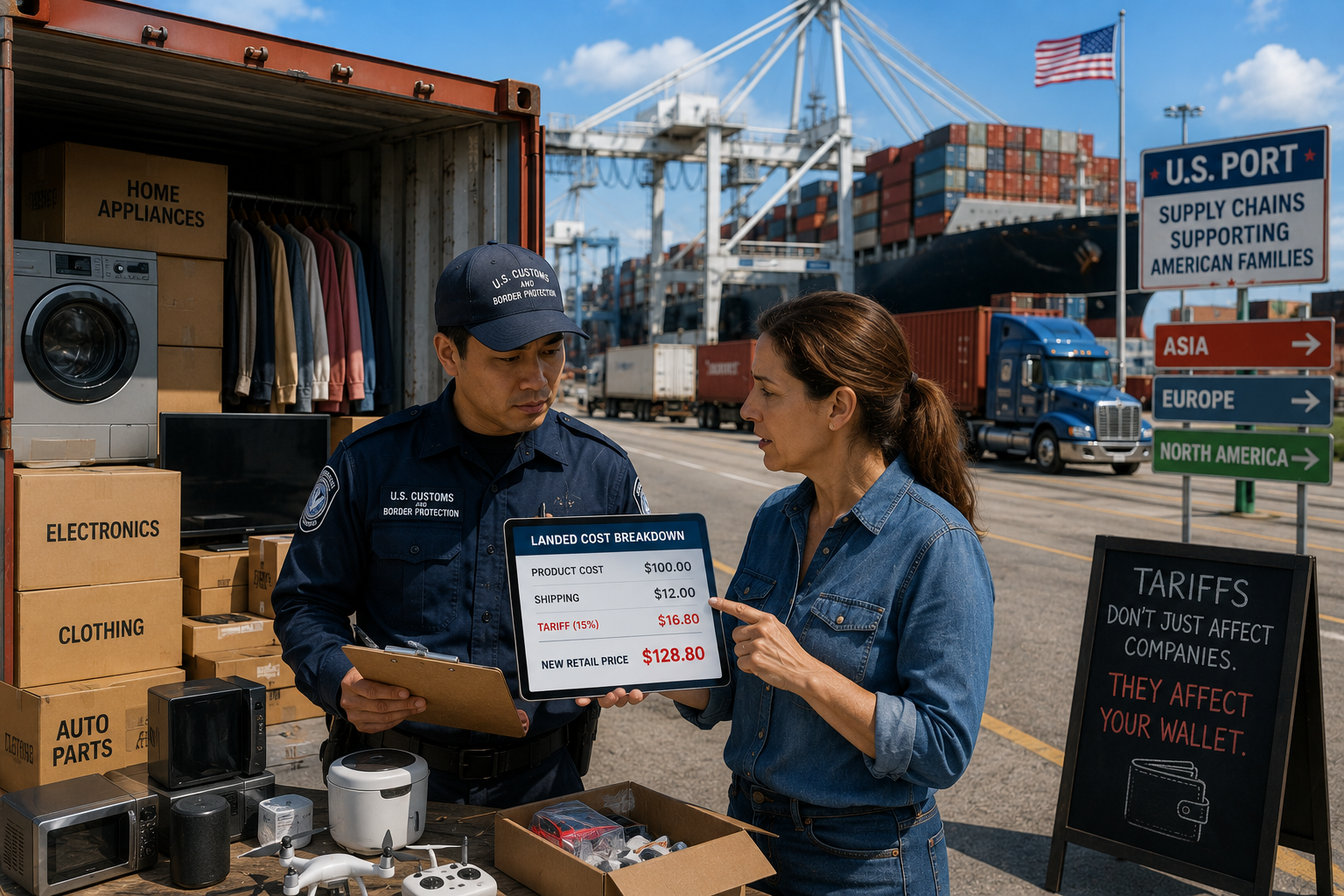
For decades, globalization helped make a simple promise to American consumers:
Companies could manufacture products wherever production was cheapest, move them across borders efficiently, and sell them at competitive prices.
That system helped fill American homes with:
- Affordable electronics
- Inexpensive clothing
- Imported food
- Appliances
- Furniture
- Auto parts
- Smartphones
- Toys
- Solar equipment
- Household goods
But the global economy is changing.
Governments around the world are increasingly using:
- Tariffs
- Import restrictions
- Export controls
- Subsidies
- Local manufacturing requirements
- National-security rules
- Strategic supply-chain policies
to influence where products are made and who gets access to them.
That is why the global trade war 2026 is different from a simple argument about tariffs.
The bigger story is the gradual transformation of the global supply chain.
Countries increasingly want critical products made:
- Domestically
- By political allies
- Or at least outside countries considered strategic competitors
That may improve national resilience in some industries.
It may also raise costs.
And those costs can eventually reach:
- Consumers
- Businesses
- Investors
- Workers
The financial risk is simple:
Where something is made is becoming increasingly important to what it eventually costs.
A washing machine may use components from several countries.
A smartphone may contain:
- American-designed chips
- Asian-made components
- Rare-earth materials sourced elsewhere
- Assembly performed in another country
A car may have thousands of parts crossing international borders before it reaches the dealership.
A tariff or export restriction affecting only one important component can influence the entire product.
This global trade war 2026 guide will explain:
- Why governments are intervening more aggressively in trade
- How tariffs reach household budgets
- Why subsidies can also change prices
- Which products are most exposed
- Why electronics and automobiles deserve attention
- How businesses respond to trade restrictions
- Why moving manufacturing does not happen overnight
- How consumers can “trade-war-proof” major purchases
- Which companies may benefit
- Which investment risks deserve attention
No political argument.
No prediction that globalization is ending tomorrow.
Just the money.
Global Trade War 2026: What Has Actually Changed?
A traditional trade war is easy to understand.
Country A places tariffs on Country B.
Country B retaliates.
Products become more expensive.
But the modern trade conflict is broader.
Governments are increasingly competing through:
Tariffs
Taxes placed on imported goods.
Export restrictions
Rules preventing or limiting strategically important products from leaving the country.
Subsidies
Government financial support for domestic industries.
Local-content rules
Requirements that products contain a certain amount of domestically produced material.
Investment restrictions
Rules controlling where companies can invest or which foreign companies can own strategic assets.
Technology controls
Restrictions involving:
- Chips
- AI hardware
- Semiconductor equipment
- Telecommunications
- Critical minerals
This means companies can no longer design supply chains based only on:
Where can we produce this cheapest?
They increasingly must ask:
Where can we produce this without creating geopolitical risk?
That changes the economics.
The Global Trade War 2026 Is Really a Supply-Chain War
The word “tariff” receives most of the attention.
But supply chains may be the bigger story.
Suppose a manufacturer produces a refrigerator in the United States.
Sounds domestic.
But the refrigerator may still contain:
- Imported steel
- Electronics
- Compressors
- Wiring
- Sensors
If imported components become more expensive, the American-made refrigerator can become more expensive too.
This is why simply checking whether a final product says:
Made in USA
does not tell you whether it is protected from global trade disruptions.
Modern manufacturing is deeply interconnected.
How a Tariff Reaches Your Wallet
Consider a simplified example.
An American retailer imports a product from overseas.
Original cost:
$100
Suppose a 15% tariff applies.
New import cost:
$115
The importer now has several choices.
Option 1: Absorb the tariff
Profit margin falls.
Option 2: Raise the selling price
Consumer pays more.
Option 3: Pressure the supplier
Foreign manufacturer lowers its price.
Option 4: Change suppliers
Company sources elsewhere.
Option 5: Redesign the product
Cheaper components are used.
Usually, the result is some combination of these.
That is why the full tariff does not always appear immediately as a matching retail price increase.
The cost moves through the supply chain.
Tariffs Are Not Always Paid by the Foreign Country
This is one of the most misunderstood parts of trade policy.
A tariff is collected when an imported product enters the country.
The importing company typically pays the tariff to the government.
The company then decides what to do with the added cost.
That can eventually affect:
- Retail prices
- Profit margins
- Supplier contracts
- Wages
- Investment
The foreign producer may absorb part of the cost by reducing prices.
But consumers and American businesses can also bear part of it.
Who ultimately pays depends on:
- Competition
- Demand
- Supplier alternatives
- Pricing power
The Global Trade War 2026 Household Risk Table
| Household category | Trade-war exposure | Why |
|---|---|---|
| Smartphones/electronics | High | Global chips, components and assembly |
| Vehicles | High | Thousands of globally sourced parts |
| Appliances | Moderate to high | Metals, motors and electronics |
| Clothing | High | Heavy dependence on imported manufacturing |
| Furniture | Moderate | Large imported share |
| Groceries | Varies | Depends on product and season |
| Gasoline | Indirect | Energy and geopolitical exposure |
| Homebuilding | Moderate to high | Lumber, metals and equipment |
| Solar equipment | High | Global manufacturing concentration |
Global trade war 2026 household risk table showing which consumer products face the highest international supply-chain exposure.
The point is not to rush out and buy everything.
The point is understanding where price volatility may appear first.
Electronics May Be One of the Biggest Pressure Points
Modern electronics depend on enormous global networks.
A laptop might require:
- Semiconductor chips
- Memory
- Display panel
- Battery
- Camera sensors
- Rare-earth materials
- Networking components
These may originate in several different countries.
Semiconductors are especially strategic because they power:
- AI
- Smartphones
- Vehicles
- Military equipment
- Medical devices
- Industrial machinery
Governments increasingly view advanced chips as a national-security issue.
That means trade restrictions in semiconductors may persist even when broader economic relationships improve.
For consumers, that can affect:
- Computer prices
- Smartphones
- Gaming hardware
- Vehicles
- Smart appliances
Should You Buy Electronics Early Because of Tariffs?
Not automatically.
Fear purchasing can be expensive.
Imagine buying a:
$1,500 laptop
six months before you need it because you fear prices will rise 10%.
Potential avoided increase:
$150
But what if:
- The laptop goes on sale later?
- A better model launches?
- Your current computer keeps working?
- Prices never rise 10%?
You may spend $1,500 early to protect yourself from a hypothetical $150 increase.
That can be poor financial planning.
Use the replacement-window rule.
If you genuinely expect to replace an item within:
3–6 months
and:
- The current price is competitive
- You have cash available
- The product already fits your needs
buying before a known price increase may make sense.
If replacement is years away, wait.
Cars Are Extremely Exposed to Global Trade
Modern automobiles are among the most complicated products consumers buy.
A vehicle can contain:
- Chips
- Batteries
- Steel
- Aluminum
- Electronics
- Wiring harnesses
- Tires
- Sensors
from multiple countries.
That means trade restrictions can affect vehicles through several channels.
Not just tariffs on complete imported cars.
A domestic carmaker may still rely on imported:
- Parts
- Metals
- Batteries
This is why auto prices can respond to global trade policy even when the vehicle is assembled in America.
The $50,000 Car Example
Suppose a vehicle currently sells for:
$50,000
Trade-related costs increase production expenses by:
$2,000
The manufacturer may:
- Absorb part
- Raise MSRP
- Reduce incentives
- Increase financing promotions elsewhere
Perhaps the customer sees only:
$1,200 higher purchase price
On a financed vehicle, that increase can cost more after interest.
If financed for six years, the total household cost could exceed the initial $1,200 difference.
Trade policy can therefore influence both:
purchase price
and
financing cost.
Grocery Prices Can Also Be Affected
Food supply chains are international.
Americans import:
- Fruit
- Vegetables
- Seafood
- Coffee
- Cocoa
- Wine
- Specialty products
Tariffs or trade disputes can affect some categories more than others.
Agriculture is also commonly used in retaliation.
Why?
Because agricultural exports are politically sensitive.
If Country A taxes manufactured products, Country B may retaliate against:
- Soybeans
- Dairy
- Meat
- Alcohol
- Produce
This can affect:
- Farmers
- Exporters
- Food processors
- Consumers
Households should avoid panic-buying groceries based on trade headlines.
Instead build flexibility.
The Trade-War Grocery Strategy
Use substitutions.
If one imported product rises sharply, consider:
- Different brand
- Domestic alternative
- Seasonal alternative
- Store brand
- Different protein
- Different produce
Price flexibility is one of the strongest household defenses against inflation.
The more emotionally attached you are to one product, the more pricing power the seller has over you.
Clothing and Shoes Are Especially Sensitive
Apparel supply chains have historically concentrated production in lower-cost manufacturing countries.
That means trade restrictions can affect:
- Clothing
- Shoes
- Accessories
Brands may respond by relocating sourcing to:
- Vietnam
- India
- Bangladesh
- Mexico
- Turkey
- Central America
But changing factories is not instant.
Companies must:
- Qualify suppliers
- Check quality
- Negotiate contracts
- Build logistics
- Meet labor standards
That transition costs money.
Consumers may eventually pay part of that cost.
“Made Somewhere Else” Does Not Mean Made Cheaper
Companies attempting to avoid tariffs often move production from one country to another.
This process is sometimes called:
trade diversion
Instead of importing from Country A, a business imports from Country B.
But Country B may have:
- Higher labor costs
- Less manufacturing capacity
- Worse transportation
- Higher energy costs
So tariffs can change supply chains even when consumers never see a product labeled as tariffed.
The new supplier may simply cost more.
Friend-Shoring and Near-Shoring
Companies increasingly use strategies such as:
Friend-shoring
Moving production toward politically allied countries.
Near-shoring
Moving production closer to the final consumer.
For American companies, near-shoring may involve:
- Mexico
- Canada
- Central America
Potential benefits include:
- Shorter shipping routes
- Faster delivery
- Less geopolitical risk
Potential downsides:
- Higher production costs
- Limited capacity
- Infrastructure constraints
Resilience often costs more than maximum efficiency.
The Old Supply Chain Was Built Around Efficiency
For decades, companies focused heavily on:
- Lowest cost
- Just-in-time inventory
- Global specialization
This made products cheaper.
But it also created vulnerabilities.
COVID exposed one.
Geopolitical tensions exposed another.
If one critical factory stops producing, global companies can face shortages.
Now businesses increasingly value:
resilience
alongside:
efficiency.
That may mean:
- Extra suppliers
- More inventory
- Domestic manufacturing
- Redundant factories
All of these improve resilience.
All can cost money.
Global Trade War 2026: Why Subsidies Matter Too
Tariffs make imports more expensive.
Subsidies work differently.
A government may give:
- Tax credits
- Grants
- Cheap financing
to encourage domestic production.
Examples can involve:
- Semiconductors
- Batteries
- Solar manufacturing
- Energy
Subsidies may initially reduce costs for companies.
But they can also encourage countries to compete by spending large amounts supporting national industries.
That can distort investment.
A factory may exist partly because of:
government incentives
rather than purely because it is the most efficient producer.
Investors need to know the difference.
The Subsidy Cliff
Imagine a company earns:
$500 million annually
but receives:
$200 million
in government support.
If the subsidy expires:
Profitability changes dramatically.
Investors should ask:
- How dependent is this company on tax credits?
- When do incentives expire?
- Would the project still be profitable without government support?
Government policy can create winners.
Policy changes can reverse them.
Rare Earths Are a Hidden Trade Risk
Modern products require critical minerals such as:
- Lithium
- Cobalt
- Nickel
- Graphite
- Rare-earth elements
These materials matter for:
- EV batteries
- Electronics
- Defense systems
- Wind turbines
Supply is concentrated geographically.
That creates strategic risk.
Governments increasingly want secure access.
Export restrictions on critical minerals can ripple through many industries.
The average consumer may never buy raw lithium.
But they may pay more for:
- Electric vehicles
- Batteries
- Electronics
if material costs rise.
The Global Trade War 2026 Small-Business Problem
Large corporations can adapt more easily than small businesses.
A multinational retailer may have:
- International sourcing teams
- Lawyers
- Customs specialists
- Multiple suppliers
A small importer may have:
- One supplier
- Limited inventory
- Small cash reserves
Suppose a business imports:
$100,000 of inventory
A new 15% tariff creates:
$15,000 additional cost
The business must pay the cost before eventually selling the goods.
That creates a working-capital problem.
The owner may:
- Raise prices
- Borrow
- Reduce staff
- Cut inventory
That is how trade policy can eventually affect local businesses.
Consumers Should Watch Discounts, Not Only Sticker Prices
Companies do not always respond by raising the official price.
They may instead reduce:
- Promotions
- Coupons
- Free shipping
- Rebates
Example:
Old price:
$1,000
Normal discount:
$150
Real price:
$850
After trade costs:
Sticker price stays:
$1,000
Discount falls:
$50
Real price:
$950
The official price did not change.
The consumer still pays:
$100 more.
Watch the full transaction price.
The TWM Trade-War Purchase Rule
For large purchases, ask:
Do I need it?
Need beats fear.
Will I buy within six months anyway?
If yes, timing may matter more.
Is the current price historically competitive?
Compare.
Can I pay without debt?
Do not create credit-card debt to avoid hypothetical inflation.
Is there a reasonable substitute?
Brand flexibility protects money.
Trade-War Purchase Decision Table
| Situation | Smart response |
| Laptop works well | Wait |
| Laptop failing and replacement planned soon | Compare prices now |
| Car purchase optional | Avoid panic buying |
| Appliance near end of life | Begin price monitoring |
| Clothing price rises | Substitute brands |
| Imported food rises | Use alternatives |
| Home renovation optional | Recalculate material costs |
| Solar project planned | Review equipment pricing and incentives |
Global trade war 2026 purchase decision table showing when consumers should buy, wait or substitute products.
Investors: Trade Wars Create Winners and Losers
Trade restrictions do not affect every company equally.
Potential beneficiaries may include:
- Domestic manufacturers
- Logistics companies
- Local suppliers
- Strategic-mineral producers
Potential losers may include:
- Import-heavy retailers
- Companies with thin margins
- Manufacturers dependent on restricted components
- Exporters facing retaliation
But do not buy stocks simply because:
“Tariffs help American manufacturers.”
Reality is more complex.
Domestic manufacturers may still depend on imported inputs.
Read company disclosures.
The Four Questions Investors Should Ask
1. Where are products manufactured?
Geographic concentration matters.
2. Where are components sourced?
Final assembly does not tell the whole story.
3. Can the company raise prices?
Strong brands may pass on costs more easily.
4. How quickly can supply chains move?
Companies with several suppliers have more flexibility.
Trade policy has become a balance-sheet question.
Currency Changes Can Complicate Everything
Trade wars can influence currencies.
If the U.S. dollar strengthens, imported goods may become cheaper in dollar terms.
That can offset part of a tariff.
If foreign currency strengthens, costs can rise further.
This is why tariff math rarely translates directly into retail-price math.
Several forces interact:
- Tariffs
- Currency
- Supplier pricing
- Shipping
- Demand
The final consumer price reflects all of them.
Retaliation Can Hurt American Exporters
Trade wars operate in both directions.
If the U.S. raises barriers, trading partners may retaliate.
American companies exporting:
- Agriculture
- Machinery
- Technology
- Alcohol
- Vehicles
may face new barriers abroad.
That can affect:
- Revenue
- Jobs
- Investment
A policy designed to protect one industry may create costs for another.
Investors should evaluate companies individually.
Global Trade War 2026: Build a Household Trade Buffer
You do not need a special “tariff emergency fund.”
But a general household buffer helps absorb price shocks.
Suppose monthly expenses are:
$5,000
Create an inflation/trade buffer of:
2%
Monthly:
$100
Annual:
$1,200
This money can absorb increases involving:
- Clothing
- Electronics
- Repairs
- Household goods
without immediately using debt.
If prices remain stable, the money becomes savings.
Use Sinking Funds for Trade-Sensitive Purchases
Examples:
Electronics
Expected replacement:
$1,500 in 18 months
Monthly saving:
Approximately $84
Appliance
Expected replacement:
$1,200 in 24 months
Monthly saving:
$50
Vehicle
Future down payment:
$10,000 in 36 months
Monthly saving:
Approximately $278
A price increase becomes much easier to absorb when the purchase is already funded.
The Best Trade-War Defense Is Flexibility
Consumers with the most flexibility have more options.
They can:
- Delay purchases
- Change brands
- Buy used
- Substitute products
Consumers with no flexibility may have to accept whatever price exists.
Build flexibility through:
- Cash savings
- Low debt
- Brand independence
- Advance planning
Financial flexibility is purchasing power.
Don’t Stockpile Random Products
Trade headlines can create panic buying.
Do not buy:
- Multiple televisions
- Extra laptops
- Appliances you don’t need
to “beat tariffs.”
Inventory sitting in your garage is not wealth.
Technology depreciates.
Warranties expire.
Cash is flexible.
Only accelerate purchases already inside a realistic replacement window.
The 12-Month Trade-War Household Plan
Months 1–3: Identify Exposure
Review planned purchases:
- Vehicle
- Electronics
- Appliances
- Home improvements
Months 4–6: Build Sinking Funds
Automate savings.
Months 7–9: Compare Alternatives
Research:
- Used options
- Domestic alternatives
- Different brands
Months 10–12: Review Pricing
Compare actual price changes with your original expectations.
Do not let news headlines dictate spending.
Use real prices.
Global Trade War 2026: The Bigger Economic Risk
The largest long-term risk may not be one tariff.
It is fragmentation.
Imagine a world where major economic blocs develop separate:
- Technology standards
- Manufacturing networks
- Energy systems
That can create redundancy.
Instead of one efficient global factory network, companies may maintain several.
Resilience improves.
Efficiency declines.
The world may pay more for the same amount of production.
That is the deeper financial story behind trade fragmentation.
Why This May Be Different From Temporary Inflation
A temporary shipping problem eventually disappears.
A structural redesign of global supply chains can last years.
Factories require:
- Land
- Equipment
- Workers
- Infrastructure
Companies cannot move them overnight.
That means the costs of deglobalization or supply-chain diversification can persist for a long time.
Consumers should prepare for more price volatility across internationally traded goods.
External Resource
For authoritative information on current U.S. tariff actions, trade enforcement and Section 301 measures, review the Office of the United States Trade Representative:
Continue Building Your Financial Knowledge
Read more practical saving, investing and consumer-money strategies on the True Wealth Moves blog:
https://truewealthmoves.com/wealth-blog
Use the True Wealth Moves resources page for financial tools, guides and calculators:
Final Verdict: Global Trade War 2026 Means Where Things Are Made Matters Again
For years, most consumers did not need to think much about global supply chains.
You wanted:
- A phone
- A car
- Shoes
- Furniture
You compared the price.
The global production system worked in the background.
That system is becoming more visible.
The global trade war 2026 means companies increasingly must consider:
- Tariffs
- National security
- Export restrictions
- Political alliances
- Domestic subsidies
- Critical minerals
when deciding where to manufacture products.
Those decisions can eventually affect your wallet.
But consumers should not respond with panic.
The right response is preparation.
Remember:
- Do not buy products early solely because you fear tariffs.
- Accelerate only purchases already within a realistic replacement window.
- Compare total prices rather than sticker prices.
- Stay flexible on brands.
- Build sinking funds for electronics, vehicles and appliances.
- Avoid high-interest debt.
- Understand that domestic products can still contain imported components.
- Investors should examine supply-chain exposure company by company.
The world is not necessarily abandoning international trade.
But trade is becoming more political.
And when politics determines where products can be built, the cheapest production option may no longer win.
That can make household prices more unpredictable.
That is the True Wealth Moves conclusion:
The next time you buy something, the most important question may not only be “How much does it cost?” It may also be “Where did it come from—and how many borders did it cross before reaching me?”
Looking for More Finance Topics?
Use the search box below to explore hundreds of articles on True Wealth Moves — we’ve probably already written about what you’re looking for.





