
Extreme Heat Cost of Living: How Hotter Summers Are Quietly Raising Your Bills
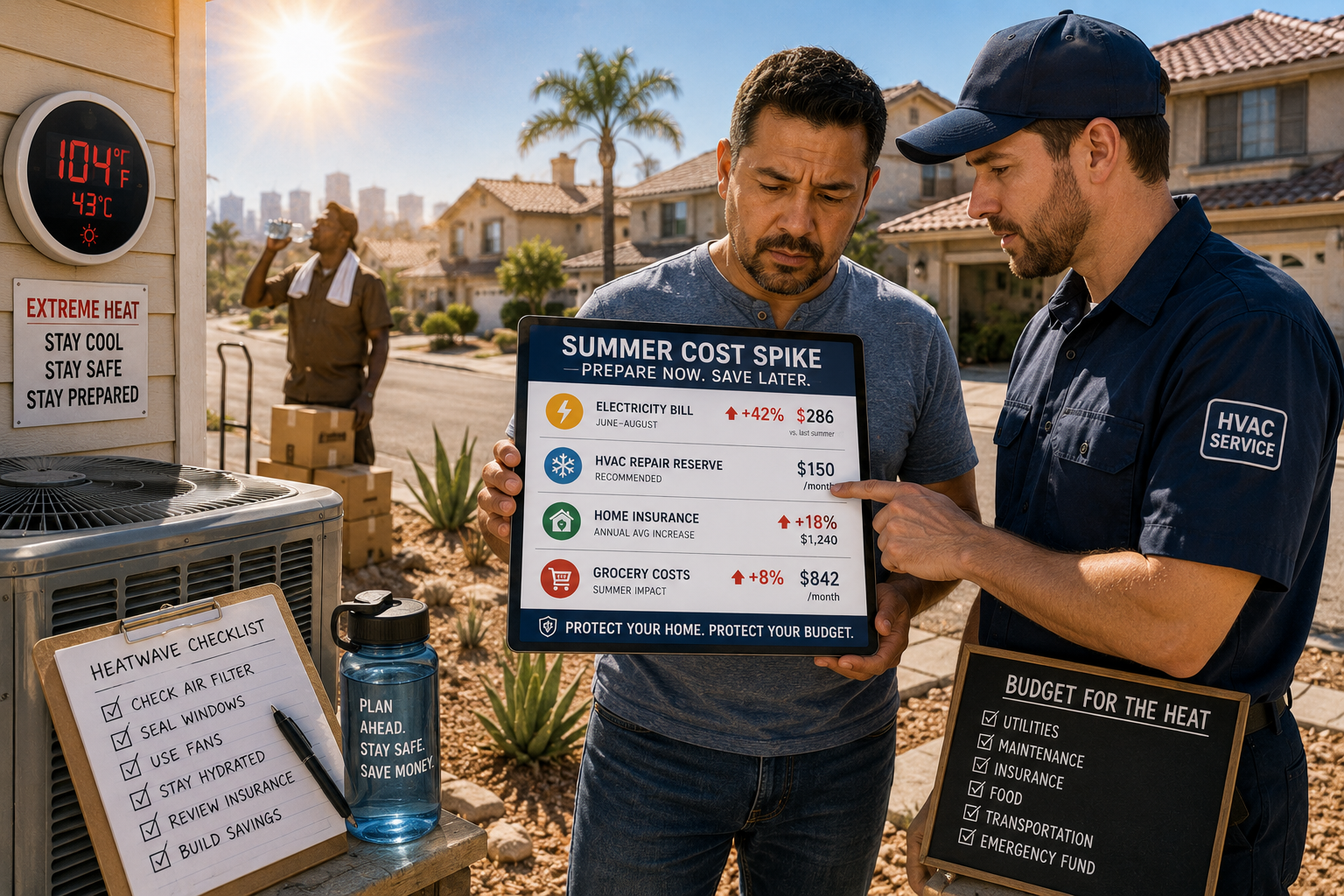
Extreme heat used to feel like a weather problem.
Now it is becoming a money problem.
When temperatures rise for days or weeks at a time, the impact does not stop at discomfort.
Your air conditioner runs longer.
Electricity demand increases.
Food production becomes harder.
Farmers use more irrigation.
Workers become less productive.
Wildfires become more likely.
Insurance companies face larger claims.
Power grids become strained.
Transportation systems can slow down.
And eventually, many of those costs can show up inside the household budget.
That is why the extreme heat cost of living deserves much more attention from consumers.
This is not about predicting one unusually hot summer.
The bigger issue is financial preparation for a world where extreme temperatures may become more frequent, more expensive and more disruptive.
For ordinary households, the financial impact can appear through:
- Higher electricity bills
- More expensive groceries
- Increased home insurance
- Auto and property damage
- Air-conditioning repairs
- Higher medical expenses
- Lost work hours
- Travel disruptions
- Water restrictions
- More expensive home upgrades
Some costs are obvious.
You see the electricity bill.
Others are hidden inside:
- Food prices
- Insurance premiums
- Taxes
- Business prices
The financial mistake is treating every heat-related expense as an unexpected emergency.
A better strategy is building it into your household plan before the hottest part of the year arrives.
This guide will show you:
- Why extreme heat affects so many household expenses
- How cooling costs can rise dramatically
- Why lower-income households are especially vulnerable
- How heat can affect grocery prices
- Why insurance deserves attention
- Which home upgrades may actually save money
- How renters should prepare
- How workers can protect income
- How to create a climate expense sinking fund
- The TWM heatwave money plan
No panic.
No political argument.
Just the financial reality of hotter weather.
Extreme Heat Cost of Living: Why One Heatwave Can Affect So Many Prices
Heat enters the economy through several channels.
The first is simple.
People need more cooling.
That means increased use of:
- Air conditioners
- Fans
- Refrigeration
- Commercial cooling systems
Electric utilities must generate or purchase more electricity.
Businesses also pay more to cool:
- Stores
- Offices
- Warehouses
- Restaurants
- Factories
Those business costs may eventually appear in the prices customers pay.
But electricity is only the beginning.
Heat can also affect:
- Agriculture
- Shipping
- Construction
- Manufacturing
- Healthcare
- Tourism
- Insurance
That is why the extreme heat cost of living is not one expense.
It is a network of expenses.
Your Electricity Bill Is Usually the First Place You Feel It
Air conditioning can become one of the largest seasonal household electricity expenses.
Imagine a household with a normal electricity bill of:
$160 per month
During a prolonged heatwave, additional cooling raises the bill to:
$260
Difference:
$100
If extreme temperatures last three months:
$100 × 3 = $300
That is an additional $300 the household did not necessarily include in its normal annual budget.
Now imagine:
- Electricity rates increase
- The home has poor insulation
- The air-conditioning system is inefficient
The increase could be much larger.
This is why a household can experience a financial shock without buying anything new.
The same home simply becomes more expensive to operate.
Extreme Heat Cost of Living Electricity Example
| Monthly item | Normal summer | Extreme heat period | Increase |
|---|---|---|---|
| Electricity | $160 | $260 | +$100 |
| Water | $70 | $90 | +$20 |
| Gasoline | $250 | $265 | +$15 |
| Groceries | $800 | $840 | +$40 |
| Total | $1,280 | $1,455 | +$175 |
Three-month additional cost:
$175 × 3 = $525
Alt text for table: Extreme heat cost of living example showing how electricity, water, gasoline and grocery costs can rise during a hot summer.
A $525 seasonal increase may not destroy a middle-income household.
But for someone already living paycheck to paycheck, it can push normal expenses onto a credit card.
That is where heat becomes debt.
The Energy-Burden Problem
The cost of electricity does not affect every household equally.
Suppose Household A earns:
$12,000 per month
Summer electricity bill:
$300
Electricity represents:
2.5% of monthly income
Now Household B earns:
$3,000 per month
Same $300 bill.
Electricity represents:
10% of income
Same bill.
Very different financial burden.
Lower-income households may face an especially difficult choice:
- Keep the home safely cooled
- Buy groceries
- Pay medication costs
- Pay rent
That is why high heat can become an affordability issue rather than merely an energy issue.
Never Save Money by Making Your Home Unsafe
There is an important distinction between reducing energy waste and refusing necessary cooling.
Older adults, young children and people with certain health conditions can be especially vulnerable during extreme heat.
Do not treat safe indoor temperatures like an optional luxury.
The financial goal should be:
Lower the cost of safe cooling.
Not:
Avoid cooling completely.
Strategies may include:
- Improving insulation
- Using ceiling fans
- Closing blinds during peak sun
- Using programmable thermostats
- Cooling occupied rooms more efficiently
- Maintaining the HVAC system
But health and safety come first.
Your Air Conditioner Is a Financial Asset During Extreme Heat
Most households think about the air conditioner only when it breaks.
That is expensive thinking.
During extreme heat, HVAC repair companies may experience huge demand.
A repair that normally feels inconvenient can become urgent.
Suppose a system fails during a heatwave.
Potential costs:
- Emergency service call
- Hotel stay
- HVAC repair
- Full replacement
A major replacement can easily cost thousands of dollars depending on the home and equipment.
That is why HVAC belongs in your financial planning.
Create an HVAC Sinking Fund
Suppose you expect future HVAC repair or replacement costs of roughly:
$8,000
You hope the current system lasts another:
5 years
Simple monthly target:
$8,000 ÷ 60 = approximately $133 per month
You may choose a smaller amount.
The important point is creating dedicated money before failure occurs.
Even:
$50 per month
creates:
$600 annually
and:
$3,000 over five years
before interest.
That can significantly reduce the amount that eventually goes onto a credit card.
Maintenance Can Be Cheaper Than Emergency Repair
Regular HVAC maintenance may help identify:
- Dirty filters
- Refrigerant issues
- Worn components
- Airflow problems
before they become major failures.
Also check:
- Window seals
- Weather stripping
- Attic insulation
- Duct leaks
A powerful air conditioner inside an inefficient house can still produce an enormous electricity bill.
Efficiency begins with the building.
Extreme Heat Cost of Living and Grocery Prices
Agriculture depends heavily on weather.
Extreme heat can affect:
- Crop yields
- Livestock
- Irrigation
- Soil moisture
- Harvest timing
When yields fall, supply can tighten.
That does not mean every heatwave instantly increases every grocery price.
Food markets are complex.
Inventories, imports and global production all matter.
But repeated extreme heat across major agricultural regions can create pressure.
Foods particularly sensitive to weather may include:
- Grains
- Fruits
- Vegetables
- Coffee
- Cocoa
- Dairy
- Meat
Heat can affect livestock too.
Animals may:
- Eat less
- Produce less milk
- Require more cooling
- Experience greater health risks
Those costs eventually matter.
The Grocery Substitution Strategy
You cannot control global crop yields.
You can control how flexible your shopping is.
If one category increases sharply, switch.
Example:
Chicken rises substantially.
Compare:
- Turkey
- Eggs
- Beans
- Fish
- Other proteins
If berries become expensive, consider:
- Frozen fruit
- Seasonal alternatives
- Bananas
- Apples
Flexibility is an inflation defense.
Brand and product loyalty can become expensive during supply shocks.
Extreme Heat Cost of Living and Water Bills
Heat increases water demand.
Households may use more for:
- Lawns
- Gardens
- Pools
- Showers
At the same time, drought conditions can reduce available supply.
Some communities may introduce:
- Water restrictions
- Higher seasonal rates
- Usage penalties
Landscaping can become surprisingly expensive during prolonged heat.
Consider whether your yard requires:
- Heavy irrigation
- Frequent replacement plants
- Pool refilling
A lower-water landscape may reduce long-term costs in hotter areas.
Insurance Is One of the Biggest Hidden Heat Costs
Insurance pricing reflects risk.
Extreme heat does not always create insurance claims directly.
But heat contributes to conditions that can increase:
- Wildfire risk
- Drought
- Property damage
- Infrastructure stress
Insurance companies respond to risk by adjusting:
- Premiums
- Deductibles
- Coverage
- Underwriting rules
Some homeowners may see:
- Higher premiums
- Reduced coverage
- Nonrenewal risk
particularly in areas exposed to wildfire and other climate-related hazards.
That makes insurance an increasingly important part of the extreme heat cost of living.
Run a Home Insurance Audit Every Year
Do not automatically renew.
Review:
- Premium
- Deductible
- Dwelling coverage
- Personal-property coverage
- Additional living expenses
- Wildfire exclusions
- Roof rules
Then compare competitors.
But do not chase the cheapest premium blindly.
A low premium with weak coverage can be extremely expensive after a disaster.
Compare equivalent protection.
The Deductible Reserve
Suppose your homeowners insurance deductible is:
$5,000
Do you actually have $5,000 available?
If not, your insurance may not fully protect you financially.
Create an insurance-deductible sinking fund.
Example:
Goal:
$5,000
Monthly savings:
$100
Time:
50 months
You may accelerate it.
The principle is simple:
Know what you must pay before insurance starts paying.
Wildfire Risk Can Affect Renters Too
Renters may think:
“I don’t own the building, so this isn’t my problem.”
But renters still face:
- Temporary relocation
- Damaged belongings
- Lost food
- Hotel expenses
Renters insurance can be relatively inexpensive.
Review whether the policy covers:
- Personal property
- Additional living expenses
- Smoke damage
Also document belongings.
Take photos or video.
Store receipts for expensive items when possible.
Food in Your Refrigerator Is Money
Power outages during extreme heat can spoil:
- Meat
- Dairy
- Frozen foods
A full refrigerator and freezer can represent hundreds of dollars.
Some insurance policies may provide limited coverage for food spoilage after certain losses.
But deductibles and rules vary.
A simpler strategy is reducing loss risk.
Before major heat events:
- Avoid unnecessarily overstocking frozen food
- Know freezer safety guidelines
- Keep appliance doors closed during outages
- Consider a safe backup power option where appropriate
Do not improvise indoor generator use.
Carbon-monoxide risks can be deadly.
Extreme Heat Cost of Living and Transportation
Heat can affect vehicles too.
High temperatures can contribute to wear involving:
- Batteries
- Tires
- Cooling systems
- Air conditioning
Your car may need extra maintenance during extremely hot periods.
Electric vehicles can also experience reduced efficiency when significant energy is used for cabin cooling.
Transportation budgets should include maintenance rather than waiting for failures.
The Summer Car Sinking Fund
Possible annual categories:
- Tires
- Battery
- A/C repair
- Coolant
- Routine service
Suppose expected annual maintenance averages:
$1,200
Monthly sinking fund:
$100
A repair then becomes:
“Use the car fund”
instead of:
“Use the credit card.”
That is the TWM difference.
Heat Can Reduce Worker Income
Not every worker spends the summer inside air conditioning.
Outdoor and heat-exposed workers include:
- Construction
- Agriculture
- Landscaping
- Delivery
- Warehouse work
- Hospitality
Extreme heat can reduce productivity or available hours.
Some employers may:
- Shift schedules
- Reduce work
- Pause operations
For hourly workers, fewer hours can mean less income.
This creates a double problem:
Higher household bills
plus
lower income.
That is why workers with weather-sensitive jobs may need larger emergency reserves.
Weather-Sensitive Income Buffer
If your income changes seasonally, calculate the lowest normal month.
Example:
Normal take-home:
$5,000
Heat-disrupted month:
$3,800
Potential monthly gap:
$1,200
A three-month income buffer:
$3,600
This is separate from normal emergency savings.
Seasonal income volatility is predictable.
Plan for it.
Business Owners Face Heat Costs Too
Small businesses may pay more for:
- Cooling
- Refrigeration
- Employee breaks
- Equipment maintenance
- Insurance
Restaurants may face:
- Higher refrigeration costs
- Food spoilage
- Lower outdoor seating demand
Contractors may lose productive hours.
Retailers may pay higher electricity bills.
Eventually, businesses may increase prices.
That means extreme heat can indirectly affect households even when the consumer’s own home energy bill stays stable.
Extreme Heat Cost of Living and Travel
Heat can also change travel finances.
Possible disruptions include:
- Flight delays
- Rail restrictions
- Wildfires
- Road closures
A vacation during extreme heat may require:
- Travel insurance
- Flexible reservations
- Different destinations
Also consider health and comfort.
The cheapest booking is not always the best value if conditions make the trip miserable.
Hotter Summers Can Change Tourism Prices
Tourism patterns may shift.
Some traditionally popular summer destinations may experience:
- Lower demand during extreme heat
while cooler regions receive more visitors.
That can change:
- Airfare
- Hotels
- Seasonal pricing
Travelers who remain flexible may find savings by:
- Traveling during shoulder seasons
- Choosing cooler locations
- Booking refundable options
Climate can become part of travel budgeting.
The Home Efficiency Question
Some upgrades can reduce cooling costs.
Examples:
- Attic insulation
- Efficient windows
- Shade trees
- Reflective roofing
- Heat pumps
- Efficient HVAC
But do not assume every upgrade has a quick payback.
Calculate:
Upgrade cost ÷ annual savings = approximate break-even years
Example:
Upgrade:
$3,000
Estimated energy savings:
$300 annually
Break-even:
10 years
If you expect to remain in the home long enough, it may make sense.
If you’re moving next year, maybe not.
Comfort and resale value can also matter.
But know the financial math.
Extreme Heat Cost of Living Home Upgrade Table
| Upgrade | Potential benefit | Financial caution |
| Weather stripping | Low-cost efficiency improvement | Check installation |
| Ceiling fans | Reduce cooling discomfort | Fans cool people, not empty rooms |
| Attic insulation | Lower heat transfer | Upfront cost |
| Smart thermostat | Better scheduling | Savings depend on behavior |
| Efficient HVAC | Lower energy use | Large upfront expense |
| Shade landscaping | Reduces solar heat | Water and maintenance costs |
| Window improvements | Comfort and efficiency | Long payback possible |
Extreme heat cost of living home upgrade table comparing cooling improvements and financial tradeoffs.
Renters Have Fewer Upgrade Options—but Still Have Choices
Renters generally cannot replace HVAC systems.
But they can:
- Use blackout curtains
- Seal removable window gaps
- Use fans safely
- Talk with landlords about maintenance
- Understand local tenant rules
Before renting, consider:
- Cooling system
- Window direction
- Building insulation
- Utility history
A cheaper apartment with terrible energy efficiency may cost more overall.
Ask for past utility estimates when possible.
Watch Time-of-Use Electricity Pricing
Some utilities charge different electricity prices depending on the time of day.
Peak periods can cost more.
If your utility uses time-of-use pricing, you may save by shifting activities such as:
- Laundry
- Dishwashing
- EV charging
to off-peak periods.
But never sacrifice safe cooling just to avoid peak prices.
Instead use:
- Pre-cooling
- Efficient thermostat scheduling
- Fans
when safe and appropriate.
Understand your utility plan.
Build a Climate Expense Sinking Fund
This is one of the most practical strategies in this article.
Create a dedicated fund for weather-related expenses.
Possible uses:
- Summer electricity spike
- HVAC repair
- Insurance deductible
- Hotel during outage
- Vehicle repair
Example target:
$2,400 annually
Monthly contribution:
$200
You may need much less.
Even:
$75 monthly
creates:
$900 annually
That money reduces the chance that a heatwave becomes credit-card debt.
The TWM Climate Expense Formula
Estimate:
Expected seasonal utility increase
plus
Annual HVAC reserve
plus
Insurance deductible contribution
plus
Weather-related transportation reserve
Example:
Higher utilities:
$600
HVAC reserve:
$600
Insurance reserve:
$600
Vehicle reserve:
$600
Annual target:
$2,400
Monthly:
$200
Adjust based on your location.
Arizona is not Maine.
California wildfire risk is different from a humid Midwestern summer.
Build for your reality.
Extreme Heat Household Risk Table
| Household | Major risk | Money priority |
| Renter in hot climate | High electricity | Utility buffer |
| Homeowner with old HVAC | System failure | HVAC sinking fund |
| Wildfire-area homeowner | Insurance and evacuation | Deductible/emergency savings |
| Outdoor worker | Lost hours | Income buffer |
| Family with children | Cooling and food | Larger monthly margin |
| Retiree | Fixed income and cooling | Energy assistance and reserves |
| Small-business owner | Energy and lost productivity | Business cash reserve |
Extreme heat cost of living household risk table showing different financial priorities for renters homeowners workers and retirees.
Do Not Finance Every Home Upgrade
Extreme heat creates a strong sales environment for companies offering:
- HVAC systems
- Windows
- Solar
- Insulation
Be careful with financing.
A contractor may say:
“Only $199 per month.”
Ask:
- Total financed amount
- Interest rate
- Loan term
- Fees
- Total repayment
A $15,000 system can become much more expensive over a long financing period.
Compare:
- Cash price
- Financing offer
- Credit union loan
- Utility incentives
Do not make a fear-driven decision during the hottest day of the year if you have alternatives.
Emergency Repairs Are Where Preparation Pays
A failing air conditioner during 110-degree heat creates urgency.
Urgency reduces negotiating power.
If you already have:
- Emergency savings
- HVAC reserve
- Contractor research
you can make a calmer decision.
Preparation creates bargaining power.
Extreme Heat Cost of Living and Emergency Funds
A general emergency fund remains essential.
Suggested targets vary.
Possible starting levels:
- $1,000 starter buffer
- 3 months of essential expenses
- 6 months for greater protection
Households facing:
- Unstable employment
- High insurance deductibles
- Climate exposure
may prefer more.
The emergency fund is not there only for unemployment.
It protects against multiple financial shocks arriving together.
Extreme heat can create exactly that.
Your 30-Day Heat Money Audit
Before the hottest part of your year:
Week 1: Review utilities
Check last year’s summer bills.
Find the highest month.
Week 2: Inspect HVAC
Replace filters.
Schedule maintenance if needed.
Week 3: Review insurance
Check:
- Premium
- Deductible
- Coverage
Week 4: Build the buffer
Calculate:
- Utility reserve
- Repair reserve
- Deductible reserve
Automate savings.
The 12-Month Extreme Heat Money Plan
Months 1–3: Audit
Review:
- Electricity
- Insurance
- HVAC age
- Vehicle maintenance
Months 4–6: Prepare
- Service cooling system
- Build sinking funds
- Improve low-cost efficiency
Months 7–9: Protect
During peak heat:
- Monitor bills
- Keep the home safely cooled
- Avoid unnecessary peak electricity use
Months 10–12: Review
Compare:
- Actual expenses
- Budget
- Repairs
Then adjust next year’s sinking fund.
Every extreme season teaches you more about your real household climate cost.
The Investment Side of Extreme Heat
Investors also need to understand that heat can affect companies differently.
Potential costs include:
- Lower worker productivity
- Higher electricity
- Crop losses
- Insurance claims
- Transportation disruption
Industries with significant exposure may include:
- Agriculture
- Utilities
- Insurance
- Tourism
- Construction
- Logistics
Do not buy a company simply because someone labels it a “climate winner.”
Evaluate:
- Revenue
- Debt
- Cash flow
- Competitive advantage
Climate exposure is one factor.
Not the entire investment thesis.
The Bigger Inflation Problem
Extreme heat is especially difficult for central banks because many climate-related price increases come from supply problems.
Interest rates cannot create more:
- Crops
- Water
- Electricity generation
If heat damages supply, prices may rise even if consumer demand is weak.
That can make inflation more complicated.
For households, the solution remains similar:
Build margin.
Reduce high-interest debt.
Increase emergency savings.
Stay flexible.
External Resource
For official U.S. electricity data, household energy trends and current energy-market information, review the U.S. Energy Information Administration:
Continue Building Your Financial Knowledge
Read more practical saving, insurance and wealth-building strategies on the True Wealth Moves blog:
https://truewealthmoves.com/wealth-blog
Use the True Wealth Moves resources page for financial tools, guides and calculators:
Final Verdict: Extreme Heat Cost of Living Is Becoming a Real Household Budget Category
A heatwave does not send you an invoice labeled:
Climate Expense: $500
The costs appear separately.
Electricity:
+$100
Groceries:
+$40
Water:
+$20
Car repair:
+$300
Insurance renewal:
+$400 annually
That is why the extreme heat cost of living can be easy to underestimate.
The expenses arrive from different directions.
But together, they can meaningfully reduce household purchasing power.
The goal is not fearing every weather forecast.
It is recognizing that seasonal heat is increasingly something households may need to budget for.
Your strongest defenses are:
- A productive emergency fund
- A climate expense sinking fund
- HVAC maintenance
- Adequate insurance
- Home efficiency
- Flexible grocery spending
- Transportation reserves
- Income buffers for weather-sensitive work
Do not wait until the air conditioner fails during the hottest week of summer.
Do not wait until the utility bill doubles.
Do not wait until an insurance renewal creates a surprise.
Weather may be unpredictable.
The financial response does not have to be.
That is the True Wealth Moves conclusion:
You cannot control how hot the summer gets. But you can stop the heat from turning into high-interest debt.
Looking for More Finance Topics?
Use the search box below to explore hundreds of articles on True Wealth Moves — we’ve probably already written about what you’re looking for.





