
AI Stocks 2026: Why Buying “Anything AI” Could Be the Next Expensive Investing Mistake
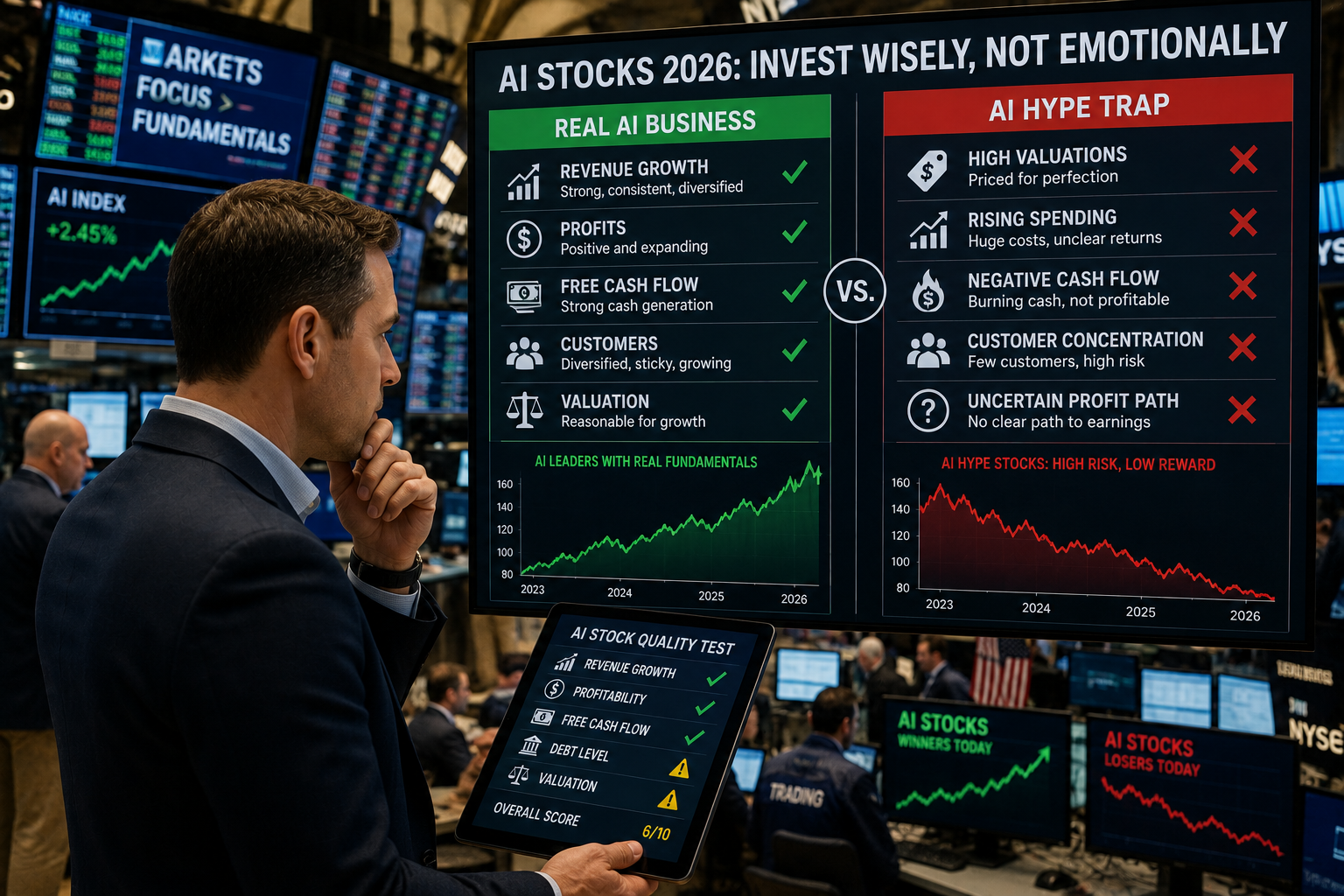
Artificial intelligence is producing some of the most exciting investment stories in the stock market.
Companies connected to:
- AI chips
- Cloud computing
- Data centers
- Networking equipment
- Electricity
- Cooling infrastructure
- Cybersecurity
- Enterprise software
have attracted enormous investor attention.
Some stocks have risen dramatically.
Entire companies are being revalued based on expectations that artificial intelligence could transform productivity, advertising, healthcare, software, manufacturing and almost every major industry.
And that creates one of the most dangerous investing sentences imaginable:
“It has AI, so the stock should go up.”
That is not an investment thesis.
It is a theme.
The difference matters.
The AI stocks 2026 market is increasingly separating companies that are producing real revenue, cash flow and customer demand from companies whose valuations depend much more heavily on future expectations.
Artificial intelligence may absolutely transform the global economy.
But history teaches us something investors should never forget:
A revolutionary technology does not automatically make every company associated with that technology a good investment.
The automobile changed the world.
Most early automobile companies disappeared.
Railroads transformed transportation.
Many railroad investors still lost fortunes.
The internet fundamentally changed business and society.
Thousands of dot-com companies failed.
Artificial intelligence can become one of the most important technologies ever created while many AI stocks still disappoint investors.
Both things can be true.
That is why the right question is not:
“Which company talks about AI?”
The better question is:
“Which company can turn AI demand into durable profits without requiring investors to pay an unreasonable price today?”
This guide will show you:
- Why AI stocks have become so powerful
- Why the AI investment trade is beginning to divide
- How to separate real AI businesses from AI marketing
- Why revenue growth alone is not enough
- How to evaluate free cash flow
- Why capital spending matters
- How valuation can destroy returns
- Which financial numbers beginner investors should examine
- Why diversification matters even during a powerful technology boom
- The TWM AI Stock Quality Test
No predictions that AI is definitely a bubble.
No promises that one stock will make you rich.
No fear of missing out.
Just investment discipline.
AI Stocks 2026: Why the Market Is Becoming More Selective
During the early stages of a major investment theme, investors often reward almost every company associated with the trend.
The pattern can look like this:
Artificial intelligence becomes popular.
A company announces an AI strategy.
Investors become excited.
The stock rises.
More companies begin using the term AI in:
- Earnings calls
- Investor presentations
- Product announcements
- Marketing
Eventually, however, Wall Street starts asking harder questions.
Where is the revenue?
Where are the profits?
Where is the cash flow?
How much money must be spent to produce that growth?
That transition is important.
The first phase of an investment boom often rewards the story.
The later phase begins rewarding execution.
That is what makes the current AI stocks 2026 environment particularly interesting.
Investors increasingly have evidence showing which companies are actually monetizing AI and which ones remain heavily dependent on future promises.
The First Rule: AI Growth and Stock Returns Are Not the Same Thing
Suppose artificial intelligence becomes:
- More powerful
- More widely adopted
- More profitable
Does that guarantee every AI stock rises?
No.
Investment returns depend on two separate things:
- How the business performs
- How much you paid for the stock
This second part is frequently ignored during market excitement.
Imagine Company A earns:
$5 per share
Its stock trades at:
$50
Price-to-earnings ratio:
10
Now imagine investors become extremely optimistic.
The stock rises to:
$150
while earnings remain $5.
P/E ratio:
30
The company did not suddenly become three times more profitable.
Investors simply became willing to pay three times as much for each dollar of earnings.
That can work when earnings later increase dramatically.
But if earnings disappoint, the valuation may fall.
That is where investors can lose money even when the underlying company remains successful.
A Great Company Can Be a Bad Stock at the Wrong Price
This is one of the most important investing lessons.
A company can have:
- Brilliant management
- Strong products
- Growing revenue
- Powerful competitive advantages
- Excellent technology
and still become a poor investment if you pay too much.
Suppose a company is worth approximately:
$100 per share
based on reasonable future assumptions.
Investor excitement pushes the price to:
$180
Now the company must outperform already enormous expectations merely to justify today’s price.
The stock has become fragile.
Even good news may not be good enough.
That is why earnings reports often produce seemingly strange results.
A company reports:
- Revenue growth
- Higher profits
- Strong customer demand
and the stock falls.
Why?
Because investors expected even more.
Stocks are priced based on expectations.
Not simply whether the company is doing well.
AI Stocks 2026: The Four Major AI Investment Groups
Instead of treating AI as one investment category, divide the ecosystem.
1. AI Infrastructure
These companies provide:
- Chips
- Servers
- Networking
- Memory
- Cooling
- Data centers
- Power equipment
Their profits may benefit directly from infrastructure spending.
2. Cloud and Hyperscalers
These companies operate enormous computing platforms.
They invest billions building AI capacity and then sell:
- Cloud computing
- AI models
- Enterprise tools
3. AI Software Companies
These businesses attempt to generate revenue from:
- AI assistants
- Automation
- Analytics
- Cybersecurity
- Enterprise software
4. AI Adopters
These companies are not primarily AI businesses.
They use AI to improve:
- Productivity
- Advertising
- Customer service
- Logistics
- Pricing
- Manufacturing
This fourth category is frequently overlooked.
Some of the biggest long-term winners from AI may not sell AI at all.
They may simply use it better than competitors.
The AI Investment Chain
Think of AI like a gold rush.
During a gold rush, money can be made by:
- Finding gold
- Selling tools
- Providing transportation
- Selling food
- Financing miners
- Owning land
AI has a similar investment chain.
| AI layer | Examples of business activity | Major risk |
|---|---|---|
| Semiconductors | GPUs, memory, processors | Competition and chip cycles |
| Data centers | Computing capacity | Massive capital requirements |
| Networking | Connecting AI infrastructure | Customer spending cycles |
| Utilities | Powering data centers | Regulation and construction delays |
| Cloud | Renting computing capacity | Enormous capital expenditures |
| Software | Selling AI applications | Competition and weak differentiation |
| AI adopters | Using AI to cut costs | Benefits may be hard to measure |
AI stocks 2026 investment chain showing semiconductors, data centers, utilities, cloud companies and AI software risks.
Each layer has different financial characteristics.
Do not compare them as if they are interchangeable.
Revenue Growth Is Not Enough
One of the easiest traps is seeing:
“AI revenue up 100%”
and immediately assuming the company is attractive.
Revenue tells you how much money the company collected.
It does not tell you:
- How much it spent
- How much debt exists
- Whether customers are profitable
- How much cash remains
- Whether revenue growth is sustainable
Consider two companies.
Company A
Revenue:
$10 billion
Expenses:
$7 billion
Operating profit:
$3 billion
Company B
Revenue:
$10 billion
Expenses:
$12 billion
Operating loss:
-$2 billion
Same revenue.
Completely different business quality.
Always move below the revenue line.
AI Stocks 2026: Why Free Cash Flow Matters
Free cash flow is one of the most useful numbers for understanding whether a company is actually generating cash after major investment.
A simplified formula is:
Operating cash flow − capital expenditures = free cash flow
Suppose:
Operating cash flow:
$30 billion
Capital spending:
$15 billion
Free cash flow:
$15 billion
Now compare another company:
Operating cash flow:
$30 billion
Capital spending:
$35 billion
Simplified free cash flow:
-$5 billion
The second company may still be an excellent investment.
Perhaps it is deliberately building infrastructure that will generate enormous future profit.
But investors should understand the difference.
The company is not currently funding all expansion internally.
It may need:
- Cash reserves
- Debt
- Partnerships
- New equity
Capital intensity matters.
The AI Capital-Spending Test
Ask:
How much does this company need to spend before it can generate another dollar of revenue?
This question helps separate different AI businesses.
A software company may require relatively little physical infrastructure.
A data-center operator may need billions.
Neither model is automatically better.
But their financial risks differ.
Suppose:
Company X
Adds $10 billion of annual revenue after investing $3 billion.
Company Y
Adds $10 billion of revenue after investing $20 billion.
Company Y may eventually produce excellent returns.
But it requires significantly more capital.
Capital efficiency matters.
Why AI Infrastructure Companies Can Be More Cyclical Than They Look
During strong demand:
- Chip orders surge
- Data-center capacity sells out
- Memory prices rise
- Server demand increases
Companies expand production.
But what happens if supply eventually catches up?
Prices can fall.
Customers may delay purchases.
Inventory can build.
Margins can shrink.
This pattern has happened repeatedly in semiconductor markets.
Artificial intelligence may increase long-term chip demand substantially.
But that does not eliminate business cycles.
A long-term growth industry can still experience brutal short-term downturns.
Do Not Assume Today’s AI Leader Will Always Be the Leader
Technology leadership changes.
Companies that dominate one generation can lose ground in the next.
Investors should ask:
- How strong is the company’s competitive advantage?
- How much does it spend on research?
- Are customers locked in?
- Can competitors offer cheaper alternatives?
- Is the technology proprietary?
- How quickly can customers switch?
A stock should not be valued as if competition no longer exists.
Success attracts competitors.
The bigger the opportunity, the more companies will fight for it.
The Customer Concentration Risk
Some AI infrastructure companies generate large amounts of revenue from a small number of customers.
That creates risk.
Example:
Total revenue:
$10 billion
Largest customer:
$4 billion
Second-largest:
$2 billion
Two customers represent:
60% of revenue
If either customer:
- Reduces spending
- Builds internally
- Changes providers
- Renegotiates pricing
the company’s financial results could change dramatically.
Look for customer concentration inside:
- Annual reports
- SEC filings
- Earnings presentations
Fast growth can hide concentration risk.
The Backlog Trap
Companies may advertise enormous order backlogs.
A $50 billion backlog sounds powerful.
But investors should ask:
- Are contracts cancellable?
- Over how many years?
- What margins will those contracts produce?
- Are customers financially strong?
- Does the company need billions more in capital to fulfill them?
Backlog is useful.
Backlog is not cash.
Revenue is not recognized simply because a customer expressed interest.
Understand contract economics.
AI Stocks 2026: Profitability Separates Story From Business
There are several stages of AI investing.
Stage 1: Idea
“We are developing AI.”
Stage 2: Product
“We launched an AI product.”
Stage 3: Revenue
“Customers are paying for it.”
Stage 4: Profit
“We make money after providing it.”
Stage 5: Cash flow
“The business generates real excess cash.”
The further a company moves down that list, the more evidence investors have.
Early-stage companies may offer greater potential upside.
They also carry more risk.
Do not value:
Stage 1
like
Stage 5.
The TWM AI Stock Quality Scorecard
Before buying an AI stock, examine these factors.
| Factor | Stronger signal | Warning signal |
| Revenue | Growing consistently | Growth depends on one contract |
| Profit | Positive and expanding | Persistent heavy losses |
| Free cash flow | Strong or improving | Deeply negative |
| Debt | Manageable | Rising rapidly |
| Customers | Diversified | Highly concentrated |
| Capital spending | Producing measurable returns | Spending without monetization |
| Valuation | Reasonable relative to growth | Assumes near-perfect execution |
| Competition | Durable advantage | Easily copied product |
AI stocks 2026 quality scorecard comparing financially strong companies with speculative AI investments.
You do not need every box to be perfect.
You need to understand what you are paying for.
Valuation: The Part AI Investors Cannot Ignore
A common beginner mistake is asking:
“Do I like this company?”
Instead ask:
“At this price, what future results am I already paying for?”
Imagine a company earns:
$2 billion annually
Market value:
$40 billion
Investors pay:
20 times earnings
Now AI excitement increases the market value to:
$100 billion
Earnings remain $2 billion.
Investors now pay:
50 times earnings
This does not automatically mean the stock is overpriced.
Maybe earnings will grow enormously.
But the required future growth is now much higher.
Valuation tells you how much optimism is already included in the stock price.
The Price-to-Earnings Ratio
The P/E ratio is:
Share price ÷ earnings per share
Suppose:
Stock price:
$100
Earnings per share:
$5
P/E:
20
Investors are paying $20 for each dollar of annual earnings.
High-growth companies often deserve higher ratios.
But higher valuation means higher expectations.
The question is:
Can earnings grow fast enough to justify the premium?
Do not compare every company using P/E alone.
Some firms:
- Are not profitable
- Have unusual accounting
- Are extremely capital intensive
Use multiple measures.
Price-to-Sales Can Be Dangerous
When companies have little or no profit, investors often use price-to-sales.
Example:
Market capitalization:
$50 billion
Annual revenue:
$5 billion
Price-to-sales:
10
But sales do not belong entirely to shareholders.
The company must pay:
- Employees
- Suppliers
- Data-center expenses
- Interest
- Taxes
- Research
- Equipment
A high sales multiple assumes that revenue will eventually become substantial profit.
Never confuse sales with earnings.
AI Stocks 2026 and the “Total Addressable Market” Trap
Investor presentations love huge numbers.
“The AI market could reach $2 trillion.”
“Our addressable market is $500 billion.”
These statements can be useful.
But enormous markets do not guarantee enormous profits.
Imagine a company operating in a:
$500 billion market
but capturing:
1%
Revenue:
$5 billion
Then aggressive competition pushes profit margins to:
5%
Profit:
$250 million
A giant industry does not automatically mean a giant business.
Market size is only one part of the investment case.
The AI Washing Problem
During every major trend, some companies reposition themselves to attract investors.
Crypto had:
- Blockchain announcements
The internet boom had:
- Companies adding “.com”
AI has:
- Companies placing artificial intelligence at the center of investor messaging
Some AI strategies are genuine.
Others may be primarily marketing.
Watch for:
- Repeated AI references without meaningful revenue
- No clear explanation of the product
- No customer evidence
- No measurable financial contribution
- Constantly changing strategy
- Promotional press releases without execution
Ask one simple question:
If I removed the words “artificial intelligence” from the presentation, would this still look like a good business?
That question can save money.
Real AI Integration Should Eventually Affect Financial Results
Companies integrating AI successfully may eventually show improvement in:
- Revenue
- Productivity
- Margins
- Customer retention
- Operating costs
Not instantly.
Technology investment takes time.
But eventually the investment should produce measurable economics.
AI should not remain a permanent excuse for:
- Higher expenses
- Lower cash flow
- Endless capital spending
Investors deserve evidence.
The Picks-and-Shovels Strategy
Some investors prefer companies supplying AI infrastructure rather than trying to identify the winning AI application.
This is sometimes called the picks-and-shovels strategy.
During a gold rush, the companies selling:
- Picks
- Shovels
- Equipment
could profit regardless of who discovered gold.
AI equivalents may include:
- Semiconductor equipment
- Chips
- Networking
- Cooling
- Electricity
- Data centers
The strategy can work.
But it is not risk-free.
If everyone builds too much capacity, suppliers can eventually face:
- Order reductions
- Lower prices
- Excess inventory
Picks and shovels can still become overpriced.
The Electricity AI Trade
AI data centers require enormous electricity.
That has caused increased investor attention toward:
- Utilities
- Power generation
- Nuclear energy
- Natural gas
- Grid equipment
- Transformers
This creates another danger.
A company may become labeled an “AI beneficiary” even though AI represents only part of its business.
Do not buy a utility solely because someone on social media called it an AI stock.
Study:
- Regulation
- Debt
- Capital spending
- Electricity rates
- Customer growth
- Project timelines
Every AI-related investment still needs normal financial analysis.
AI Stocks 2026 and the Diversification Problem
Suppose your retirement account already owns:
- Broad U.S. stock-market index fund
That fund may already have significant exposure to:
- Major technology companies
- Semiconductor companies
- AI leaders
Then you separately buy:
- Several AI stocks
- Semiconductor ETF
- Technology ETF
- Nasdaq fund
You may believe you are diversified.
In reality, you may own the same companies repeatedly.
This is called portfolio overlap.
Know what your funds already contain.
You may have much more AI exposure than you realize.
The 10% Theme Rule
For someone who wants additional exposure to a speculative investment theme, one practical approach is limiting the theme to a smaller portion of the portfolio.
For example:
Core diversified investments:
90%
AI-specific individual stocks:
10%
This is only an illustration, not a universal allocation recommendation.
Someone with:
- Low risk tolerance
- Short time horizon
- Limited savings
may want far less.
The principle is:
Do not allow one exciting story to determine your entire financial future.
FOMO Is Not Due Diligence
You see a stock:
- Up 50%
- Up 100%
- Up 200%
Then your brain says:
“I am missing out.”
So you buy.
That is not analysis.
That is performance chasing.
Ask:
If the stock had fallen 20% yesterday but nothing about the underlying business changed, would I still want to own it?
If the answer is no, you may be buying momentum rather than the business.
Never Buy a Stock Because You Missed Another Stock
A dangerous thought:
“I missed Nvidia, so I need to find the next Nvidia.”
This encourages investors to buy weaker companies simply because they appear cheaper.
There may never be another identical winner.
Instead:
Evaluate each company independently.
Do not turn regret into a portfolio strategy.
The “Cheap Stock” Illusion
A $10 stock is not automatically cheaper than a $500 stock.
Share price alone means almost nothing.
Company A:
Share price:
$10
Shares outstanding:
10 billion
Market value:
$100 billion
Company B:
Share price:
$500
Shares:
100 million
Market value:
$50 billion
The $500 stock represents the smaller company.
Always consider:
Market capitalization
not simply share price.
AI Stocks 2026: The Five Numbers Every Beginner Should Check
Before buying, look at:
1. Revenue growth
Is the business actually expanding?
2. Operating income
Does the core business make money?
3. Free cash flow
Is the company generating cash after investment?
4. Total debt
How much financial leverage exists?
5. Valuation
How much future success is already priced in?
You can find these numbers in:
- Annual reports
- Quarterly reports
- SEC filings
- Company investor-relations materials
Do not make financial decisions from social-media screenshots alone.
The Earnings Call Test
Listen to or read earnings-call transcripts.
Pay attention to what executives say when analysts ask:
- How is AI generating revenue?
- What is the return on capital spending?
- When will spending moderate?
- What are customer retention rates?
- What are margins?
Executives naturally present their companies positively.
Analyst questions can reveal where uncertainty exists.
Insider Selling Is Not Automatically a Warning
People sometimes panic when executives sell shares.
Executives may sell because of:
- Diversification
- Taxes
- Prearranged trading plans
- Personal expenses
Large or unusual selling can deserve attention.
But do not assume every insider sale means executives expect the company to fail.
Context matters.
Stock Splits Do Not Make Companies Cheaper
AI-related companies sometimes receive attention after stock splits.
Suppose:
One share worth:
$1,000
becomes:
10 shares worth $100 each
You did not become richer.
The company’s value did not automatically change.
A pizza cut into 10 pieces is not larger than the same pizza cut into four.
Stock splits may improve accessibility.
They do not reduce valuation.
The Earnings-Growth Test
Suppose Stock A trades at 40 times earnings.
That looks expensive.
But earnings grow 35% annually.
Stock B trades at 15 times earnings.
Looks cheap.
But earnings are falling 10% annually.
Valuation must be compared with business trajectory.
There is no single “good P/E.”
Context matters.
The AI Stock Decision Table
| Situation | Better response |
| Stock doubled recently | Study valuation before chasing |
| Company says “AI” constantly | Look for actual revenue |
| Revenue growing fast | Check profitability and cash flow |
| Strong earnings | Compare with market expectations |
| Massive capital spending | Ask what return management expects |
| High debt | Compare debt with operating cash flow |
| Social media calls it “next Nvidia” | Ignore slogan and analyze business |
| You already own tech-heavy index funds | Check portfolio overlap |
AI stocks 2026 decision table showing how investors can separate AI investment fundamentals from hype.
Build an AI Watchlist Instead of Buying Immediately
You do not need to buy a stock the day you discover it.
Create a watchlist.
Track:
- Current price
- Revenue
- Earnings
- Free cash flow
- Debt
- Valuation
- Next earnings date
Then wait.
Read another quarter.
Study competition.
You lose nothing by understanding a company before risking money.
Sometimes the best investment decision is:
Not yet.
The TWM Three-Layer AI Portfolio Framework
A simple conceptual structure:
Layer 1: Core
Broad diversified investments.
The foundation.
Layer 2: Established AI beneficiaries
Profitable companies with strong balance sheets and established businesses.
Layer 3: Speculative AI
Smaller or unprofitable companies with higher potential upside and higher failure risk.
The speculative layer should not be large enough to destroy your financial plan if it performs poorly.
Invest according to risk capacity.
Not excitement.
What Would Make the AI Trade Collapse?
Several things could hurt AI stocks simultaneously.
AI spending slows
Hyperscalers reduce infrastructure budgets.
Revenue disappoints
Companies struggle to monetize products.
Competition increases
Margins shrink.
Interest rates remain high
High valuations become less attractive.
Infrastructure becomes overbuilt
Supply exceeds demand.
Regulation increases
Costs and restrictions rise.
Investors simply change expectations
No disaster is required.
A stock can fall significantly merely because investors decide they are no longer willing to pay such a high valuation.
What Could Keep AI Stocks Rising?
The positive case is powerful.
AI may:
- Increase business productivity
- Create entirely new products
- Reduce labor-intensive tasks
- Improve advertising
- Accelerate drug discovery
- Improve software development
- Transform customer service
If these improvements generate large sustainable profits, many AI businesses could justify substantial investment.
The question is not whether AI has economic potential.
It clearly does.
The question is:
Which companies capture the profits—and what price should investors pay for them?
External Resource
Before purchasing an individual stock, use the SEC’s EDGAR database to review official company filings, including 10-K annual reports, 10-Q quarterly reports, debt disclosures, risk factors and financial statements:
https://www.sec.gov/edgar/search
Continue Building Your Financial Knowledge
Read more practical investing and wealth-building strategies on the True Wealth Moves blog:
https://truewealthmoves.com/wealth-blog
Use the True Wealth Moves resources page for financial tools, guides and calculators:
Final Verdict: AI Stocks 2026 Are Entering the “Prove It” Stage
Artificial intelligence is no longer only a technology experiment.
It is becoming a major economic investment cycle.
Companies are spending hundreds of billions building the infrastructure.
Businesses are integrating AI into products.
Customers are paying for AI services.
Real revenue is being created.
That is the bullish case.
But the AI stocks 2026 investment story is becoming more complicated.
The market is beginning to distinguish between:
- AI revenue and AI marketing
- Growth and profitable growth
- Capital spending and productive investment
- Backlog and actual cash
- Great businesses and great stock prices
That distinction is healthy.
Investors should welcome it.
The next phase of AI investing may reward companies that can demonstrate:
- Strong revenue
- Expanding profit
- Durable customer demand
- Positive cash flow
- Manageable debt
- Efficient capital spending
while punishing businesses that rely primarily on:
- Hype
- Endless financing
- Unrealistic valuations
- Weak differentiation
Remember:
You do not need to predict which AI company will dominate the world.
You need to protect your money from paying an irrational price for a story.
The technology can succeed while a stock fails.
The company can grow while investors lose money.
And a stock that already rose 300% is not automatically destined to rise another 300%.
Build the investment thesis from the financial statements upward.
Not from the stock chart downward.
That is the True Wealth Moves conclusion:
Do not buy a company because artificial intelligence is the future. Buy only when the business can capture that future—and the stock price does not already assume perfection.
Looking for More Finance Topics?
Use the search box below to explore hundreds of articles on True Wealth Moves — we’ve probably already written about what you’re looking for.





