
AI Debt Boom 2026: Could Borrowing Billions for Artificial Intelligence Create the Next Corporate Debt Problem?
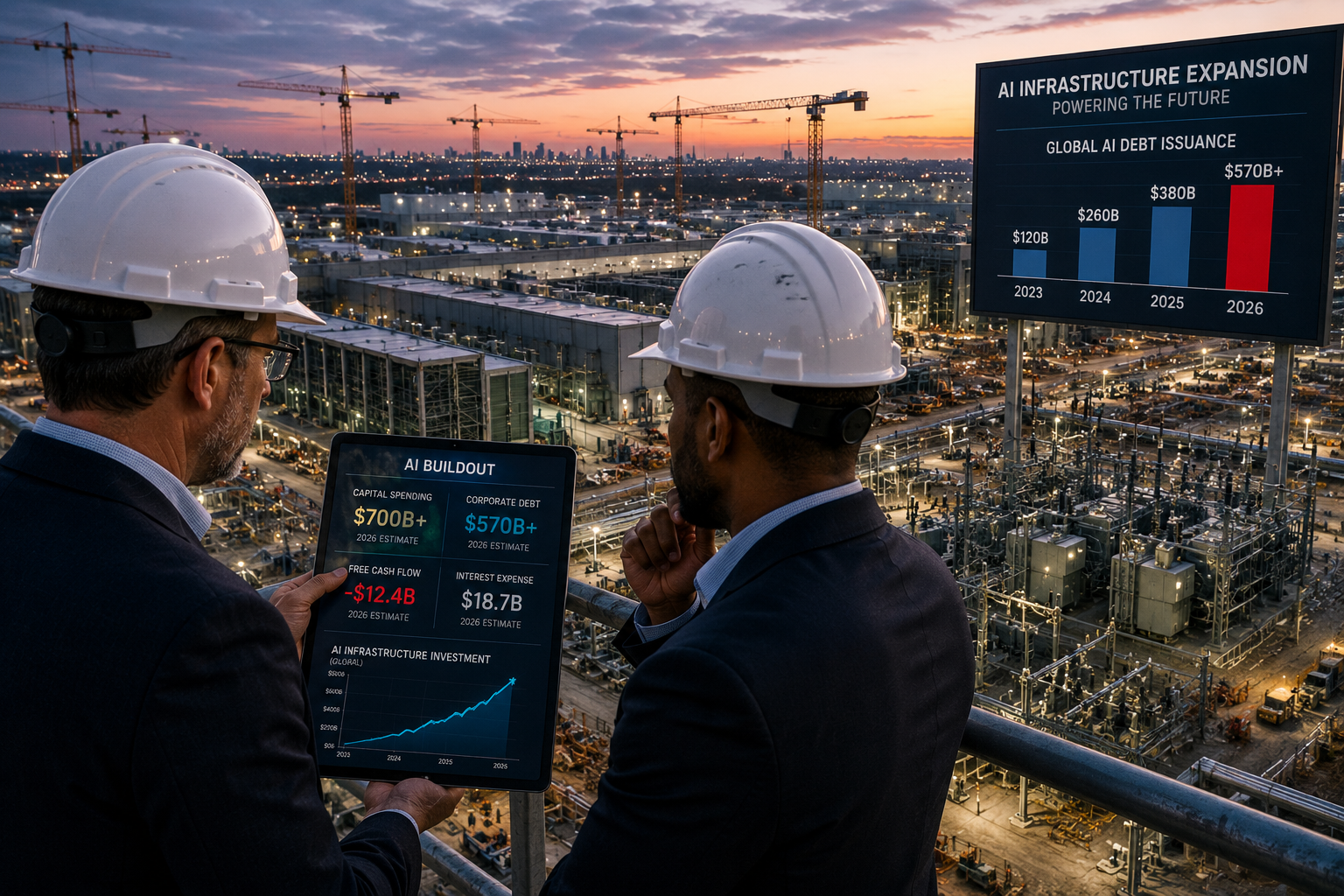
Artificial intelligence is being sold as the biggest technological opportunity of the decade.
Companies are spending enormous amounts of money to build it.
New data centers.
More powerful chips.
Massive power infrastructure.
Cooling systems.
Cloud capacity.
Networking equipment.
Land.
Transmission lines.
AI research laboratories.
The numbers are becoming so large that even some of the richest technology companies in the world are increasingly turning to debt markets to help finance the expansion.
And that raises an important question that ordinary investors should understand:
What happens if the AI boom does not generate profits quickly enough to justify all the borrowing?
That is the financial story behind the AI debt boom 2026.
The issue is not that borrowing money is automatically dangerous.
Healthy companies borrow money all the time.
Corporate bonds and loans can help companies expand faster, build infrastructure and create future revenue.
The concern begins when three things happen at the same time:
- Investment spending becomes enormous.
- Debt grows rapidly.
- Future profitability depends heavily on optimistic assumptions.
That combination deserves attention.
Global AI-related debt issuance is expected to exceed $570 billion in 2026, according to projections reported this year.
Some of the largest technology and cloud companies are raising tens of billions of dollars through bond markets while simultaneously spending hundreds of billions building AI infrastructure.
Alphabet has pursued major bond financing.
Amazon has conducted enormous bond offerings.
Meta, Oracle, Microsoft and other large technology companies continue committing extraordinary amounts of capital toward AI.
Meanwhile, newer infrastructure companies such as CoreWeave are using specialized loans backed partly by expensive GPU infrastructure.
This does not mean an AI financial crisis is coming.
It does mean investors should stop assuming that every dollar spent on AI is automatically productive.
The critical question is:
Will the future cash flow generated by artificial intelligence justify the money being spent today?
This AI debt boom 2026 guide will explain:
- Why AI requires so much capital
- Why technology companies are borrowing despite massive revenues
- What hyperscaler debt actually means
- Why data centers are expensive
- How AI financing differs from traditional technology spending
- Why corporate debt can become dangerous
- What investors should examine before buying AI stocks or bonds
- Why free cash flow matters more than AI headlines
- How interconnected AI financing could create risk
- The TWM AI investment checklist
No “AI bubble is definitely crashing” predictions.
No blind AI optimism.
Just the financial structure behind the boom.
AI Debt Boom 2026: Why Artificial Intelligence Costs So Much Money
Many people think of AI primarily as software.
You open an application.
Type a question.
Receive an answer.
What you do not see is the enormous physical infrastructure behind that interaction.
Modern AI systems require:
- Advanced semiconductors
- GPU servers
- Massive data centers
- High-speed networking
- Electrical infrastructure
- Cooling systems
- Backup power
- Real estate
- Fiber-optic connectivity
These systems can cost billions of dollars.
Unlike traditional software businesses, where a company might create software and distribute it cheaply to millions of users, large-scale AI requires enormous ongoing infrastructure investment.
A company may need:
Billions of dollars today
before the AI products generate enough future revenue to recover the investment.
That changes the financial model.
The Data Center Is Becoming the New Factory
Think about the industrial economy.
A car manufacturer needs:
- Factories
- Machinery
- Workers
- Supply chains
An airline needs:
- Aircraft
- Maintenance facilities
- Airport infrastructure
The AI economy has its own capital-intensive infrastructure.
The modern equivalent of the factory may be the data center.
Inside one major AI data center can be:
- Thousands of expensive GPUs
- Networking equipment
- Cooling systems
- Backup generators
- Power distribution equipment
And the cost does not stop after construction.
The facility also requires electricity.
A lot of it.
This creates additional investment needs involving:
- Power plants
- Grid upgrades
- Renewable-energy projects
- Battery storage
- Transmission lines
The AI boom therefore extends far beyond technology companies.
It is affecting:
- Utilities
- Construction
- Commercial real estate
- Energy companies
- Semiconductor manufacturers
- Banks
- Bond markets
- Private credit
That is why the AI debt boom 2026 has become a financial-market story rather than merely a technology story.
Why Would Rich Technology Companies Borrow Money?
This is an important question.
Companies such as Alphabet, Amazon, Meta and Microsoft generate enormous revenue.
So why borrow?
There are several reasons.
Preserve cash
A company may prefer keeping cash available for:
- Acquisitions
- Share repurchases
- Research
- Emergencies
- Other investments
Spread costs over time
A data center may generate value for many years.
Financing part of the construction allows the company to spread the cost.
Take advantage of credit markets
Large profitable companies often have access to relatively favorable borrowing rates compared with smaller businesses.
Protect financial flexibility
Using a combination of:
- Cash
- Bonds
- Loans
- Partnerships
can prevent one project from consuming too much liquidity.
Debt itself is therefore not the problem.
The issue is how much debt is created relative to future cash flow.
AI Debt Boom 2026: The Hyperscaler Borrowing Wave
The companies at the center of cloud computing are often called hyperscalers.
These include companies operating enormous global computing networks.
Examples include:
- Amazon
- Alphabet
- Microsoft
- Meta
- Oracle
Their AI investment plans have become enormous.
Recent estimates suggest that the largest technology companies collectively could spend well above $700 billion during 2026 on infrastructure and capital investment tied heavily to AI and cloud capacity.
At the same time, debt issuance has increased sharply.
One reason is simple.
Even extremely wealthy companies eventually face a choice:
Use more internal cash or bring outside capital into the expansion.
Bond markets provide that outside capital.
Investors buy bonds.
The technology company receives cash.
The company promises:
- Interest payments
- Repayment of principal
The bet is that the assets built with the money will generate enough future profit to comfortably service the debt.
What Is a Corporate Bond?
When you buy a company’s stock, you become a partial owner.
When you buy its bond, you are lending the company money.
Suppose a technology company issues:
$10 billion in bonds
with an interest rate around:
5%
Approximate annual interest expense:
$10 billion × 5% = $500 million
That interest must be paid whether:
- AI revenue beats expectations
- AI revenue disappoints
- The stock rises
- The stock crashes
Debt does not disappear because management’s strategy fails.
That is one of the major differences between debt and equity financing.
The Debt Service Problem
Debt becomes dangerous when operating cash flow cannot comfortably cover:
- Interest payments
- Principal repayment
- Ongoing investment needs
Imagine a smaller AI infrastructure company.
Annual revenue:
$5 billion
Operating cash flow:
$1 billion
Annual interest expense:
$600 million
Remaining cash before other investment:
$400 million
Now suppose the company still needs:
$2 billion annually
for infrastructure expansion.
Something must fill the gap.
Possible sources:
- More debt
- New stock issuance
- Asset sales
- Partnerships
- Slower expansion
That is when financing risk begins compounding.
AI Financing Risk Table
| Financial condition | Healthy signal | Warning signal |
|---|---|---|
| Debt growth | Debt supports profitable expansion | Debt grows much faster than revenue |
| Interest coverage | Cash flow comfortably covers interest | Interest consumes large share of cash flow |
| AI capital spending | Returns are measurable | Spending grows without clear monetization |
| Free cash flow | Remains positive or improving | Turns deeply negative for extended periods |
| Customer demand | Diversified paying customers | Revenue depends on few major clients |
| Infrastructure | Assets remain productive | Equipment becomes obsolete quickly |
| Refinancing | Strong access to affordable capital | Company depends on constant refinancing |
AI debt boom 2026 corporate financing comparison showing healthy and risky debt characteristics.
The GPU Problem: Expensive Assets Can Age Quickly
AI infrastructure has an unusual characteristic.
The equipment is extremely expensive.
But technology advances rapidly.
A GPU cluster purchased today may still be useful years from now.
But newer processors may become:
- Faster
- More energy efficient
- More capable
That creates depreciation risk.
Suppose a company borrows billions to buy AI hardware expected to produce revenue for seven years.
Then a much more efficient generation of technology arrives in three years.
The old hardware may still work.
But customers may demand newer infrastructure.
The company may then need additional capital before the original debt has been fully repaid.
This is one reason AI infrastructure financing deserves careful analysis.
The debt may last longer than the competitive advantage of the hardware.
AI Debt Boom 2026 and CoreWeave
CoreWeave provides one of the clearest examples of how AI infrastructure financing is evolving.
The company has used large financing facilities tied to high-performance computing infrastructure.
In May 2026, CoreWeave announced a $3.1 billion delayed-draw term loan facility designed to finance infrastructure tied to customer contracts.
The company described the structure as part of an emerging asset class involving infrastructure-backed AI financing.
It had already completed another multi-billion-dollar financing facility earlier in the year.
This is important because AI finance is beginning to look increasingly similar to other capital-intensive industries.
Assets are being financed through:
- Loans
- Bonds
- Private credit
- Structured financing
That brings traditional credit-market risks into the AI ecosystem.
What Happens If AI Demand Slows?
Imagine the following.
A company builds data centers expecting:
90% utilization
Actual demand produces:
65% utilization
Revenue falls below projections.
But the company still must pay:
- Debt interest
- Employees
- Electricity
- Maintenance
- Lease costs
The data center does not become free because demand missed expectations.
This is the basic financial risk.
Large fixed costs require large consistent revenue.
The faster AI infrastructure expands, the more important utilization becomes.
The Airline Comparison
Consider airlines.
Aircraft are expensive.
An airplane sitting on the ground still costs money.
AI infrastructure has a similar financial characteristic.
A GPU server sitting underutilized does not produce its expected return.
Yet the company still has:
- Financing costs
- Electricity
- Building expenses
- Maintenance
The goal is therefore not simply building more infrastructure.
It is keeping that infrastructure economically productive.
Why AI Revenue Needs to Catch Up With AI Spending
Investors often focus on AI revenue growth.
But revenue alone does not answer the question.
You need to compare:
Incremental AI profit
with
Incremental AI investment
Imagine:
AI revenue increases:
$20 billion
But AI capital spending increases:
$60 billion
That does not automatically mean the investment is bad.
The infrastructure may generate revenue for many future years.
But it does mean investors should ask:
What return will that additional $60 billion eventually produce?
That is the central question behind the AI debt boom 2026.
Return on Invested Capital Matters
One useful measure is return on invested capital.
The general idea:
How much operating profit is the company generating from the capital invested in the business?
You do not need to become a professional analyst.
Look for the trend.
If:
- Investment rises dramatically
- Debt rises dramatically
- Profitability rises slowly
investors should pay attention.
The AI strategy may still succeed.
But the financial burden has increased.
Free Cash Flow Is One of the Numbers Investors Should Watch
Free cash flow broadly represents the cash remaining after operating expenses and capital investment.
A company can report impressive earnings while free cash flow weakens because enormous amounts are being spent on infrastructure.
Suppose:
Operating cash flow:
$50 billion
Capital expenditure:
$45 billion
Simplified free cash flow:
$5 billion
Now capital spending increases:
$60 billion
while operating cash flow remains:
$50 billion
Simplified result:
-$10 billion
The company may finance the difference using:
- Cash reserves
- Debt
- Equity
Temporary negative free cash flow is not automatically dangerous.
But persistent negative free cash flow combined with rising debt deserves attention.
AI Debt Boom 2026: The Five Numbers Stock Investors Should Watch
When evaluating an AI-heavy company, look beyond:
“AI revenue grew 100%.”
Watch:
1. Capital expenditures
How much is being spent building infrastructure?
2. Free cash flow
What remains after investment?
3. Total debt
Is borrowing accelerating?
4. Interest expense
How expensive is the debt?
5. Revenue generated from AI investment
Is monetization keeping pace with spending?
Together, these numbers tell a much better story than AI headlines alone.
The Debt-to-Cash-Flow Test
Consider two hypothetical AI companies.
Company A
Debt:
$20 billion
Annual operating cash flow:
$40 billion
Company B
Debt:
$20 billion
Annual operating cash flow:
$5 billion
Same debt.
Completely different risk.
Company A may have enormous repayment capacity.
Company B has much less flexibility.
Do not judge corporate borrowing only by the dollar amount.
Judge it relative to the company’s ability to generate cash.
Big Tech Debt Is Not the Same as Startup Debt
This distinction is extremely important.
Large technology companies often have:
- Massive revenue
- Large cash balances
- Profitable businesses outside AI
- Strong credit ratings
Their debt may be very manageable.
Smaller AI infrastructure companies may depend much more heavily on:
- Borrowing
- A few customers
- Continued investor funding
That creates different risk.
The same AI boom can contain:
financially strong borrowers
and
financially fragile borrowers.
Do not treat the entire sector as one company.
Customer Concentration Risk
Suppose an AI infrastructure provider generates:
60% of revenue from two customers.
That can create vulnerability.
If one customer:
- Renegotiates
- Cuts spending
- Builds its own infrastructure
- Moves to a competitor
the provider could experience significant cash-flow pressure.
Meanwhile, the debt remains.
Look for:
- Customer concentration
- Contract length
- Cancellation terms
- Credit quality of customers
A huge revenue backlog sounds attractive.
But investors should understand who is obligated to pay it.
The Circular Financing Concern
One unusual feature of the AI ecosystem is how interconnected many participants are.
Money can move between:
- Chipmakers
- AI labs
- Cloud providers
- Infrastructure companies
- Investors
For example:
A technology company invests in an AI startup.
The startup then uses money purchasing cloud computing.
The cloud company purchases chips.
The chip manufacturer may invest in other AI companies.
This does not automatically mean anything improper is happening.
Strategic partnerships are common in technology.
But investors should understand whether demand comes primarily from:
independent end customers
or increasingly from companies financing one another inside the same ecosystem.
The stronger the genuine outside demand, the healthier the economic foundation.
AI Debt Boom 2026 and Credit Markets
The AI investment wave could affect people who never buy an AI stock.
Why?
Corporate bonds may appear inside:
- Mutual funds
- Bond ETFs
- Retirement funds
- Pension portfolios
- Insurance-company portfolios
As technology companies issue more debt, AI exposure becomes more important inside credit markets.
Some analysts estimate hyperscalers now represent a meaningful share of new investment-grade issuance.
That means the AI boom is increasingly influencing:
- Corporate bond supply
- Credit spreads
- Interest rates
- Portfolio composition
Artificial intelligence is becoming part of the debt market itself.
What Could Go Wrong?
The worst-case scenario would require several events occurring together.
AI revenue disappoints
Companies struggle to monetize expensive infrastructure.
Technology changes rapidly
Existing equipment loses economic value faster than expected.
Interest rates remain elevated
Refinancing becomes expensive.
Customer demand weakens
Data-center utilization falls.
Investors lose confidence
New financing becomes harder to obtain.
A heavily indebted company could then face:
- Credit-rating downgrades
- Higher borrowing costs
- Stock-price declines
- Asset sales
- Reduced investment
Again, this is not a prediction.
It is the risk structure.
What Could Go Right?
There is another scenario.
AI adoption may grow enormously.
Businesses may incorporate AI into:
- Healthcare
- Finance
- Manufacturing
- Logistics
- Education
- Advertising
- Software
Data-center demand could remain strong.
AI products could generate enormous revenue.
Productivity gains could increase profits throughout the economy.
In that scenario, today’s infrastructure spending may look remarkably intelligent years from now.
Infrastructure booms often look expensive at the beginning.
Railroads required enormous capital.
Telecommunications networks required enormous capital.
The internet required enormous investment.
Some companies failed.
The infrastructure itself transformed the economy.
Both things can happen simultaneously.
The Dot-Com Lesson
The internet was real.
It changed the world.
But many internet stocks still collapsed.
That distinction matters.
A technology can be revolutionary while individual investments are terrible.
AI may transform:
- Business
- Healthcare
- Transportation
- Education
- Finance
That does not mean every AI company deserves any valuation or any amount of debt.
Separate:
Technology thesis
from
Investment thesis.
AI can change the world.
You can still overpay for an AI stock.
The TWM AI Investment Quality Test
Before buying an AI-related stock, ask:
Is the company profitable?
If not, how is expansion financed?
Is free cash flow positive?
If negative, why?
How much debt exists?
Compare debt growth with revenue growth.
Can operating cash flow comfortably cover interest?
This is critical.
How diversified are customers?
Avoid ignoring concentration risk.
Is AI spending producing measurable revenue?
Look beyond promises.
Is the stock valuation assuming perfection?
A great company can still be a bad investment at the wrong price.
AI Investor Risk Table
| Question | Stronger company | Higher-risk company |
| Profitability | Consistent profits | Heavy ongoing losses |
| Cash flow | Strong operating cash generation | Depends on new financing |
| Debt | Manageable relative to cash flow | Debt growing rapidly |
| Customers | Diversified | Concentrated |
| AI spending | Clear revenue return | Unclear monetization |
| Hardware risk | Can refresh technology easily | Debt tied heavily to aging equipment |
| Refinancing | Strong investment-grade access | Depends on costly credit |
AI debt boom 2026 investor checklist comparing financially strong AI companies with higher-risk borrowers.
Do Not Confuse a Credit Rating With Zero Risk
Large corporations may have strong credit ratings.
That means analysts believe they have strong repayment capacity.
It does not mean:
- Bonds cannot lose market value
- Business conditions cannot change
- Debt cannot increase
- Investors cannot suffer losses
Credit quality exists on a spectrum.
Even financially strong companies deserve analysis when borrowing expands rapidly.
What Bond Investors Should Watch
If you own corporate bonds or bond funds, watch:
Credit spreads
The extra yield investors demand relative to government bonds.
Credit ratings
Downgrades can increase borrowing costs.
Maturity schedule
When must debt be refinanced?
Interest coverage
Can earnings comfortably cover interest?
Cash flow
Strong cash generation creates resilience.
You do not need to sell every bond because AI debt is increasing.
Just understand what you own.
The Refinancing Wall
Debt eventually matures.
Suppose a company borrows:
$20 billion
at:
4%
Annual interest:
$800 million
Several years later, the debt matures.
If refinancing now costs:
7%
Annual interest:
$1.4 billion
Difference:
$600 million annually
That money now goes to interest instead of:
- Research
- Employees
- Shareholders
- New infrastructure
This is why long-term interest-rate conditions matter for heavily financed industries.
Energy Is Another Hidden AI Cost
AI infrastructure does not only require debt.
It requires electricity.
Data-center operators increasingly must secure:
- Long-term electricity contracts
- New generation capacity
- Grid connections
Power constraints can delay projects.
And delays matter when debt has already been raised.
If a company starts paying interest before a facility begins generating revenue, project economics can worsen.
That is another risk investors should understand.
Political and Community Risk
Data centers have also faced increased resistance over:
- Electricity consumption
- Water use
- Noise
- Land use
- Local infrastructure
A delayed project can create financial problems.
Imagine borrowing billions.
Then permits are delayed for two years.
Interest still exists.
Construction costs may rise.
Revenue arrives later.
AI infrastructure investing therefore includes more than technology risk.
It also includes:
- Regulatory risk
- Environmental risk
- Local political risk
AI Debt Boom 2026: Five Warning Signs to Watch
Warning Sign 1: Debt rises faster than revenue for several years
One year may be investment.
Several years may deserve concern.
Warning Sign 2: Free cash flow stays deeply negative
Ask how expansion is being financed.
Warning Sign 3: Interest expense rises rapidly
Debt is becoming more burdensome.
Warning Sign 4: Capital expenditure keeps increasing without clear returns
Management should be able to explain the economics.
Warning Sign 5: Management focuses only on growth
Revenue growth is not the same as shareholder value.
How Ordinary Investors Should Respond
Do not panic.
Do not short every AI company.
Do not sell all technology stocks.
Instead:
Diversify
Avoid allowing one theme to dominate your entire portfolio.
Favor financial strength
Look for:
- Strong balance sheets
- Positive cash flow
- Manageable debt
Understand valuation
Excellent companies can still become overpriced.
Separate AI beneficiaries
AI infrastructure includes different businesses:
- Semiconductor companies
- Data centers
- Cloud companies
- Utilities
- Networking
- Software
They carry different risks.
Keep long-term perspective
Infrastructure booms can last for many years.
But enthusiasm can also create overinvestment.
The TWM AI Portfolio Rule
Never ask only:
“Will AI grow?”
Ask:
“If AI grows, how much of that growth is already priced into this investment?”
That question can prevent expensive mistakes.
A company can have:
- Great technology
- Great management
- Huge revenue growth
and still deliver weak investment returns if the purchase price was too high.
External Resource
For a primary-source example of how AI infrastructure is increasingly financed through large debt facilities, review CoreWeave’s May 2026 SEC-filed announcement covering its $3.1 billion infrastructure-backed financing:
https://www.sec.gov/Archives/edgar/data/1769628/000176962826000236/ex9912.htm
Continue Building Your Financial Knowledge
Read more practical investing and wealth-building strategies on the True Wealth Moves blog:
https://truewealthmoves.com/wealth-blog
Use the True Wealth Moves resources page for financial tools, guides and calculators:
Final Verdict: The AI Debt Boom 2026 Is About Whether Future Profits Justify Today’s Borrowing
Artificial intelligence may become one of the most important technologies in modern economic history.
But revolutionary technology still has to obey financial mathematics.
Companies can borrow billions.
They can build enormous data centers.
They can purchase millions of powerful chips.
They can promise extraordinary future demand.
Eventually, however, those investments must generate cash.
That is the central lesson of the AI debt boom 2026.
Debt is not automatically bad.
Large profitable companies can responsibly use debt to accelerate valuable investment.
The danger appears when:
- Debt grows faster than cash flow
- Infrastructure becomes obsolete quickly
- Customers become concentrated
- Interest costs increase
- Expansion depends on endless new financing
- AI revenue fails to justify capital spending
Investors should therefore stop judging AI companies only by:
- Revenue growth
- Headlines
- Product launches
- Stock-price momentum
Look at:
- Capital expenditure
- Free cash flow
- Total debt
- Interest expense
- Customer concentration
- Return on invested capital
Artificial intelligence may create enormous wealth.
But history teaches us something important:
When a transformative technology arrives, the technology can win while many investors still lose.
The railway changed the world.
Not every railroad company survived.
The internet changed the world.
Not every dot-com investor became wealthy.
AI could follow the same pattern.
That is the True Wealth Moves conclusion:
Do not ask only whether AI is the future. Ask whether the company borrowing billions to build that future can actually earn enough money to pay for it.
Looking for More Finance Topics?
Use the search box below to explore hundreds of articles on True Wealth Moves — we’ve probably already written about what you’re looking for.






One Comment