
Prime Day Strategy 2026: How to Spot Real Deals vs Fake Discounts (and Buy Without Regret)
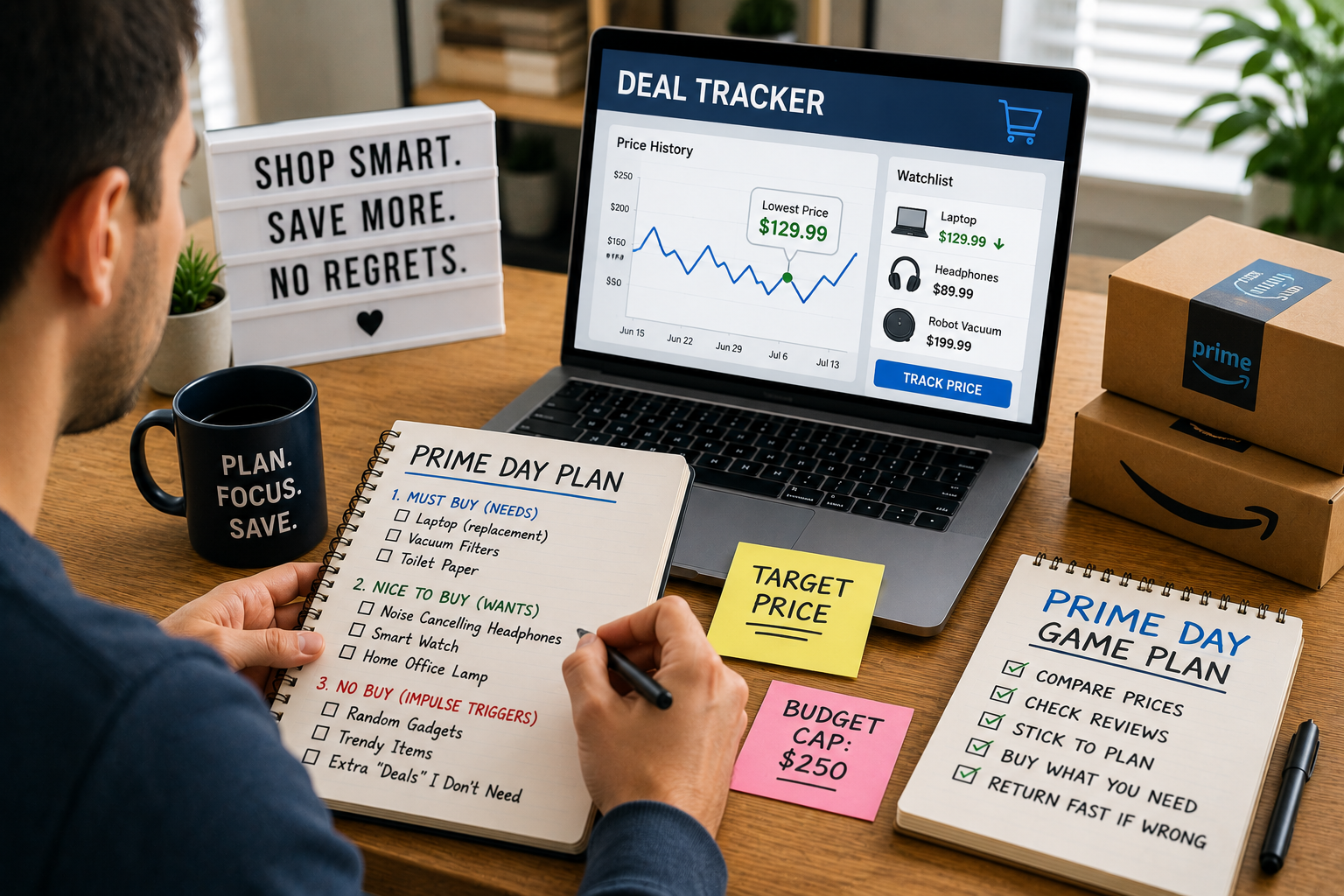
Prime Day can be a money-saving event…
or a budget-ruining event.
Same sale.
Two outcomes.
Because Prime Day doesn’t just discount products.
It discounts your discipline:
- “limited-time deal”
- “only a few left”
- “you’ll regret it if you don’t buy now”
And the average shopper doesn’t lose money because the item was “too expensive.”
They lose money because they bought things they were never going to buy until the sale pressured them.
So this post is your True Wealth Moves Prime Day strategy 2026 playbook:
- how to tell a real deal from a fake discount
- the 7 biggest Prime Day traps (and how to beat them)
- the “3-list” method that stops impulse buying
- the timing strategy (what to buy early vs wait on)
- the return/refund discipline that protects you after you buy
- and a simple table you can screenshot that tells you what to do category-by-category
No hype. Just a system.
What Prime Day actually is (in money terms)
Prime Day is not just “a sale.”
It’s a high-intensity buying environment.
That means:
- prices change quickly,
- discounts look bigger than they feel,
- and the psychological pressure is high.
So your Prime Day strategy 2026 must be built around one truth:
The biggest savings is not the discount — it’s the purchase you don’t make.
The #1 rule: Prime Day strategy 2026 starts 7 days before Prime Day
Most people “shop” Prime Day.
Winners plan Prime Day.
Here’s why:
If you start planning early, you can separate:
- what you need,
from - what you want,
from - what Prime Day wants you to want.
The entire goal is clarity before pressure.
The 7 Prime Day traps that cost people the most
Let’s name them.
Trap 1: Fake discounts
Some listings show “was $199, now $129” when the item is often near $129 anyway.
That’s how people feel cheated later.
Prime Day strategy 2026 requires a price reality check.
Trap 2: “Deal stacking” that becomes overspending
You buy Item A because it’s 40% off…
then Item B…
then Item C…
and suddenly you spent $380 when you planned to spend $80.
Discounts don’t stop math.
Trap 3: Buying the upgraded version instead of what you need
Prime Day loves upgrades:
“Get the bigger one, it’s only $40 more.”
That $40 happens 6 times and becomes $240.
Trap 4: Accessories that don’t feel expensive
Cables, cases, add-ons, “small essentials.”
These are the silent budget killers on Prime Day.
Trap 5: “I’ll return it later” behavior
Returns you don’t complete become permanent overspending.
Trap 6: Buying something you don’t understand
If you can’t explain why you need it, it’s probably a dopamine buy.
Trap 7: Missing your best deal because you didn’t know your target price
Prime Day strategy 2026 works when you know:
“What price would make this a win for me?”
If you don’t know that number, any discount can trick you.
The True Wealth Moves Prime Day system: The 3-List Method
This is the method that stops regret.
List 1: Must Buy (needs)
Things you will buy in the next 30 days anyway:
- household staples (if price is right)
- school supplies
- replacement items you already planned
- required electronics replacement (only if planned)
List 2: Nice to Buy (wants)
Things you want, but your life is fine without:
- upgrades
- decor
- hobbies
- extras
List 3: No Buy (impulse triggers)
Your personal weakness categories:
- random gadgets
- “viral” products
- trendy items you’ve never used before
- anything that solves a problem you don’t actually have
Prime Day strategy 2026 rule:
You only buy from List 1 unless List 2 fits your budget AFTER List 1 is completed.
How to tell a real deal from a fake discount
You don’t need to be a pricing detective.
You just need a simple rule set.
Rule A: Compare to your target price, not Amazon’s “was” price
Before Prime Day, decide your target price:
- “If this hits $X, I buy.”
- “If it doesn’t, I don’t.”
That protects you from “fake discount psychology.”
Rule B: Check two other sellers for big purchases
For purchases over a threshold (you decide, like $100+):
- check one other retailer price
- check manufacturer site pricing if relevant
If the price is similar everywhere, it’s not a Prime Day miracle.
Still may be a fine buy — but don’t treat it like a once-in-a-lifetime deal.
Rule C: Watch the total cost, not the headline
Total cost = item + tax + shipping (if any) + accessories you’ll need.
A “cheap” device that requires a $50 accessory isn’t cheap.
Rule D: Avoid “bundle traps”
Bundles can be great, but only if you were buying the bundle items anyway.
Otherwise you’re paying for extras you didn’t need.
What to buy early vs what to wait on
Not every category behaves the same.
Buy early when:
- it’s a planned replacement
- it’s an essential you already budgeted for
- it’s a limited inventory item you truly need (not want)
- it’s a core household staple and the price is genuinely lower
Wait when:
- it’s a “nice to buy”
- you’re buying because of urgency language
- you don’t have a target price
- it’s an upgrade, not a replacement
Prime Day strategy 2026 isn’t “buy fast.”
It’s “buy right.”
The Prime Day budget rule that saves people
Set a hard Prime Day budget cap BEFORE you open the app.
Example:
- $100
- $250
- $500 (families with planned replacement buys)
Then use this rule:
If it’s not on List 1 and you’re at 80% of your cap, you stop.
Because you don’t get wealthy by maxing out your excitement.
The table: Prime Day strategy 2026 — what to do by category
Prime Day strategy 2026 table showing which categories are best to buy, what to avoid, and how to confirm a real deal
| Category | Best Prime Day buys | Biggest trap | Real-deal check |
|---|---|---|---|
| Electronics | planned replacements (laptop/tablet/phone accessories) | upgrading “because it’s on sale” | compare 2 sellers + set target price |
| Home appliances | replacements you already planned | buying big items impulsively | total cost + warranty/return rules |
| Household essentials | items you truly use monthly | buying bulk you won’t use | buy only what you’d buy in 30–60 days |
| Kids/school | planned supplies + basics | buying “extra” toys | stick to List 1 |
| Fitness/health gear | proven basics you’ll use | trendy gadgets | ask “will I use this weekly?” |
| Smart home | only if it solves a real pain | “cool factor” spending | must have clear daily use |
| Clothing | basics you already need | “sale hunting” | buy only if it replaces a planned purchase |
Screenshot this table and Prime Day gets much easier.
Return and refund discipline: where Prime Day savings is won or lost
Prime Day buyers often regret later, but don’t return.
That’s where savings disappears.
Your 48-hour rule:
When items arrive:
- open them
- test them
- decide keep vs return within 48 hours
If you wait, you forget.
Then the return window closes.
Then you paid full price with extra steps.
Prime Day strategy 2026 is not only “buy smart.”
It’s “return fast if wrong.”
How to stop Prime Day from becoming clutter
If Prime Day tends to create clutter in your home, use this rule:
“One in, one out.”
If you buy a new kitchen gadget, something else goes out.
If you buy a new pair of shoes, one pair is donated.
This turns Prime Day into a controlled upgrade — not a pile.
The “Prime Day regret” checklist
Before you click “Buy,” ask:
1) Was this on my List 1?
2) Would I buy this at full price within 30 days?
3) Do I already own something that solves this?
4) Am I buying because it’s urgent… or because it’s useful?
5) Can I return it easily if it disappoints?
If you can’t answer clearly, pause.
How to actually save money during Prime Day
Real Prime Day savings comes from three actions:
1) Buy planned replacements
You were going to spend the money anyway.
Now you spend less.
2) Buy essentials you already use
Not “maybe I’ll use this.”
Actual use.
3) Avoid impulse upgrades
Upgrades are where Prime Day steals budgets.
Your one evergreen external link (exactly one)
For a stable, consumer-authority guide on shopping smart online (including avoiding deceptive practices and pressure tactics), use the FTC’s online shopping guidance:
https://consumer.ftc.gov/articles/how-shop-safely-online
Two True Wealth Moves internal links (exactly two)
https://truewealthmoves.com/wealth-blog/
https://truewealthmoves.com/resources/
Final truth
Prime Day strategy 2026 is not about finding every deal.
It’s about protecting your money while you shop in a high-pressure environment.
If you:
- use the 3-list method,
- set a budget cap,
- shop by target price,
- verify big purchases with simple comparisons,
- and follow the 48-hour return rule…
…Prime Day can save you money without stealing your peace.
That’s the True Wealth Moves way: disciplined buying that still lets you enjoy the sale.
Looking for More Finance Topics?
Use the search box below to explore hundreds of articles on True Wealth Moves — we’ve probably already written about what you’re looking for.





