
Amazon Savings Stack: The 2026 Playbook to Save Money Without Overspending
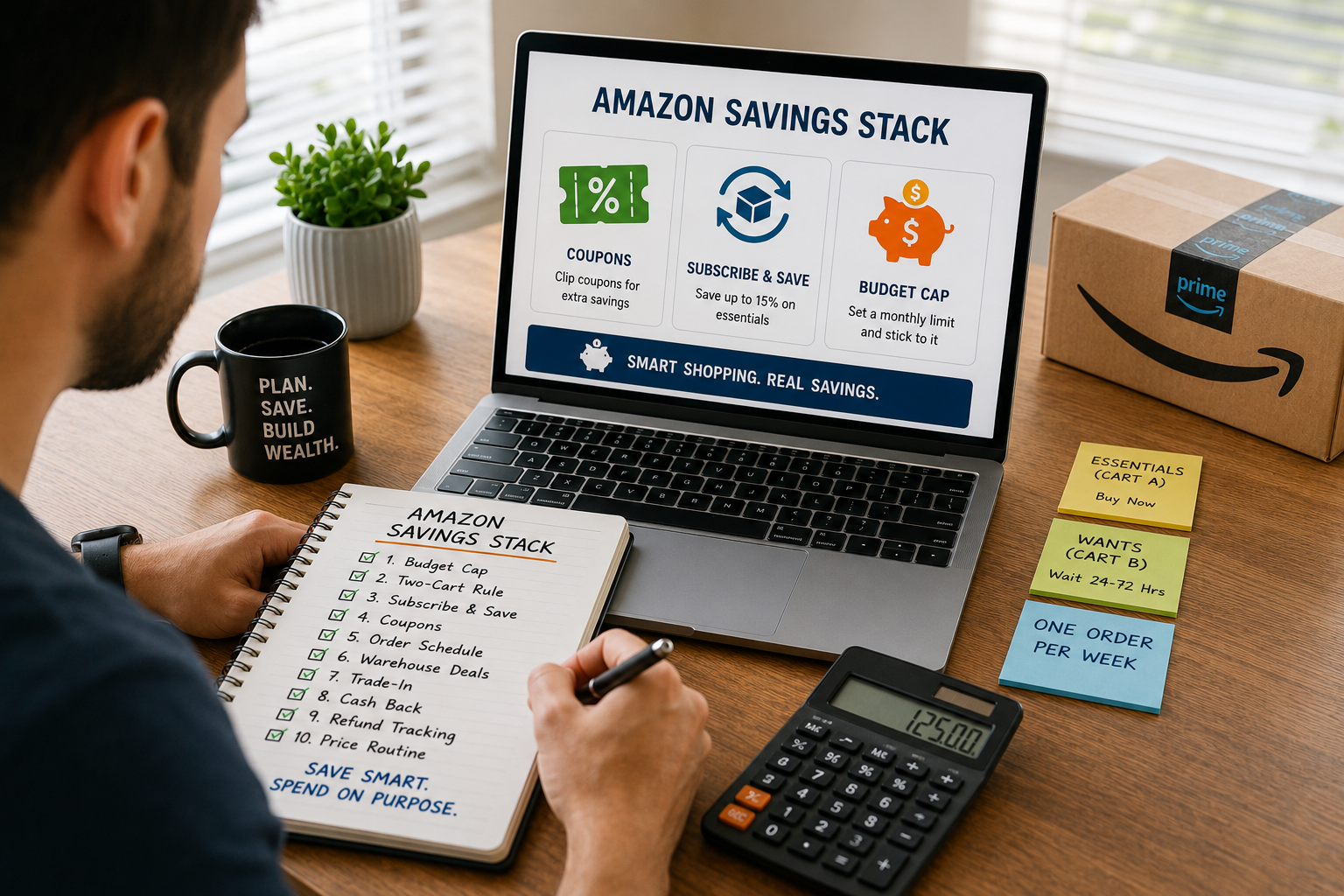
Amazon can either be:
- the easiest place to save money, or
- the easiest place to quietly lose money.
Same app.
Two outcomes.
The difference is whether you shop Amazon like entertainment… or like a CFO.
Because Amazon isn’t “one store.” It’s a stack of programs, discounts, coupons, recurring deals, cash-back options, and pricing quirks that can save you serious money — but only if you use a system.
This post is your True Wealth Moves Amazon Savings Stack playbook:
- the exact order to stack savings (so you don’t miss easy wins)
- how to avoid fake “deals” and impulse buying traps
- how to use Subscribe & Save without getting trapped
- how to use coupons and “repeat delivery” discounts the smart way
- how to shop Warehouse/Open-Box safely
- how to build a monthly Amazon budget that protects your wealth goals
- and the one routine that makes Amazon work for your household instead of against it
No gimmicks.
No “spend more to save more.”
Just a plan that keeps your wallet calm.
The Amazon truth most people miss
Amazon doesn’t make you overspend by force.
Amazon makes overspending feel small.
It’s the “just add it” effect:
- small items
- quick checkout
- saved cards
- 1-click
- free shipping thresholds
So people don’t feel the spend until the bank statement hits.
That’s why the #1 Amazon savings rule is this:
Amazon savings starts with spending control.
If you don’t control the cart, you won’t feel the savings.
The Amazon Savings Stack (the correct order)
Here’s the order you should think in — because stacking in the wrong order is how people miss savings.
1) Budget cap + cart discipline (so you don’t overspend)
2) Subscribe & Save (only for repeat essentials)
3) Coupons (clippable savings)
4) Multi-buy planning (group essentials for the same delivery)
5) Warehouse / open-box (for select categories)
6) Trade-in / gift card offsets (only when it beats reselling)
7) Credit card cash back (only if you pay in full)
8) Prime value math (only if it breaks even)
9) Returns discipline (so “cheap” doesn’t become expensive)
10) Price-check routine (so you avoid fake deals)
Now let’s break each layer down in a way you can actually use.
Step 1: Set an Amazon budget cap (the rule that makes everything else work)
Before you “stack savings,” you must stop the money leak.
Here’s the True Wealth Moves Amazon budget cap system:
The “Two-Cart Rule”
You create two lists:
- Cart A: Essentials (things you would buy anyway)
- Cart B: Wants (things you want but don’t need)
You only check out Cart A during your scheduled Amazon day (more on that below).
Cart B sits for 24–72 hours. If you still want it later and it fits your budget, fine.
This one habit prevents 60% of Amazon overspending.
The monthly Amazon cap
Pick a number. Any number.
Example caps:
- $50/month
- $100/month
- $200/month (for families)
The cap isn’t a punishment.
It’s protection.
Because “cheap items” stack into expensive months.
Step 2: Use Subscribe & Save — but ONLY for stable essentials
Subscribe & Save is one of the best Amazon savings tools… and also one of the easiest ways to overspend if you treat it like a toy.
The right way to use it:
- only for repeat household essentials
- only for items you already use monthly or quarterly
- only when you’re confident you won’t waste it
Examples that typically work:
- diapers/wipes (if relevant)
- paper towels/toilet paper
- laundry detergent
- trash bags
- vitamins you consistently take
- pet food (if your household uses the same one)
Examples that often become waste:
- trendy snacks you don’t actually finish
- seasonal items
- random “try it” purchases
The Subscribe & Save discipline rule
You do not subscribe on impulse.
You do a “two-cycle test”:
- Buy it once normally.
- If you reorder it within 30–60 days, then subscribe.
That’s how you avoid subscriptions that become clutter.
Step 3: Clip coupons — but only after you confirm you need it
Amazon coupons can be real savings, but they can also trigger purchases you wouldn’t make otherwise.
True Wealth Moves rule:
Coupons only apply to Cart A (Essentials), not Cart B (Wants).
Because the fastest way to lose money is “buying something you didn’t need because it had a coupon.”
Step 4: Multi-buy planning — group essentials and reduce checkout frequency
One reason people overspend on Amazon is how often they check out.
More checkouts = more opportunities to add “one more thing.”
Use a schedule:
- 1 Amazon order per week, OR
- 1 Amazon order per pay period
This reduces impulse buying and makes tracking easier.
If you have multiple essentials, group them into one delivery:
- fewer random purchases
- fewer return issues
- fewer “where did my money go?” moments
Step 5: Prime value math — don’t pay for Prime unless it breaks even
Prime is worth it for some households and not worth it for others.
A simple break-even test:
- How many orders do you make monthly?
- How much do you actually value faster shipping and included services?
- Would you order less if shipping wasn’t “free”?
Prime can increase spending because it removes friction.
So Prime only “saves” money if you’re disciplined.
If Prime makes you buy more, it’s not a savings tool.
It’s a spending accelerator.
Step 6: Amazon Warehouse / open-box — the smart way to buy “used like new”
Warehouse deals can save you real money on:
- electronics
- small appliances
- home goods
- accessories
But you need rules:
- Buy Warehouse only when return policy is clear
- Avoid Warehouse for items you can’t easily test quickly
- Test immediately on delivery day
Warehouse savings only works if you prevent the “broken item + missed return window” problem.
Step 7: Trade-in offsets — only when it beats your alternatives
Trade-in can be helpful if:
- you want convenience
- the offer is strong
- you don’t want the hassle of reselling
But your rule is:
Compare trade-in value vs resale value vs donation value.
Sometimes reselling gets more.
Sometimes trade-in is faster and worth it.
Sometimes neither is worth it.
True Wealth Moves mindset:
Choose the best net value for your time.
Step 8: Credit card cash back — only if you pay in full
Cash back can be real savings if:
- you pay the statement in full
- you don’t use cash back as an excuse to spend more
If you carry a balance at 20–30% APR, cash back is not savings.
It’s a distraction.
Your rule:
Cash back only works in a debt-free payment system.
Step 9: Returns discipline — the money you don’t track is the money you lose
Amazon overspending becomes permanent when:
- returns aren’t completed
- refunds aren’t tracked
- items sit in the house unused
Your Amazon routine must include “Refund Reconciliation.”
Refund Reconciliation Routine (10 minutes weekly)
Open your orders and ask:
- What arrived?
- What needs return?
- What is “refund pending”?
- What was refunded?
Then record it in a simple notes app line:
Date — Item — Refund amount — Status
This prevents “I think they refunded me?” money loss.
Step 10: Price discipline — stop getting fooled by fake deals
Amazon prices move constantly.
Some “deals” are real.
Some are normal pricing dressed up as a discount.
Your protection:
- Leave items in Cart A for 24 hours before checkout (unless urgent)
- Compare to at least one other seller (for big purchases)
- Track a “target price” for items you buy often
You don’t need perfection.
You need a habit that stops emotional buying.
The Amazon Savings Stack table (screenshot this)
Amazon savings stack table showing the correct order to save money and the rule for each step
| Stack Layer | What you do | Why it saves money | What people do wrong |
|---|---|---|---|
| Budget cap | Set a monthly Amazon limit | Stops impulse spend | “I’ll just be careful” |
| Two-cart rule | Essentials vs Wants | Cuts dopamine purchases | Check out everything same day |
| Subscribe & Save | Only repeat essentials | Locks consistent savings | Subscribe to random items |
| Coupons | Clip only for essentials | Real discount on needed items | Buy stuff because coupon exists |
| Order schedule | 1 order/week or pay period | Fewer impulse checkouts | 5 tiny orders/week |
| Warehouse | Open-box with fast testing | Big discounts on big items | Miss return window |
| Trade-in | Compare vs resale | Converts clutter into value | Accept low offers blindly |
| Cash back | Only if paid in full | True discount on spend | Carry balance and “earn” pennies |
| Refund tracking | Weekly check | Prevents lost refunds | Assume refunds always come |
| Price routine | 24-hour cart pause | Avoids fake deals | Buy in a rush |
This table is your full Amazon system in one glance.
The “Amazon Day” routine (the easiest way to stop overspending)
Pick one day of the week:
Example: Saturday morning.
That’s your Amazon day:
- You review Cart A
- You remove anything unnecessary
- You clip coupons
- You check Subscribe & Save items
- You check out once
This single habit gives you:
- control
- fewer returns
- easier refund tracking
- and more savings from fewer impulse buys
Common Amazon overspending triggers (and how to beat them)
Trigger 1: “Free shipping” psychology
Fix:
Always ask: Would I buy this if shipping wasn’t free?
Trigger 2: “Add-on item” behavior
Fix:
If it’s under $10, it still counts.
Under-$10 items are the most dangerous.
Trigger 3: “Lightning deals” urgency
Fix:
No urgency purchases unless it’s an essential already on your list.
Trigger 4: “I’ll return it later”
Fix:
Return window discipline — decide within 48 hours of delivery.
How to use Amazon to make money (without scams)
You asked “save on them or make money off them.”
Here are legit, low-risk ways to make money tied to Amazon:
1) Sell unused items (not drop shipping)
Use Amazon or other marketplaces to sell what you already own.
Goal:
turn clutter into cash.
(This is a starter wealth move, not a long-term business.)
2) Amazon affiliate content (ethical version)
You create content around products you genuinely recommend:
- gift guides
- household essentials lists
- “best budget items” posts
Then earn commission through affiliate links.
Best practice:
Never promote trash products just for commission.
That ruins trust and destroys long-term income.
3) Amazon trade-in + resale arbitrage (simple version)
Sometimes you can:
- buy a good used device locally cheap
- trade it in if the trade-in value is unusually high
But this only works if you track fees and risk carefully.
Most people should focus on selling their own items first.
True Wealth Moves rule:
Start with low risk: sell what you already own.
Your ONE evergreen external link (exactly one)
Use this Amazon help page as the single external link in the post (covers coupons / promotions guidance and is stable):
https://www.amazon.com/gp/help/customer/display.html?nodeId=G6LDPN7YJHYKH2J6
Two True Wealth Moves internal links (exactly two)
https://truewealthmoves.com/wealth-blog/
https://truewealthmoves.com/resources/
Final truth
Amazon can be a savings tool or a spending trap.
If you want the savings, you need a system:
- monthly cap
- Two-Cart Rule
- Subscribe & Save only for true essentials
- coupons only for essentials
- one order per week
- refund tracking routine
That’s how you save money on Amazon without “saving money” your way into overspending.
Looking for More Finance Topics?
Use the search box below to explore hundreds of articles on True Wealth Moves — we’ve probably already written about what you’re looking for.





